
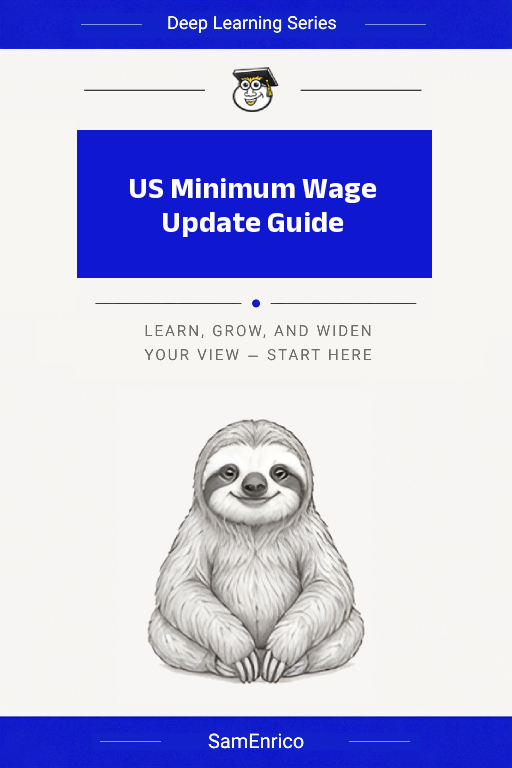
Non-FictionAnnual CheckupUS Labor Law
US Minimum Wage Update Guide eBook
Track federal, state, and local minimum wage incre
Track federal, state, and local minimum wage increases for 2024 and 2025 to ensure payroll compliance.
Formats
Free sample
Chapter 1: The Frozen Trap--–- The letter arrived on a Tuesday, but the damage had been accumulating for eleven months. A regional pizza chain with seventeen locations across the Chicago metropolitan area had just received notice from the Department of Labor. The allegation was simple, devastating, and entirely avoidable: they had underpaid eighty-nine employees by a total of 42,847.Thecausewasnotgreed,notfraud,butsomethingfarmoremundane.On Julyfirstofthepreviousyear,the Cityof Chicagohadraiseditsminimumwage.Thepayrollmanager,whodutifullyupdatedratesevery Januaryfirst,hadsimplymissedit.Thecompanypaidthebackwages,doubledtheminliquidateddamages,andadded42,847. The cause was not greed, not fraud, but something far more mundane. On July first of the previous year, the City of Chicago had raised its minimum wage.
The payroll manager, who dutifully updated rates every January first, had simply missed it. The company paid the back wages, doubled them in liquidated damages, and added 42,847.Thecausewasnotgreed,notfraud,butsomethingfarmoremundane.On Julyfirstofthepreviousyear,the Cityof Chicagohadraiseditsminimumwage.Thepayrollmanager,whodutifullyupdatedratesevery Januaryfirst,hadsimplymissedit.Thecompanypaidthebackwages,doubledtheminliquidateddamages,andadded18,000 in civil penalties. A $103,000 mistake born from the false assumption that payroll compliance was a once-a-year event.This is the frozen trap. And nearly every employer in America is standing in it.The federal minimum wage has not changed since 2009. For sixteen years, the United States government has told employers that $7.25 per hour is the legal floor for paying workers.
That number has become so familiar, so static, that it has lulled generations of payroll professionals into a dangerous complacency. The federal rate feels like bedrock. It feels permanent. It feels safe.It is none of those things.While Washington has remained paralyzed, states and cities have done the opposite. They have moved aggressively, creatively, and asynchronously.
California now sits at 16.50perhour.Washington Stateisat16.50 per hour. Washington State is at 16.50perhour.Washington Stateisat16.66 and climbing with inflation. New York City requires 16.50formostemployers.Denverhits16.50 for most employers. Denver hits 16.50formostemployers.Denverhits18.81 for certain industries. Seattle exceeds 20forlargeemployers.Emeryville,California,acityofjusttwelvesquaremiles,demands20 for large employers.
Emeryville, California, a city of just twelve square miles, demands 20forlargeemployers.Emeryville,California,acityofjusttwelvesquaremiles,demands19.90 per hour. The gap between the federal floor and local reality has grown so wide that relying on the federal rate is no longer merely insufficient—it is professionally negligent.The frozen trap is the cognitive dissonance between what the federal government requires and what local jurisdictions enforce. Employers who think they are compliant because they pay above 7.25areoftenwildlynoncompliantbecausetheyarepaying7.25 are often wildly noncompliant because they are paying 7.25areoftenwildlynoncompliantbecausetheyarepaying10 or 12oreven12 or even 12oreven14 in a jurisdiction that demands $17. The gap is not small. The penalties are not forgiving.
And the pace of change is not slowing.This chapter dismantles the false comfort of federal stagnation. It explains why the $7.25 floor is a mirage, how the failed 2024 Overtime Rule created chaos for employers who prepared too early, and what the actual 2025 standards are for federal minimum wage and overtime exemptions. Most importantly, it establishes the foundational principle of the entire book: in the modern compliance landscape, the federal rate is almost never the rate that matters.The Geography of Complacency Understanding why employers fall into the frozen trap requires understanding the psychology of payroll. Payroll departments are built on consistency, predictability, and repetition. Employees are paid every two weeks.
Tax withholdings follow the same formulas. Direct deposits arrive like clockwork. This rhythmic reliability is the strength of payroll operations but also their vulnerability.When something remains unchanged for sixteen years, the human brain ceases to treat it as variable. The $7.25 federal minimum wage has become a background assumption, like the fact that there are twenty-four hours in a day or that Social Security numbers have nine digits. Payroll software defaults to it.
Employment agreements reference it. Even sophisticated HR professionals, when asked in surveys, consistently overestimate how often the federal rate changes.This cognitive bias has a name: status quo bias. It is the tendency to prefer things to remain the same, to assume that current conditions will persist into the future. In the context of minimum wage compliance, status quo bias is a direct threat to solvency.Consider the data. Between 2010 and 2020, the number of local minimum wage ordinances in the United States grew from fewer than ten to more than one hundred and forty.
States with automatic inflation adjustments now see their minimum wages change every January first, regardless of legislative action. Cities like Denver and Seattle have tied their minimum wages to the Consumer Price Index, meaning the rate changes whenever inflation moves. Some jurisdictions have separate rates for large employers, small employers, hotel workers, and tipped employees. The complexity is exponential, and the federal rate has become irrelevant to most of it.The frozen trap is not about what the federal government does. It is about what employers assume the federal government means.
And that assumption is bankrupt.The False Safety Net The most dangerous phrase in payroll compliance is this: "At least we're paying above the federal minimum."Employers who utter this phrase believe they have built a buffer. They pay 10or10 or 10or12 or 15perhour,confidentthattheyaresafelyabovethe15 per hour, confident that they are safely above the 15perhour,confidentthattheyaresafelyabovethe7.25 floor. They are correct about the federal law. They are often disastrously wrong about state and local law.A restaurant in Los Angeles paying 15perhourmightfeelgenerouscomparedtothefederalrate.Butthe Cityof Los Angelesrequires15 per hour might feel generous compared to the federal rate. But the City of Los Angeles requires 15perhourmightfeelgenerouscomparedtothefederalrate.Butthe Cityof Los Angelesrequires17.28 for most employers.
That restaurant is underpaying by 2.28perhour,peremployee.Forastaffofthirty,workingfortyhoursperweek,thatisanannualunderpaymentofapproximately2.28 per hour, per employee. For a staff of thirty, working forty hours per week, that is an annual underpayment of approximately 2.28perhour,peremployee.Forastaffofthirty,workingfortyhoursperweek,thatisanannualunderpaymentofapproximately142,000 before penalties.The false safety net operates because employers think in terms of absolutes. They ask "Is my rate above $7.25?" and answer yes. They do not ask "Is my rate above the rate in the specific city where each employee physically performs work?" That question is harder. It requires tracking multiple jurisdictions, multiple effective dates, and multiple exemption categories.
It is precisely the kind of question that payroll systems are not designed to answer without deliberate configuration.The false safety net also conceals the second-order consequences of federal stagnation. Because the federal rate has not increased, there is no federal pressure to simplify or harmonize state and local rates. The patchwork grows more complex each year precisely because Washington provides no unifying force. Each jurisdiction sets its own rate, its own effective date, its own rules for tipped workers, its own exemptions for small businesses. The resulting chaos is not a bug in the system.
It is the inevitable outcome of federal inaction.Employers who rely on the federal rate as their benchmark are navigating a map from 2009. They are driving with a rearview mirror while the road ahead has been completely rebuilt. The false safety net is comfortable. It is also a financial disaster waiting to happen.The 2024 Overtime Rule: What Almost Changed Everything To understand the current federal landscape, one must understand the rule that never took effect. In April 2024, the Department of Labor under the Biden administration published its final rule raising the salary threshold for white-collar overtime exemptions.
The rule was aggressive, sweeping, and designed to reshape the exempt workforce.The existing threshold, still in effect today, is 684perweek,or684 per week, or 684perweek,or35,568 per…
This is the end of the free sample. Get the eBook to keep going. Buy now
About this book
Details
- Author
- Hastings Lacy
- Publisher
- SamEnrico
- Language
- English
- Genre
- Non-Fiction, Annual Checkup, US Labor Law
- Released
- 2026-06-01
- Pages (approx.)
- 152
- Available as
- eBook, Audiobook

Read better in the ZLOADR app
Your eBooks on your phone or tablet. Sign in with your SamEnrico account and start reading.
More by Hastings Lacy
 Twelve Step Programs And Harm Reduction GuideHastings Lacy$11.99
 Relationship Maintenance PlanHastings Lacy$11.99
 Stress Immune System RecoveryHastings Lacy$11.99
 Criminal Defense StressHastings Lacy$11.99
 Options Trading AddictionHastings Lacy$11.99
 Recording Embedded CommandsHastings Lacy$11.99
 Pet Keepsake IdeasHastings Lacy$11.99
 Anger After Betrayal HealingHastings Lacy$11.99
 Ymir's Bones: The World Born from a Giant's FallHastings Lacy$11.99
 The Green Pioneers: Black Naturalists Who Charted Africa’s Wild FrontiersHastings Lacy$11.99
 How to Produce Mobile Phone AccessoriesHastings Lacy$11.99
 A Collector's Handbook to the Pontiac Quality SixHastings Lacy$11.99
You may also like
 Hong Kong Handover 1997Dunn Johnnie$11.99
 Zumba For Postnatal Recovery CourseNeal Christian$11.99
 Zumba for BeginnersLadner Nikia$11.99
 YouTube Comment Mining GuideHumes Pandora$12.99
 Worry Box MeditationCarlin Rudy$11.99
 Workplace Stress MeditationNguyen Lynn$11.99
 Workplace Stress and Sleep RepairHawley Ivory$11.99
 Workplace Perfectionism CureDelaney Jeffry$11.99
 Workplace Injustice Anger GuideWallen Isabelle$11.99
 Work Addiction and Burnout LinkGreenwood Ester$11.99
 Women in Yoga and WellnessBeattie Galina$11.99
 Women in Stand Up ComedyChun Evangeline$11.99