
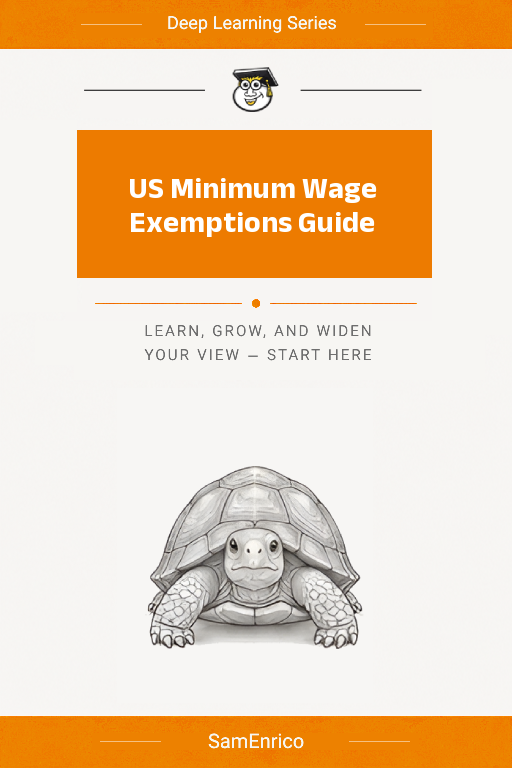
Non-FictionAnnual CheckupExemptions
US Minimum Wage Exemptions Guide eBook
Identify exempt workers including certain seasonal
Identify exempt workers including certain seasonal, agricultural, and small business employees.
Formats
Free sample
Chapter 1: The $187,000 Mistake--–- The envelope arrived on a Tuesday. Harold Wilson had been a dairy farmer for thirty-one years, and in all that time, he had never received a letter from the United States Department of Labor. He didn't even know the Department of Labor sent letters to people like him. He thought the DOL was for factories and big corporations, for companies with human resources departments and lawyers on retainer. He was a farmer.
He woke up before dawn, milked cows, mended fences, and fell into bed exhausted. The idea that the federal government had been tracking his labor practices, that someone in an office building two hundred miles away had been counting the days his teenage neighbors worked during hay season—that idea had never crossed his mind.The letter was polite. It was professional. It was devastating.After a thirty-day investigation, the Wage and Hour Division had determined that Harold's farm was not exempt from the Fair Labor Standards Act. His three teenage helpers, who had each worked a few Saturdays and a handful of summer weeks, were employees under the law.
His small farm—which he had run with no outside help except his wife and those local kids—owed 187,000inbackwages.Harolddidn′thave187,000 in back wages. Harold didn't have 187,000inbackwages.Harolddidn′thave187,000. He had a mortgage on the barn, a tractor held together with baling wire and stubbornness, and a checking account that rarely saw four digits after the decimal point.Within eighteen months, Harold Wilson's farm was sold at auction. The buyer was a corporate dairy operation with a full-time compliance officer on staff. Harold now works for that company, driving the same tractor he used to own, for minimum wage.Harold's story is not unique.
It is not even unusual. Every year, thousands of small business owners, farmers, seasonal camp directors, restaurant operators, and farm labor contractors receive letters that begin the same way. Most of them never saw it coming. They believed—sincerely, reasonably, but wrongly—that because they were small, because they were family-run, because they were seasonal, the minimum wage laws simply did not apply to them.Some of those beliefs are correct. Some are partially correct.
And some, like Harold's, are catastrophically wrong.The difference between staying in business and losing everything often comes down to a single number: the number of man-days worked last quarter, the number of weeks a hand-harvest worker was employed, the number of miles a farm labor contractor traveled from home. This book exists to ensure you never receive the letter Harold received.The Great Misunderstanding There is a dangerous myth circulating among small business owners, particularly in agriculture, hospitality, and seasonal industries. The myth sounds like this: "The minimum wage laws are for big corporations. I'm just a small operation. The government has bigger fish to fry."The truth is exactly the opposite.The Department of Labor's Wage and Hour Division actively targets small businesses—not because they are evil, but because the DOL knows that small businesses are where the most common violations occur.
Large corporations have human resources departments, compliance software, and legal teams. The family farm has a kitchen table, a shoebox of receipts, and a farmer who is too exhausted from milking cows at 4 a.m. to read the Federal Register.The data is stark. In fiscal year 2023, the Wage and Hour Division recovered over 274millioninbackwagesformorethan200,000workers.Nearly60percentofall FLSAviolationsoccurredinbusinesseswithfewerthanfiftyemployees.Theagricultureindustryhadthehighestviolationraterelativetoitssize,withsmallfarmsaccountingforthemajorityofcitations.Theaverageback−wageawardforamisclassificationcaseinvolvingseasonalworkersexceeded274 million in back wages for more than 200,000 workers. Nearly 60 percent of all FLSA violations occurred in businesses with fewer than fifty employees.
The agriculture industry had the highest violation rate relative to its size, with small farms accounting for the majority of citations. The average back-wage award for a misclassification case involving seasonal workers exceeded 274millioninbackwagesformorethan200,000workers.Nearly60percentofall FLSAviolationsoccurredinbusinesseswithfewerthanfiftyemployees.Theagricultureindustryhadthehighestviolationraterelativetoitssize,withsmallfarmsaccountingforthemajorityofcitations.Theaverageback−wageawardforamisclassificationcaseinvolvingseasonalworkersexceeded85,000 per employer.These are not rounding errors. These are life-altering sums for small business owners. And the vast majority of these violations were not intentional fraud. They were misunderstandings of the complex web of exemptions, thresholds, and definitions that Congress built into the Fair Labor Standards Act of 1938.The Accidental Architecture of Exemptions To understand why minimum wage exemptions exist—and why they are so maddeningly confusing—you need to understand the political compromise that created them.The Fair Labor Standards Act was signed into law by President Franklin D.
Roosevelt on June 25, 1938. It was a landmark piece of New Deal legislation that established a federal minimum wage (initially twenty-five cents per hour), a forty-four-hour workweek (later reduced to forty), and overtime pay requirements. It also banned most forms of child labor. The FLSA was, and remains, one of the most consequential labor laws in American history.But the FLSA almost didn't pass.Southern Democrats and agricultural-state Republicans formed a coalition that threatened to kill the bill unless significant exemptions were carved out. Their argument was simple but powerful: small farms, seasonal businesses, and family-run operations could not absorb the same labor costs as industrial factories.
If forced to pay a factory wage, they argued, family farms would go bankrupt, summer camps would close, and rural economies would collapse.The compromise was a patchwork of exemptions. Section 13(a) of the FLSA (29 U.S.C. § 213) lists dozens of exemptions from minimum wage and overtime requirements. These include small farms that use fewer than five hundred man-days of labor in any calendar quarter; immediate family members of farm owners; hand-harvest laborers who work fewer than thirteen weeks and commute daily; seasonal amusement and recreational establishments; certain small businesses with less than $500,000 in annual sales that do not engage in interstate commerce; employees with disabilities working under 14(c) certificates; and companionship services provided directly by families.The problem is not that these exemptions are unreasonable. The problem is that they are technical, interconnected, and frequently overridden by state laws.
A farmer in Texas might be exempt under federal law but fully covered in Illinois. A camp counselor in New York might be exempt under the Seven-Month Rule but not in Colorado. A restaurant server in Alabama might be subject to the tip credit but not in California.This book is your map through that maze.The Vocabulary of Survival Before we dive into the specific exemptions in subsequent chapters, you need to master the vocabulary. These terms will appear constantly throughout this book, and misunderstanding even one of them could lead to a misclassification. Consider this section your emergency glossary—the words that can save your business.Enterprise Coverage vs.
Individual Coverage The FLSA applies to businesses in two ways: enterprise coverage and individual coverage.Enterprise coverage means that the business as a whole is covered because it meets certain thresholds. The primary threshold for non-farm businesses is $500,000 in annual gross sales, a topic we will explore fully in Chapter 7. If your business has enterprise coverage, every single one of your employees is covered, regardless of their individual duties or how many hours they work.Individual coverage means that even if your business is not covered as an enterprise, an individual employee may still be covered if they engage in interstate commerce or the production of goods for interstate commerce. This is the "hook"…
This is the end of the free sample. Get the eBook to keep going. Buy now
About this book
Details
- Author
- Richardson Rogelio
- Publisher
- SamEnrico
- Language
- English
- Genre
- Non-Fiction, Annual Checkup, Exemptions
- Released
- 2026-06-01
- Pages (approx.)
- 160
- Available as
- eBook, Audiobook

Read better in the ZLOADR app
Your eBooks on your phone or tablet. Sign in with your SamEnrico account and start reading.
More by Richardson Rogelio
 Voice Actor Meme Fame StoryRichardson Rogelio$11.99
 Teen Appearance ResiliencyRichardson Rogelio$11.99
 Cocaine and Kidney FailureRichardson Rogelio$11.99
 Chemical Pregnancy GriefRichardson Rogelio$11.99
 Emotional Resilience TrainingRichardson Rogelio$11.99
 Guardianship Nomination FormRichardson Rogelio$11.99
 Keeping Anger Out of TextingRichardson Rogelio$11.99
 HIIT for Muscle RetentionRichardson Rogelio$11.99
 The Timbuktu Maestros: Harmonic Scholars of the Golden AgeRichardson Rogelio$11.99
 The Timbuktu Taste of Numbers: How African Mathematicians Built a Culinary EmpireRichardson Rogelio$11.99
 Growing AruncusRichardson Rogelio$11.99
 How to Produce Commercial Lighting ProjectsRichardson Rogelio$11.99
You may also like
 Hong Kong Handover 1997Dunn Johnnie$11.99
 Zumba For Postnatal Recovery CourseNeal Christian$11.99
 Zumba for BeginnersLadner Nikia$11.99
 YouTube Comment Mining GuideHumes Pandora$12.99
 Worry Box MeditationCarlin Rudy$11.99
 Workplace Stress MeditationNguyen Lynn$11.99
 Workplace Stress and Sleep RepairHawley Ivory$11.99
 Workplace Perfectionism CureDelaney Jeffry$11.99
 Workplace Injustice Anger GuideWallen Isabelle$11.99
 Work Addiction and Burnout LinkGreenwood Ester$11.99
 Women in Yoga and WellnessBeattie Galina$11.99
 Women in Stand Up ComedyChun Evangeline$11.99