
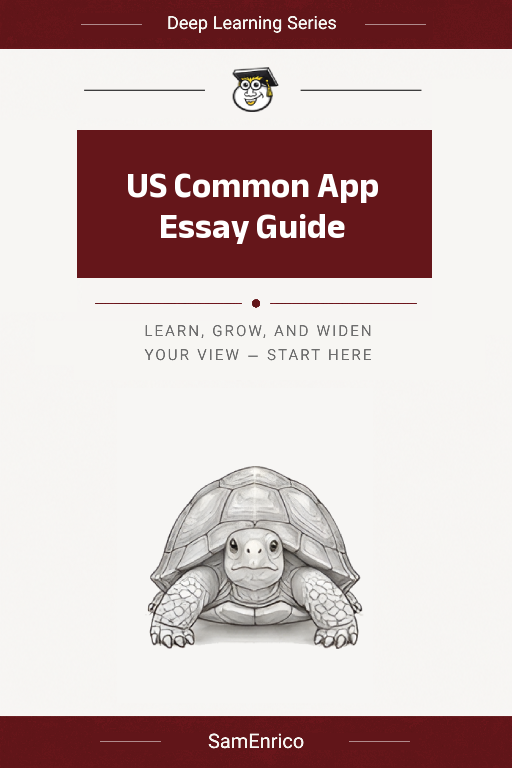
US Common App Essay Guide eBook
Write compelling personal statement for up to 20 c
Write compelling personal statement for up to 20 colleges using Common App prompts effectively.
Formats
Free sample
Chapter 1: Beyond the Transcript–- The email arrived on a Tuesday, three weeks before the deadline. “Mom,” seventeen-year-old Priya said, staring at her laptop, “I have nothing to write about. I’ve done nothing. I am nothing.” Her mother looked over her shoulder at the blinking cursor on the Common App screen. Priya had a 4.3 GPA, founded the school’s robotics club, volunteered at a hospital for two summers, and placed third in a state-wide debate tournament.
But none of that felt like a story. None of that felt like her.This is the most common panic attack in American high school education. Not the SAT. Not the waitlist. The blank page.If you are reading this book, you likely feel something similar.
You have spent four years building a resume of impressive-sounding activities, chasing grades, and checking boxes. And now someone has asked you to distill all of that into 650 words that will make a stranger in an admissions office think, I want this person in my classroom. The pressure is enormous. The advice you have received so far is probably useless: “Just be yourself” (yourself how?) or “Write about something you care about” (you care about too many things) or “Show, don’t tell” (what does that even mean?).This chapter will dismantle the single most damaging misconception about the personal statement: that it is a fifth AP score or a chance to rehash your resume. It is neither.
And once you understand what the essay actually is, the blank page becomes a doorway rather than a wall.The Three-Minute Reality Check Before we discuss what to write, you need to understand who is reading your essay and under what conditions.In the 2023–2024 admissions cycle, the average selective college received more than 50,000 applications. The University of California system received over 200,000. Admissions officers are human beings with limited time, caffeine budgets, and reading fatigue. The typical officer spends between three and five minutes on a complete application file – including grades, test scores, activities list, recommendations, and both the personal statement and supplements.Here is what that means for your personal statement: the officer will spend approximately ninety seconds reading it. Ninety seconds.This is not a secret.
Former admissions officers who write about the process consistently report the same numbers. At Harvard, according to a 2022 Harvard Crimson survey of admissions staff, the average initial read of an essay is two minutes. At the University of Michigan, it is three. At smaller liberal arts colleges, it might be four. But nowhere does an officer sit down with a cup of tea and a magnifying glass to savor your prose like a literary critic.You have ninety seconds to make someone care.This brutal reality shapes every piece of advice in this book.
You cannot afford a slow start. You cannot afford confusing sentences. You cannot afford to waste the reader’s time with information they could get from your transcript. And most importantly, you cannot afford to be forgettable.But here is the good news: ninety seconds is enough time to do something remarkable. A single, specific, emotionally honest moment can lodge itself in an officer’s memory.
A voice that sounds like a real human being – not a resume in paragraph form – can make them lean forward. And when they lean forward, they read more carefully. When they read more carefully, they advocate for you in committee meetings.The Three Things Admissions Officers Actually Want to Know If the essay is not a fifth AP score, what is it?Holistic admissions – the system used by most selective colleges – evaluates applicants across multiple dimensions. Grades and test scores show academic readiness. The activities list shows commitment and leadership.
Recommendations show how others perceive you. The personal statement has a different job entirely.Based on interviews with former admissions officers from Stanford, MIT, University of Chicago, Brown, and Swarthmore, as well as internal training documents leaked or published over the years, the personal statement exists to assess three intangible qualities that cannot be found anywhere else in the application.Vulnerability This is not a fashionable buzzword. Vulnerability, in admissions context, means the willingness to show imperfection without performing self-pity. Colleges want to know that you can acknowledge weakness, ask for help, and sit with discomfort. Why?
Because college is hard. You will fail exams, lose friends, get rejected from internships, and probably cry in a library bathroom at some point. Admissions officers want to admit students who will survive those moments – who will go to office hours, call home, or join a study group instead of spiraling alone.An essay that demonstrates vulnerability does not need to be about trauma. It can be about the time you froze during a debate tournament and lost the round. It can be about the chemistry lab where your experiment failed twice before you asked a classmate for help.
It can be about the summer job where you realized you were not as good at customer service as you thought. The key is that you show the moment of imperfection, then show what you did next.What vulnerability is not: trauma-dumping (writing about abuse, eating disorders, or family dysfunction in graphic detail without reflection), humble-bragging (“I care so much that I exhaust myself”), or pretending that failure was actually success (“I failed the test, but really I learned that I’m a hard worker”).Growth Mindset Psychologist Carol Dweck’s concept of “growth mindset” – the belief that abilities can be developed through effort rather than being fixed at birth – has become admissions shorthand for a specific quality: the ability to learn from failure and change behavior accordingly.An applicant with a growth mindset does not see a bad grade as an indictment of their intelligence. They see it as data. They ask: what went wrong? What can I do differently?
Who can I learn from? They are not defensive about feedback. They seek it out.In essay form, growth mindset looks like a clear arc: before (old belief or behavior), event (something that challenged that belief), during (the messy middle where you tried and failed and tried again), after (new belief or behavior that you now carry forward).The most common mistake students make in this area is skipping the messy middle. They go directly from “I failed” to “I succeeded” without showing the weeks of confusion, the wrong turns, the moments of doubt. That is not growth mindset – that is a montage.
Growth mindset requires showing the process, not just the outcome.Intellectual Vitality This is the quality that admissions officers at top universities talk about most and students understand least. Intellectual vitality is not the same as being smart. Plenty of smart students are intellectually passive – they memorize information, regurgitate it on tests, and never ask “what if?” or “why not?” Intellectual vitality is curiosity in motion. It is the student who stays after class to ask a question that was not on the syllabus. It is the student who reads a Wikipedia article about one topic and ends up down a rabbit hole about something completely unrelated.
It is the student who gets excited about an idea and wants to share it with anyone who will listen.In…
This is the end of the free sample. Get the eBook to keep going. Buy now
About this book
Details
- Author
- Belton Cassidy
- Publisher
- SamEnrico
- Language
- English
- Genre
- essays, Student's Shortcut
- Released
- 2026-06-01
- Pages (approx.)
- 126
- Available as
- eBook, Audiobook

Read better in the ZLOADR app
Your eBooks on your phone or tablet. Sign in with your SamEnrico account and start reading.
More by Belton Cassidy
 Perfectionism HypnosisBelton Cassidy$11.99
 Senior Grief Esteem GuideBelton Cassidy$11.99
 Networking Approach AnxietyBelton Cassidy$11.99
 Networking for People with DisabilitiesBelton Cassidy$11.99
 Loneliness Martial Arts DojoBelton Cassidy$11.99
 Stress Liver Disease LinkBelton Cassidy$11.99
 The Prevention Habit TrackerBelton Cassidy$11.99
 Lincoln LeadershipBelton Cassidy$11.99
 Melanoma Skin SurvivorBelton Cassidy$11.99
 Ghost in the Firewall: The Stuxnet Heist That Changed CyberwarBelton Cassidy$11.99
 Bakunawa: The Celestial Serpent of Philippine StormsBelton Cassidy$11.99
 The Fall of the Colombian Hip-Hop Pioneers: How Violence Silenced a RevolutionBelton Cassidy$11.99
You may also like
 YouTube Video Essay DepthLeon Lala$11.99
 TOEFL Independent Essay GuideMintz Alex$11.99
 Music Theory Essay GuideWilkinson Maisha$11.99
 Expository Essay AI PromptsApplegate Dalia$11.99
 Exam Essay MemorizationMcgovern Johna$11.99
 Compare Contrast Essay PromptsOntiveros Marx$11.99
 College Application Essay GuideSisson Aimee$11.99College Application Essay GuideSisson Aimee$11.99
 The 100 Word Essay ChallengeAli Luciana$11.99
 Journalism Essay PromptsThatcher Williemae$11.99
 Finance Essay PromptsShrader Lamont$11.99
 Cause Effect Essay GPT GuideBland Jacelyn$11.99