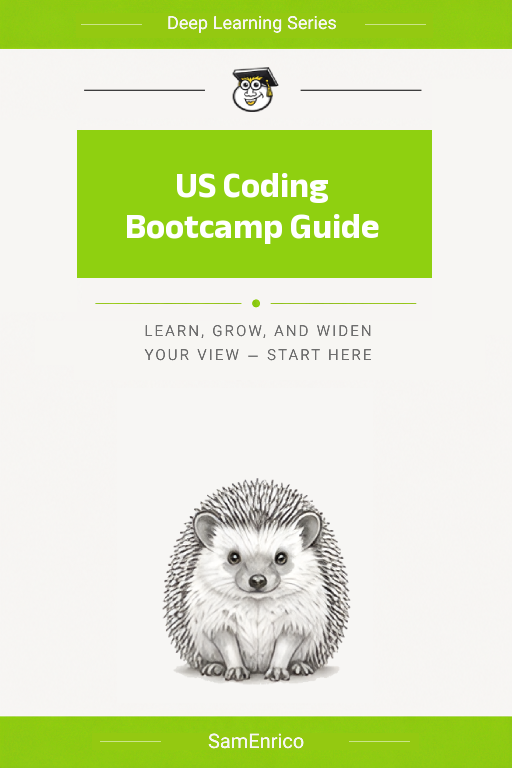
US Coding Bootcamp Guide eBook
Evaluate American bootcamps like General Assembly,
Evaluate American bootcamps like General Assembly, Flatiron, and Codesmith against traditional four year degrees.
Formats
Free sample
Chapter 1: The 420-Hour Lie--The first lie you will hear about coding bootcamps is that they take twelve weeks. The second lie is that you will be “job-ready” at the end. The third—and most dangerous—is that the number of hours you spend in a classroom has any relationship to the quality of education you receive.Let me start with a confession. I spent six months researching this book, interviewing graduates from thirty-seven different bootcamps, sitting in on live coding sessions, and auditing university CS lectures. I watched a twenty-four-year-old former barista land a ninety-thousand-dollar job after twelve weeks of General Assembly’s software engineering immersive.
I also watched a thirty-one-year-old former teacher finish the same program, spend eight months applying to seven hundred jobs, and ultimately accept a technical support role paying fifty-two thousand dollars. Same curriculum. Same number of hours. Radically different outcomes.The difference was not grit. It was not intelligence.
It was not even the quality of the instruction. The difference was a single variable that no bootcamp admissions counselor will ever volunteer: the alignment between the program’s pedagogical model and the student’s learning profile.This chapter is not a defense of bootcamps or universities. It is a dismantling of the most persistent myth in career-focused tech education: that more hours equals better outcomes, and that the “standard” three-month, four-hundred-twenty-hour model is somehow optimal for everyone. The truth is messier, more interesting, and far more useful to you as a prospective student.The Origin of the 420-Hour Standard To understand why almost every reputable bootcamp settled on approximately four hundred twenty hours of live instruction, you have to go back to 2011. General Assembly opened its doors in a shared workspace on Manhattan’s Fifth Avenue, offering classes in HTML, CSS, and basic Java Script.
The original model was part-time: ten weeks, two evenings per week, about sixty hours total. Graduates left knowing how to build a basic webpage. They did not leave employable.The shift to full-time immersive programs happened almost by accident. In 2012, a small group of students asked if they could attend the part-time program during the day instead of evenings. They wanted to quit their jobs, focus entirely on learning, and compress the timeline.
General Assembly obliged. The first full-time cohort ran nine weeks, about three hundred fifteen hours. The results were dramatically better. Students emerged with portfolio projects, not just homework assignments. Employers started paying attention.By 2014, the industry had informally converged on a twelve-week, four-hundred-twenty-hour model (forty hours per week of instruction, plus additional lab time).
This was not the result of pedagogical research. It was the result of practical constraints. Twelve weeks was the maximum duration that career-switching adults could afford to take off work. Forty hours per week was the maximum that students could tolerate without cognitive collapse. The number 420 emerged from these two boundaries—not from evidence about optimal learning.Today, that number is treated as sacred.
Bootcamps brag about their “rigorous 420-hour curriculum” as if the quantity of hours were a proxy for quality. Universities look down on bootcamps for compressing material into “only 420 hours,” as if four years of sporadic learning were obviously superior to twelve weeks of focused intensity. Both arguments miss the point entirely.What Actually Happens in 420 Hours Let me break down what those 420 hours contain at a typical bootcamp. The breakdown varies by school, but the structure is remarkably consistent across General Assembly, Flatiron, Codesmith, and their imitators.Weeks one through three: Fundamentals. You learn variables, loops, functions, arrays, objects.
If the bootcamp teaches Java Script (almost all do), you learn scope, closures, callbacks, and promises. You build a command-line game—tic-tac-toe, a trivia quiz, a simple text adventure. You feel like a genius when it works. You feel like an impostor when it does not.Weeks four through six: Front-end frameworks. Specifically, React.
You learn components, props, state, hooks, the component lifecycle. You build a to-do app, then a weather app using an API, then a simple e-commerce product page. You learn to manage state with Redux or Context. You learn to style with CSS modules or Tailwind. By week six, you can build a reasonably polished user interface that fetches data from somewhere and displays it somewhere else.Weeks seven through nine: Back-end development.
Node.js and Express. You learn to build RESTful APIs, connect to a database (Postgre SQL or Mongo DB), authenticate users with JSON Web Tokens or OAuth, and deploy to Heroku or Render or Vercel. You build a full-stack application—a blog, a task manager, a chat room—that saves data to a database and retrieves it on demand. You feel, for the first time, like a real developer.Weeks ten through twelve: Group projects and career preparation. You join a team of three or four students to build a substantial application.
You learn Git workflows, code reviews, agile standups. You polish your resume, practice technical interviews, and complete take-home challenges. You graduate with three portfolio projects and a certificate that says you completed 420 hours of instruction.This is the standard script. It works well for some students and catastrophically for others. The difference lies not in the script itself but in how individual students interact with each phase.The Hidden Variable: Learning Speed Asymmetry Here is the uncomfortable truth that no bootcamp will tell you: students learn at dramatically different speeds, and the 420-hour model forces everyone through the same pace.In week one, the variation is small.
Almost everyone struggles with loops and functions. The playing field is level. By week three, the gap appears. Some students grasped closures and promises on the second try; others are still confused after the fifth explanation. By week five, the gap is a chasm.
The faster learners are building custom hooks and optimizing renders; the slower learners are still debugging basic prop drilling. By week eight, the faster learners are helping their classmates debug authentication flows; the slower learners are wondering if they chose the wrong career.The bootcamp cannot slow down for the slower learners because the schedule is fixed. The bootcamp cannot accelerate the faster learners because there is no advanced track. Everyone moves together, regardless of individual mastery. This is not a flaw in bootcamps specifically—it is a flaw in cohort-based education generally.
But it is magnified in bootcamps because the timeline is so compressed.I interviewed a graduate of Codesmith’s Los Angeles program who had already been coding for two years as a hobby before enrolling. He described the first six weeks as “painfully slow” and the last six weeks as “finally interesting.” He is now a software engineer at a mid-sized startup. He recommends Codesmith enthusiastically. I also interviewed a graduate of the same program who had never written a line of code before enrolling. She described the first six weeks as “overwhelming” and the last six weeks as “impossible.” She is now a project manager at a non-tech company.
She does not recommend the bootcamp.Both students experienced the same 420 hours. Both had the same instructors, same curriculum, same projects. The difference was prior exposure to coding. The faster learner had already internalized the fundamentals before day…
This is the end of the free sample. Get the eBook to keep going. Buy now
About this book
Details
- Author
- Culbertson Eric
- Publisher
- SamEnrico
- Language
- English
- Genre
- Non-Fiction, Student's Shortcut, US Education
- Released
- 2026-06-01
- Pages (approx.)
- 143
- Available as
- eBook, Audiobook

Read better in the ZLOADR app
Your eBooks on your phone or tablet. Sign in with your SamEnrico account and start reading.
More by Culbertson Eric
 Second Generation FuneralsCulbertson Eric$11.99
 Paleo Autoimmune CookbookCulbertson Eric$11.99
 Self Doubt After Success GuideCulbertson Eric$11.99
 Interruption Trigger Mapping CourseCulbertson Eric$11.99
 Cab Calloway Hi De HoCulbertson Eric$11.99
 Mobile vs Desktop Subscription SignupCulbertson Eric$11.99
 Sleep Memory For PTSDCulbertson Eric$11.99
 Roth Conversion LadderCulbertson Eric$11.99
 The Ghosts of Stockholm: How a Black Scientist Unlocked the Secrets of the CellCulbertson Eric$11.99
 The Fall of a Champion: The Tragic Decline of Jonah LomuCulbertson Eric$11.99
 How to Produce Skateboard PartsCulbertson Eric$11.99
 A Collector's Handbook to the Buick Master Series 60Culbertson Eric$11.99