
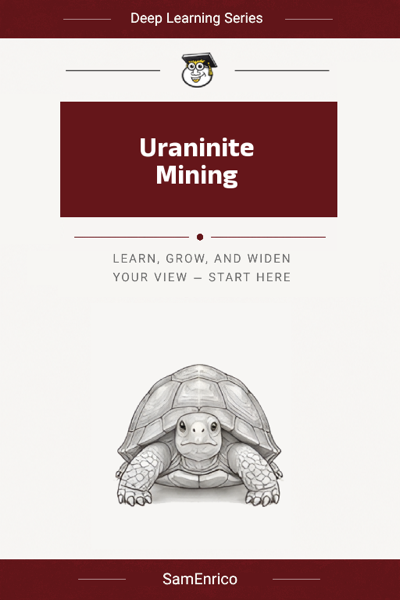
Non-FictionInformativeEducational
Uraninite Mining eBook
A Coursebook on Uraninite Mining
A Coursebook on Uraninite Mining
Formats
Free sample
Chapter 1: The Glowing Mountain--– In the autumn of 1911, a thirteen-year-old boy named Martin and his eleven-year-old sister Margaret hiked up a rocky slope near Central City, Colorado, following a vein of yellow-green rock that seemed to glow faintly even in daylight. They collected samples in their pockets, fascinated by the strange mineral their father, a local miner, had told them to avoid. That night, under their shared bedroom window, they watched the rocks cast a ghostly luminescence—not the sharp flash of lightning bugs, but a steady, silent glow that seemed to come from somewhere deep inside the stone. What the children did not know was that they were holding pitchblende, the massive variety of uraninite, and that the glow came from radium decaying into radon gas, releasing alpha particles that were already altering the cells in their lungs. Martin would be dead of leukemia at age thirty-one.
Margaret would survive until forty-eight, her body riddled with bone cancer that her doctors could never fully explain. The mountain they had climbed would later be known as the Schwartzwalder mine, one of the richest uranium deposits in the United States, and their story—quiet, forgotten, tragic—was the first chapter of an industry that would reshape geology, geopolitics, and public health for the next century.This book is about the rock that glowed. More precisely, it is about uraninite—the black, brittle, unusually dense mineral that has powered nuclear submarines, leveled cities, lit hospitals, and poisoned watersheds. It is about the mining of that mineral: the science of finding it, the engineering of extracting it, the politics of selling it, and the long, expensive, morally complicated work of cleaning up after it. If you are reading this book as a student of mining engineering, a regulator drafting new standards, an investor weighing uranium equities, or simply a citizen trying to understand how a single rock can be both a climate solution and a environmental curse, you have come to the right place.
But before we talk about cut-off grades or ion exchange resins or in-situ recovery wellfields, we need to start with the mineral itself—not as an economic statistic, but as a geological and physical phenomenon unlike any other on Earth.What Uraninite Is, and Why It Matters Uraninite is uranium dioxide (UO₂), a mineral that crystallizes in the isometric system, meaning it forms cubes and octahedra when it has room to grow. In practice, you rarely see perfect crystals. Most uraninite appears as massive, featureless, black to gray-black masses that break with a conchoidal fracture—smooth, shell-like surfaces similar to obsidian or flint. It is heavy, with a specific gravity of 10.6 to 10.9, roughly twice as dense as lead. When fresh, it has a dull, pitchy luster, which is why miners called it pitchblende—from the German Pechblende, meaning "peacock ore" or "bad luck ore," because it looked promising but contained no silver or lead.
A fresh sample of uraninite is so black that it seems to absorb light, but exposure to air and water alters it. Over time, the surface oxidizes, turning yellow, orange, red, or green as secondary minerals like autunite (yellow), rutherfordine (white), and uranophane (yellow-green) form. The old miners at Schwartzwalder called these "gummite," a sticky, gum-like alteration product that they kicked aside. They had no idea that the "worthless" black rock they were discarding contained the key to nuclear fission.The importance of uraninite does not come from its crystal structure or its color, of course. It comes from what is inside it: uranium, element 92 on the periodic table, the heaviest naturally occurring element on Earth.
Natural uranium consists of two primary isotopes—variants of the same element with different numbers of neutrons—in a fixed ratio: 99.27% uranium-238 (U-238) and 0.72% uranium-235 (U-235). For nearly the entire history of the planet, this ratio was merely an interesting footnote in nuclear physics. But in 1938, Otto Hahn and Fritz Strassmann discovered that when U-235 absorbs a neutron, it splits into two smaller atoms, releases energy, and emits additional neutrons that can split more U-235 atoms. This is nuclear fission, and it changed everything.U-235 is said to be fissile—it can sustain a chain reaction. U-238, by contrast, is fertile—it can be converted into plutonium-239, which is also fissile, but it does not itself sustain a chain reaction.
This distinction—fissile versus fertile—is the single most important concept in the nuclear fuel cycle. It determines why we enrich uranium (to increase the concentration of U-235 from 0.72% to 3–5% for reactor fuel or to 90% for weapons), why some reactor designs work and others fail, and why spent nuclear fuel remains dangerous for hundreds of thousands of years (the U-238 decay chain produces long-lived radionuclides like plutonium). And it all starts with uraninite.The Unseen Danger: Radioactivity and Decay Chains To understand the hazards of uraninite mining, you must understand radioactivity—not as an abstract concept, but as a physical process unfolding inside every piece of ore. Uranium decays. It cannot help itself.
The nucleus of U-238 is inherently unstable, with too many neutrons to hold itself together indefinitely. Over time, it emits particles and energy, transforming into a series of daughter products until it finally reaches stable lead-206. The U-238 decay chain has fourteen steps, from U-238 (half-life: 4.468 billion years) through thorium-234, protactinium-234, uranium-234, thorium-230, radium-226, radon-222, polonium-218, lead-214, bismuth-214, polonium-214, lead-210, bismuth-210, polonium-210, and finally stable lead-206. The U-235 decay chain is shorter but similarly complicated. For miners and mill workers, the most dangerous steps are not the uranium isotopes themselves but the daughters: radium-226 (half-life 1,600 years), which concentrates in bones and causes bone cancer; and radon-222 (half-life 3.8 days), a colorless, odorless, tasteless gas that seeps out of rock and into lungs, where its short-lived daughters (polonium-218, lead-214, bismuth-214, polonium-214) deliver a concentrated dose of alpha radiation to bronchial tissue.Alpha radiation is the key.
An alpha particle is two protons and two neutrons bound together—identical to the nucleus of a helium-4 atom. It is heavy, positively charged, and slow. It cannot penetrate a sheet of paper or the dead outer layer of human skin. But if an alpha-emitting radionuclide gets inside your body—through inhalation, ingestion, or absorption through a cut—it will deposit all of its energy into a tiny volume of living tissue. Alpha particles are highly ionizing, meaning they tear electrons off molecules, breaking DNA strands and creating reactive oxygen species that cause mutations, apoptosis, or malignant transformation.
One nanogram of polonium-210, a daughter of radon, is enough to kill a human if inhaled. The miners of Schwartzwalder did not know this. They breathed radon every day. Their children played on tailings piles. The glow they saw was not magic; it was radiation damage made visible by the fluorescence of zinc sulfide in the rock, a silent warning they could not read.The Practical Language of Ore: Grades, Cut-Offs, and Economics When geologists talk about uraninite, they do not speak in terms of chemistry or decay chains alone.
They speak in terms of grade: the concentration of uranium in the rock, usually expressed as percent U₃O₈ (uranium oxide, the conventional product of milling) or parts per million (ppm). A deposit of 0.1%…
This is the end of the free sample. Get the eBook to keep going. Buy now
About this book
Details
- Author
- German Aurelio
- Publisher
- SamEnrico
- Language
- English
- Genre
- Non-Fiction, Informative, Educational
- Released
- 2026-05-06
- Pages (approx.)
- 146
- Available as
- eBook, Audiobook

Read better in the ZLOADR app
Your eBooks on your phone or tablet. Sign in with your SamEnrico account and start reading.
More by German Aurelio
 Customer Service Remote Team GuideGerman Aurelio$11.99
 Burnout Recovery Minimalism GuideGerman Aurelio$11.99Burnout Recovery Minimalism GuideGerman Aurelio$11.99
 Keto for Beginners MistakesGerman Aurelio$11.99
 The Richard Strauss GuideGerman Aurelio$11.99
 Teresa of Ávila John of CrossGerman Aurelio$11.99
 The Lion of Chittor: Rana Pratap's Last Stand Against the MughalsGerman Aurelio$11.99
 How to Become a Game-farm HelperGerman Aurelio$11.99
 Faceless YouTube Pet ChannelGerman Aurelio$12.99
 Famous Startup Pivot StoriesGerman Aurelio$12.99
 Learn to Play the Gran CassaGerman Aurelio$11.99
You may also like
 Hong Kong Handover 1997Dunn Johnnie$11.99
 Zumba For Postnatal Recovery CourseNeal Christian$11.99
 Zumba for BeginnersLadner Nikia$11.99
 YouTube Comment Mining GuideHumes Pandora$12.99
 Worry Box MeditationCarlin Rudy$11.99
 Workplace Stress MeditationNguyen Lynn$11.99
 Workplace Stress and Sleep RepairHawley Ivory$11.99
 Workplace Perfectionism CureDelaney Jeffry$11.99
 Workplace Injustice Anger GuideWallen Isabelle$11.99
 Work Addiction and Burnout LinkGreenwood Ester$11.99
 Women in Yoga and WellnessBeattie Galina$11.99
 Women in Stand Up ComedyChun Evangeline$11.99