
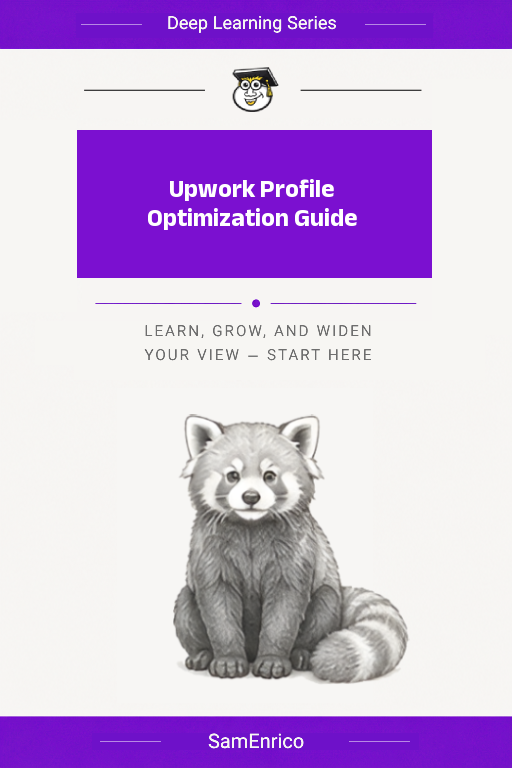
Non-FictionFirst 30 DaysPlatform SelectionBusiness Brief
Upwork Profile Optimization Guide eBook
Learn to build a standout Upwork profile that attr
Learn to build a standout Upwork profile that attracts premium clients and commands higher rates.
Formats
Free sample
Chapter 1: The Invisible Graveyard--–- On a quiet Tuesday morning, a freelance graphic designer named Marcus did something he had done every day for the past eighteen months. He opened his laptop, navigated to Upwork, and refreshed his proposals page. Nothing. He refreshed again. Still nothing.
He had sent forty-seven proposals in the last thirty days. He had received exactly two replies. Both had ghosted him after the first message. His profile showed 1,200 profile views in the past ninety days, which sounded impressive until he realized that 1,200 views had translated into exactly three interviews and zero contracts. Marcus was invisible, and he did not understand why.
His portfolio was solid. His testimonials from off-platform clients were glowing. His skills were current. But on Upwork, he might as well have been a ghost.Marcus is not alone. At the time of this writing, Upwork hosts over eighteen million freelancers.
Eighteen million. That is roughly the population of the Netherlands, all crowded into a single digital marketplace, all competing for the attention of clients who spend an average of 5.7 seconds scanning a profile before deciding whether to click away or read further. In that 5.7 seconds, a client makes a series of rapid, mostly subconscious judgments: Is this person competent? Can I trust them? Do they understand my problem?
Will they make my life easier or harder? Most freelancers fail this test before they even know they are being tested.This chapter dismantles the most dangerous belief among new and mid-tier freelancers: that technical skill is the primary driver of success on Upwork. The author reveals that raw ability is no longer a differentiator—it is a baseline requirement. The core problem is that most freelancers build a "résumé profile" (listing what they have done) instead of a "marketing profile" (selling what a client will gain).The Myth of Meritocracy Let us begin with a uncomfortable truth. Upwork is not a meritocracy.
It does not reward the most skilled freelancer. It rewards the freelancer who best solves a specific psychological equation for the client. That equation has three variables, and none of them are "years of experience" or "software proficiency."Consider two hypothetical freelancers. Freelancer A has fifteen years of experience, an impeccable portfolio, and a rate of $150 per hour. Freelancer B has four years of experience, a decent but unremarkable portfolio, and a rate of $75 per hour.
On paper, Freelancer A is objectively more qualified. Yet Freelancer B consistently wins more contracts and commands higher lifetime value per client. Why? Because Freelancer B has learned to signal something that Freelancer A has not. Freelancer B signals safety.Clients are not hiring your skills.
They are hiring the absence of risk. Every client who posts a job on Upwork is secretly terrified. They are terrified of wasting money. They are terrified of missing deadlines. They are terrified of having to redo work themselves.
They are terrified of looking foolish to their boss or their own clients. Your skills are irrelevant until you first convince the client that hiring you will not trigger any of these fears.This is why Marcus failed. His profile listed his software proficiencies, his years of experience, and his design philosophy. What it did not do was tell a potential client, in under five seconds, "I understand your specific problem, I have solved it before for people like you, and I will make the process painless." Marcus built a résumé. The clients who were hiring were looking for a sedative.The Three Mindsets of Upwork Freelancers After analyzing thousands of profiles and interviewing over two hundred high-earning freelancers, a clear pattern emerges.
There are exactly three mindsets on Upwork, and they map directly to earning potential. The mindset you adopt determines your ceiling, not your skill level.The Clock-Puncher The clock-puncher charges by the hour, waits for instructions, and competes almost exclusively on price. Their profile typically includes phrases like "reliable," "hardworking," "attention to detail," and "available 24/7." They list their skills in bullet points. They describe their work history chronologically. They end their overview with "Please contact me for a quote."The clock-puncher operates from a scarcity mentality.
They believe that freelancing is a numbers game—more proposals equals more contracts, and lower rates equals more proposals. They are partially correct in the short term. A clock-puncher can absolutely win contracts. They can absolutely earn a living. But they are always tired, always replaceable, and always one bad review away from financial distress.
Their ceiling is approximately $40 per hour, and they hit it quickly.The Problem-Solver The problem-solver has figured out something important: clients do not want to describe their problems in detail. They want someone who already understands. The problem-solver's profile focuses on outcomes rather than activities. Instead of "I write blog posts," they write "I help B2B Saa S companies generate leads through case studies." Instead of "I build websites," they write "I build Shopify stores that convert traffic into sales."The problem-solver commands rates between $50 and $100 per hour. They receive repeat business.
They have a solid Job Success Score. But they have a hidden vulnerability. They are still reactive. They solve the problems clients bring to them, but they do not anticipate problems the client has not yet articulated. They are valuable, but they are replaceable because another problem-solver can do roughly the same thing.The Strategic Partner The strategic partner operates on a different plane entirely.
They do not wait for clients to describe their problems. They diagnose problems the client did not know they had. They propose solutions that encompass not just the immediate project but the broader business context. They price on value, not hours. Their profiles rarely mention rates at all because rate discussions happen after the client is already convinced of the partner's unique value.The strategic partner commands $125 to $250 or more per hour.
They are invited to jobs more often than they apply. Their clients stay for years. They are not competing with other freelancers because no other freelancer offers their specific combination of industry insight, process expertise, and outcome guarantee.The journey of this book is the journey from clock-puncher to strategic partner. It is not a journey of learning more skills. It is a journey of reframing everything you think you know about selling your work.The Buyer's Trifecta: Competence, Trust, Proactivity Every client who lands on your profile is running a silent checklist.
They may not articulate it, but they are asking three questions. These three questions form the Buyer's Trifecta, and your profile must answer all three in under five seconds.Competence: Can you actually do this?This is the easiest question to answer and the one most freelancers overinvest in. Competence is proven by portfolio samples, by case studies with measurable results, and by relevant certifications. But here is the catch: competence is expected. It does not differentiate you.
It only eliminates you if it is absent. Think of competence as the price of admission, not the main event.Most freelancers spend 80 percent of their profile trying to prove competence. They list every software they have ever used, every certification they have earned, every project they have completed. This is a mistake.…
This is the end of the free sample. Get the eBook to keep going. Buy now
About this book
Details
- Author
- Block Lyndsey
- Publisher
- SamEnrico
- Language
- English
- Genre
- Non-Fiction, First 30 Days, Platform Selection, Business Brief, Career Development
- Released
- 2026-06-07
- Pages (approx.)
- 138
- Available as
- eBook, Audiobook

Read better in the ZLOADR app
Your eBooks on your phone or tablet. Sign in with your SamEnrico account and start reading.
More by Block Lyndsey
 B-29 Superfortress and the Pacific WarBlock Lyndsey$11.99
 Child Star Tell All Books GuideBlock Lyndsey$11.99
 Career Transition App ToolkitBlock Lyndsey$11.99
 Decision Fatigue SolutionsBlock Lyndsey$11.99
 Treatment Resistant Depression GuideBlock Lyndsey$11.99
 Upwork Connects Budgeting GuideBlock Lyndsey$11.99
 Citation Rules for Multiple Authors GuideBlock Lyndsey$11.99
 Vietnam Thud PilotBlock Lyndsey$11.99
 Carnegie RetirementBlock Lyndsey$11.99
 The Silk Road Stargazers: Ancient Women Who Charted the CosmosBlock Lyndsey$11.99
 The Oxford Circle: Where the Renaissance Met the EnlightenmentBlock Lyndsey$11.99
 The Last Stand: The Untold Story of Eric Moussambani's Olympic MiracleBlock Lyndsey$11.99
You may also like
 Hong Kong Handover 1997Dunn Johnnie$11.99
 Zumba For Postnatal Recovery CourseNeal Christian$11.99
 Zumba for BeginnersLadner Nikia$11.99
 YouTube Comment Mining GuideHumes Pandora$12.99
 Worry Box MeditationCarlin Rudy$11.99
 Workplace Stress MeditationNguyen Lynn$11.99
 Workplace Stress and Sleep RepairHawley Ivory$11.99
 Workplace Perfectionism CureDelaney Jeffry$11.99
 Workplace Injustice Anger GuideWallen Isabelle$11.99
 Work Addiction and Burnout LinkGreenwood Ester$11.99
 Women in Yoga and WellnessBeattie Galina$11.99
 Women in Stand Up ComedyChun Evangeline$11.99