
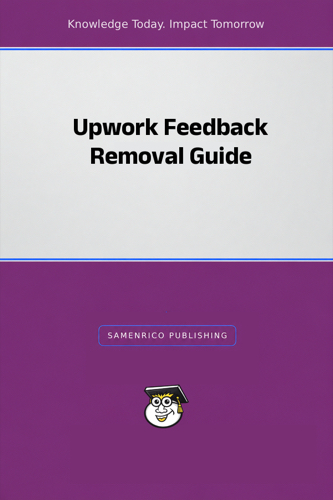
Upwork Feedback Removal Guide eBook
When and how to use perk removals for negative cli
When and how to use perk removals for negative client feedback.
Formats
Free sample
Chapter 1: The Graveyard Shift--–- The notification arrived at 11:47 PM on a Tuesday. Sarah Chen, a Top Rated Plus freelancer with $187,000 in lifetime earnings on Upwork, had just closed a $4,200 website development contract. The client had been silent for three days after final delivery—no complaints, no revision requests, no messages at all. Sarah clicked "End Contract," expecting the usual automated feedback request. What she got instead was a 3-star public review with the comment: "Work was fine but took longer than expected.
Would not hire again."Her Job Success Score dropped from 100% to 94% overnight. Within 72 hours, she lost $42,000 in pending contract invites. A client who had been negotiating a $15,000 monthly retainer ghosted her completely. Sarah did what any rational freelancer would do: she went to her Top Rated Plus dashboard, clicked the "Feedback Removal Perk" button that had saved her twice before, and waited for the relief.The button was gone.Not grayed out. Not moved.
Gone. Replaced by a Help Center article explaining that as of September 2024, Upwork had eliminated the unilateral feedback removal perk for all freelancers except those in the Enterprise program. Sarah's story is not unique. It is the new reality for over 2 million active freelancers on the platform. And this book is the answer she—and you—desperately need.Welcome to the post-perk era.
The safety net has been cut. But contrary to what you have read in panicked Reddit threads and You Tube rants, feedback removal is not impossible. It has simply changed. And those who understand the new rules—the narrow legal loopholes, the arbitration pathway, the strategic use of refunds, and the art of the professional response—will not only survive but thrive.This chapter is your guide to understanding exactly what died in September 2024, what remains, and why this shift may actually be a gift in disguise.The Perk That Was: A Brief History of the Freelancer's Safety Net Between 2016 and 2024, Upwork offered what many considered the single most valuable benefit of the Top Rated program: the Feedback Removal Perk. For every ten completed contracts, a Top Rated freelancer could remove one negative feedback entry—public stars, written comment, and crucially, the private feedback that powered the Job Success Score.
The process was simple, almost frictionless. You clicked a button, selected the offending contract, and within minutes, the review vanished as if it had never existed.The perk evolved over time. Initially, freelancers could remove one feedback for every ten contracts, with no cap on total removals. Later, Upwork restricted it to one removal per quarter. For Top Rated Plus freelancers (those with $10,000 or more in earnings over twelve months), the perk remained more generous.
But the underlying principle never changed: if a client left an unfair review, you had a nuclear option.This created what economists call a "moral hazard." Freelancers knew they could erase a certain number of bad reviews, so some became complacent about client satisfaction. Others used the perk strategically, letting small issues slide knowing they had a safety net. A few—a very few—abused the system, delivering substandard work and erasing the evidence. Upwatch's data, released in a 2024 transparency report, showed that Top Rated freelancers were 40% more likely to have a feedback removal on their record than non-Top-Rated freelancers. The perk, intended to protect good freelancers from bad clients, had become a shield for mediocrity.More importantly, the perk created a two-tiered marketplace that confused clients.
A freelancer with a 100% JSS and three removed reviews looked identical to a freelancer with a 100% JSS and zero removed reviews. Clients could not see the removals. They could not see the private feedback that remained. They could only see a pristine record that might hide significant problems.Upwatch's September 2024 policy update explicitly cited this transparency problem. In a blog post that sent shockwaves through the freelancing community, the company wrote: "We believe that honest feedback—even when negative—helps clients make better hiring decisions and helps freelancers improve their services.
Hiding negative feedback creates an artificial marketplace where quality signals are distorted."The post-perk era was born.The Official Rationale: Why Upwork Killed the Button Upwork's stated reasons for eliminating the perk fall into three categories, each worth examining in detail because understanding them helps you predict where the company will tighten rules next.Category One: Marketplace Transparency Upwork argues that every piece of feedback, positive or negative, contains valuable signal. When a freelancer removes a negative review, that signal disappears for all future clients. The company's data scientists analyzed millions of hiring decisions and found that clients who saw a freelancer's complete feedback history—including negative reviews—made hiring decisions that were 23% more accurate (meaning they were less likely to dispute payment or leave their own negative feedback). In other words, hiding bad reviews actually hurt good freelancers in the long run because it attracted mismatched clients who would later become dissatisfied.This argument has merit. Consider two freelancers: Freelancer A has ten 5-star reviews and one removed review.
Freelancer B has nine 5-star reviews and one 3-star review that explains the client was upset about a missed deadline. A client hiring for a time-sensitive project would choose Freelancer B because the honest negative review provides useful information. Freelancer A, by contrast, looks perfect but may have hidden issues. The client who hires Freelancer A based on incomplete information is more likely to be disappointed and leave their own negative review.Category Two: Reducing Freelancer Anxiety This rationale is more controversial. Upwork claims that the perk created a culture of "review terror" where freelancers obsessed over every rating, knowing they had limited removals.
By eliminating the perk entirely, the company argues, freelancers will stop treating each review as a life-or-death event and focus instead on consistent quality. The data from other platforms (notably Fiverr, which never offered a similar perk) suggests that freelancers on no-removal platforms actually have lower rates of review-related anxiety because they accept negative feedback as a normal part of doing business.Critics note that this argument conveniently ignores Upwork's own role in creating that anxiety. The JSS algorithm weights recent contracts heavily, meaning a single bad review can drop a freelancer from 100% to 90% or lower, costing them access to Top Rated benefits and reducing their visibility in search results. Upwork created the anxiety, then eliminated the safety net, then blamed the freelancers for being anxious.Category Three: Closing the Feedback Building Loophole This is the least-discussed but most important reason. Upwork's data scientists discovered that some freelancers were using the removal perk to enable a form of manipulation called "feedback building." Here is how it worked: A freelancer would complete a legitimate contract, receive a bad review, remove it with the perk, then immediately complete a series of small fake contracts with friends or alternate accounts to generate positive reviews that buried the negative one deeper in their history.
The removal perk made this strategy viable because it erased the evidence of the bad review, leaving only the fake positives.By eliminating the perk, Upwork made feedback building much harder. Now, a negative review stays visible unless removed through the more difficult pathways (To S violations, arbitration, etc.). This change has reportedly reduced…
This is the end of the free sample. Get the eBook to keep going. Buy now
About this book
Details
- Author
- Martindale Carmel
- Publisher
- SamEnrico
- Language
- English
- Genre
- Non-Fiction, Business Brief, Reputation
- Released
- 2026-06-10
- Pages (approx.)
- 149
- Available as
- eBook, Audiobook

Read better in the ZLOADR app
Your eBooks on your phone or tablet. Sign in with your SamEnrico account and start reading.
More by Martindale Carmel
 The Gardening Brain ProtocolMartindale Carmel$11.99
 Melatonin Timing HandbookMartindale Carmel$11.99
 Key Employee Loss Interim Leadership GuideMartindale Carmel$11.99
 The Addiction Journaling MethodMartindale Carmel$11.99
 Spouse Death Social SecurityMartindale Carmel$11.99
 Cannabis Use Disorder TherapyMartindale Carmel$11.99
 Flashcard Nervousness FixMartindale Carmel$11.99
 Competition Commission India FinesMartindale Carmel$11.99
 The Serpent’s Oath: Arjuna’s Forbidden ArrowMartindale Carmel$11.99
 The Siege of Sana'a: Yemen's Forgotten Stand Against the Ottomans (1597)Martindale Carmel$11.99
 AI Accounting Tool Comparison GuideMartindale Carmel$12.99
 AI Masters Tuition ComparisonMartindale Carmel$12.99