
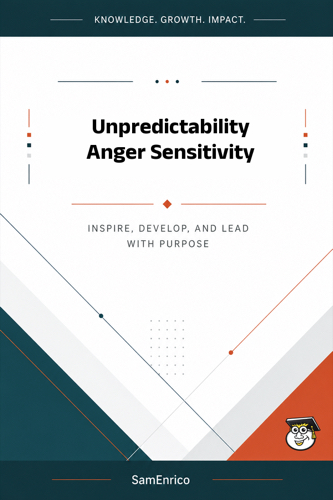
Non-FictionSelf-HelpPredictability
Unpredictability Anger Sensitivity eBook
Examines how surprise changes or lack of routine t
by Lange Mellie
Examines how surprise changes or lack of routine trigger frustration.
Formats
Free sample
Chapter 1: The Prediction Trap--–- The coffee was hot. That much he knew. Everything else in David’s field of vision had collapsed into a single, burning point of injustice. He had woken up ten minutes late because the phone charger had failed overnight—a tiny unpredictability that had already tilted his internal axis. Then the shower ran cold because his roommate had used the hot water.
Then he couldn’t find his keys, then the subway was delayed, and now, standing on the crowded platform, a stranger’s elbow had connected with his forearm, sending the coffee arcing through the morning air like a slow-motion catastrophe. The liquid splashed across his white shirt, his hand, his briefcase. And David, a reasonable man by all accounts, a man who loved his dog and called his mother every Sunday, felt something rise from his core. It wasn’t just anger. It was rage.
His face flushed. His jaw clenched. His voice, when it came out, was louder than he intended: “Are you kidding me? Watch where you’re going!”The stranger, startled, muttered an apology and disappeared into the crowd. But David didn’t feel relief.
He felt the anger still coursing through him, looking for somewhere to go. He carried it onto the train, through the office lobby, and into the elevator, where he stood silently fuming. By the time he reached his desk, he had already ruined his own morning. He would spend the next hour replaying the incident, constructing better responses he should have given, imagining what he would say if he ever saw that stranger again. His productivity for the day was shot.
His relationships with his colleagues would suffer because he would be short-tempered and withdrawn. All of this, because of a spilled coffee.Or so he thought.Here is the truth that will change how you understand every angry moment of your life: David did not lose his temper because a stranger spilled his coffee. David lost his temper because reality violated his expectation of a smooth, predictable morning.The coffee was never the problem. The problem was the gap between what David’s brain predicted would happen and what actually happened. His brain had constructed an elaborate prediction model: wake up on time, shower comfortably, find keys easily, catch the early train, sip coffee peacefully, arrive at work calm and prepared.
Every single one of those predictions was violated. The anger was not a reaction to the spills and delays. The anger was the brain’s emergency response to prediction error after prediction error after prediction error.This is the central argument of this book, and it is the key that unlocks everything else: You are not angry at change. You are angry at the violation of your expectations for control, order, and predictability.The Prediction Machine Let us begin with a radical reframing. Everything you think you know about anger is probably wrong.
Most people believe that anger is a response to a trigger—an event, a person, a situation that “makes them mad.” A rude driver makes you mad. A canceled flight makes you mad. A partner who forgets to take out the trash makes you mad. This is the common-sense view of anger, and it is also, according to decades of research in neuroscience and psychology, completely backwards.The brain does not passively wait for events to happen and then react to them. The brain is constantly, actively, obsessively predicting what will happen next.
Every moment of your waking life, your brain is running millions of simulations, forecasting the next few seconds, minutes, and hours based on past experience. This is not a choice. It is a biological necessity. Prediction is how the brain conserves energy, how it keeps you safe, how it navigates a complex world without exhausting your metabolic resources.Think of your brain as a master forecaster. When you wake up in the morning, your brain has already predicted the temperature of the shower, the taste of the coffee, the route to work, the faces you will see, the tasks you will complete.
These predictions are so seamless, so automatic, that you do not even notice them. You only notice them when they are wrong.When reality matches prediction, the brain experiences a small reward. Dopamine is released. You feel a sense of flow, of ease, of rightness. This is why routines feel good.
This is why the familiar is comforting. Your brain is designed to seek predictability because predictability has meant safety for every creature that came before you.When reality deviates from prediction, however, the brain experiences something entirely different: a prediction error. And prediction errors, from the brain’s perspective, are potential threats. In the ancestral environment, a deviation from the expected pattern might have been a predator, a rival, a natural disaster. The brain did not evolve to distinguish between a broken coffee maker and a broken twig signaling a tiger.
It evolved to treat any unexpected event as a danger until proven otherwise.This is the neurological foundation of anger. The emotion we call anger is the brain’s emergency response to a cascade of prediction errors. The cascade triggers a physiological arousal—increased heart rate, shallow breathing, muscle tension, release of adrenaline and cortisol. If that arousal is resolved quickly (you realize the unexpected sound was just the cat, not an intruder), the system calms down. But if the arousal cannot be resolved, if the prediction errors keep coming, the arousal converts into frustration, and frustration converts into anger.This is why David’s morning was a perfect storm of rage.
It wasn’t any single violation. It was the cumulative weight of prediction error after prediction error. Each violation added fuel to the fire. By the time the coffee spilled, his nervous system was already primed for explosion. The stranger’s elbow was just the final straw—the last prediction error in a chain that had been building for hours.The Four Levels of Anger Now that we understand the neurological foundation, we must introduce a crucial framework that will guide the entire book.
There is no single cause of anger. Instead, there are four levels of analysis that work together to produce every angry outburst you have ever experienced or witnessed. Understanding these four levels is the first step toward mastering unpredictability sensitivity.Level 1: Neurological (The Prediction Error)This is the foundation we have just explored. At the most basic level, anger is the brain’s response to the gap between prediction and reality. This level explains the when of anger—the moment of violation, the surge of arousal, the fight response.
Every chapter in this book will return to this neurological reality because it is the bedrock upon which everything else is built. When you feel anger rising, somewhere beneath it is a violated prediction. Learning to identify that prediction is the first skill of emotional mastery.Level 2: Emotional (The Cranky Cousins)Not every negative reaction to unpredictability is the same. Most people lump all unpleasant feelings under the label “anger,” but this is a mistake. As we will explore in Chapter 2, what you are actually feeling might be…
This is the end of the free sample. Get the eBook to keep going. Buy now
About this book
Details
- Author
- Lange Mellie
- Publisher
- SamEnrico
- Language
- English
- Genre
- Non-Fiction, Self-Help, Predictability
- Released
- 2026-06-08
- Pages (approx.)
- 146
- Available as
- eBook, Audiobook

Read better in the ZLOADR app
Your eBooks on your phone or tablet. Sign in with your SamEnrico account and start reading.
More by Lange Mellie
 Mayor of the HomelessLange Mellie$11.99
 The B2B Lead Generation GuideLange Mellie$11.99
 Burnout Disability Leave GuideLange Mellie$11.99
 Phil Mickelson Left Handed LegendLange Mellie$11.99
 The Vanishing Act: The Unsolved Mystery of the Disappearing D.B. CooperLange Mellie$11.99
 Echoes of the Underground: The Secret Tapes of the Velvet RevolutionLange Mellie$11.99
 Teachable Course LaunchLange Mellie$12.99
 Market Research On Public Wi-FiLange Mellie$12.99
 Dayforce Support AnalystLange Mellie$11.99
 Understanding Chronic Myelomonocytic LeukemiaLange Mellie$17.99
 How to Start a Construction of Utility Projects for Electricity Business (Beginners Guide)Lange Mellie$11.99
You may also like
 Hong Kong Handover 1997Dunn Johnnie$11.99
 Zumba For Postnatal Recovery CourseNeal Christian$11.99
 Zumba for BeginnersLadner Nikia$11.99
 YouTube Comment Mining GuideHumes Pandora$12.99
 Worry Box MeditationCarlin Rudy$11.99
 Workplace Stress MeditationNguyen Lynn$11.99
 Workplace Stress and Sleep RepairHawley Ivory$11.99
 Workplace Perfectionism CureDelaney Jeffry$11.99
 Workplace Injustice Anger GuideWallen Isabelle$11.99
 Work Addiction and Burnout LinkGreenwood Ester$11.99
 Women in Yoga and WellnessBeattie Galina$11.99
 Women in Stand Up ComedyChun Evangeline$11.99