
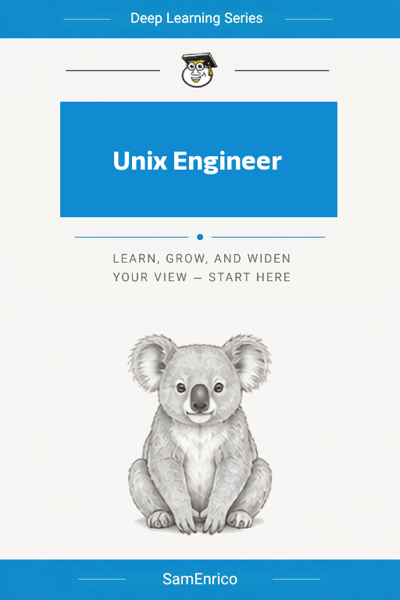
Non-FictionInformativeEducational
Unix Engineer eBook
A Coursebook on Unix Engineer
A Coursebook on Unix Engineer
Formats
Free sample
Chapter 1: The Silicon Covenant...--–- You are standing in a darkened data center at 2:47 AM. The cooling fans whine in a harmonic drone that vibrates through the concrete floor. In front of you, a rack-mounted server blinks with amber warning lights—not red (catastrophic), not green (healthy), but amber. The color of ambiguity. The color of “something is wrong, but the monitoring dashboard says everything is fine.”The server is running.
It is responding to ping. SSH accepts your connection and presents a login prompt. By every superficial metric, this machine is alive. Yet the application it hosts—the one that processes customer payments, or patient records, or overnight batch jobs—has been silent for forty-seven minutes. Your phone buzzes.
Another alert. Another manager asking for an update. Another minute of compounding interest, literal or metaphorical, ticking upward.This is not a failure of documentation. It is not a lack of monitoring tools. You have dashboards.
You have alerts. You have a ticketing system with a well-documented runbook. What you lack is something more fundamental: the ability to look at a live, breathing Unix system and understand what it is actually doing, not what it is supposed to be doing.The junior engineers around you are Googling error messages. They are pasting log snippets into Chat GPT. They are restarting services at random, hoping that one of them will stick.
They are treating the operating system as an opaque appliance, a black box that receives inputs and produces outputs, with nothing comprehensible in between.You, after reading this chapter, will not be that engineer.Welcome to the foundational covenant of Unix engineering. Before you write a single script, before you automate a single task, before you touch Ansible or Kubernetes or any of the other thousand tools that promise to make servers “disposable,” you must first understand what a Unix system actually is. Not metaphorically. Not philosophically. Mechanically.
You must understand that every piece of information about the state of that machine—every process, every open file, every network connection, every byte of memory—is exposed somewhere in the filesystem as plain text. The kernel is not hiding from you. It cannot hide from you. The covenant is this: Unix makes everything visible. Your job is to learn to see.This chapter builds the foundation for everything that follows in this book.
The “Pets vs. Cattle” mindset introduced here will inform every automation decision in Part II. The hardware-versus-OS diagnostic framework will save you hours of fruitless debugging. The tour of the Filesystem Hierarchy Standard will transform /proc from a mysterious directory into a diagnostic toolkit. And the first simple pipeline—echo "hello" | wc -c—will plant the seed for the shell mastery that Chapter 2 will cultivate into full fluency.By the end of this chapter, you will not be a Unix engineer.
That takes the whole book. But you will no longer be a passenger. You will be someone who can look at an amber light, open a terminal, and begin to ask the right questions.The Abstraction Lie (And Why It Saves You)Every operating system is a lie. A beautiful, necessary, productivity-enhancing lie, but a lie nonetheless.Your computer does not have “files.” It has sectors and blocks and inodes and pointers scattered across a spinning platter or floating transistors in a NAND chip. Your computer does not have “processes.” It has interrupt handlers and scheduler ticks and memory pages that get swapped to disk and back again.
Your computer does not have a “network connection.” It has voltage levels on twisted-pair copper or modulated radio frequencies, packets fragmenting and reassembling, retransmissions and congestion windows and checksums that may or may not match.The operating system’s single greatest achievement is that you do not have to care about any of that.This is called abstraction. The kernel presents a simplified, uniform interface to hardware, allowing you to read a file from an NVMe drive using the same system calls you would use to read from a serial port or a network socket. The kernel lies to you—or rather, it makes a promise that the underlying complexity will not leak through unless something goes terribly wrong.Most of the time, the abstraction holds. You call read() on a file descriptor, and bytes come back. You call write(), and bytes disappear toward their destination.
You do not need to know about the DMA controller or the interrupt request line or the bus topology. This is good. This is progress.But for a Unix engineer, the abstraction is also a trap.When something goes wrong—when the disk says “no space left” but df claims there is space, when a process refuses to die even after kill -9, when a network connection hangs in SYN_SENT for hours—the abstraction leaks like a sieve. The polite fiction that everything is a file breaks down, and you are left staring at the raw machinery.The difference between a user and an engineer is not that the engineer understands every layer of abstraction at all times. That is impossible.
The difference is that the engineer knows where the abstraction leaks and has the tools to look underneath when it does.The Three Tenets of the Unix Philosophy In the late 1960s and early 1970s, at Bell Labs, Ken Thompson and Dennis Ritchie were building an operating system that would eventually become Unix. They had constraints that modern developers cannot imagine: limited memory, slow processors, expensive storage, and a team of exactly a few people. They could not afford monolithic programs that did everything. They could not afford redundant code. They could not afford complexity for its own sake.Out of these constraints emerged a philosophy.
Later codified by Doug Mc Ilroy, then popularized by Peter Salus and Mike Gancarz, the Unix philosophy can be distilled into three core tenets that will guide everything you do as an engineer:Tenet One: Write programs that do one thing and do it well.A Unix program should have a single responsibility. grep searches for patterns. awk processes columns. sed transforms streams. sort orders lines.
None of these programs tries to do the job of the others. This is not a limitation—it is a superpower. Because when each tool does exactly one thing perfectly, you can combine them to do anything.Tenet Two: Expect the output of every program to become the input of another.This is the pipe. The vertical bar character (|) is the most important single character in the Unix command line. It takes the standard output of the program on the left and feeds it as standard input to the program on the right.
No intermediate files. No temporary storage. Just a stream of bytes flowing from one tool to the next, transformed at each stage.This chapter introduces the pipe conceptually with a trivial example: echo "hello" | wc -c. The echo command writes “hello” (plus a newline) to standard output. The pipe captures that output and sends it to wc -c, which counts bytes.
The result, on most systems, is 6—five letters and one newline. This is not yet impressive. But it is the seed of everything that…
This is the end of the free sample. Get the eBook to keep going. Buy now
About this book
Details
- Author
- Dorman Erminia
- Publisher
- SamEnrico
- Language
- English
- Genre
- Non-Fiction, Informative, Educational
- Released
- 2026-06-02
- Pages (approx.)
- 146
- Available as
- eBook, Audiobook

Read better in the ZLOADR app
Your eBooks on your phone or tablet. Sign in with your SamEnrico account and start reading.
More by Dorman Erminia
 Operation Drumbeat ExplainedDorman Erminia$11.99
 The Behavioral Addiction CBT GuideDorman Erminia$11.99
 Spirituality And Senior Self EsteemDorman Erminia$11.99
 Values Based Life HandbookDorman Erminia$11.99
 The Breast Cancer Caregiver GuideDorman Erminia$11.99
 The Sleep Experiment: How the CIA Tried to Erase a Man's MemoryDorman Erminia$11.99
 Installment Sale to Intentionally Defective Grantor TrustDorman Erminia$12.99
 Crop Insurance Climate RiskDorman Erminia$12.99
 How to Become a Police-academy InstructorDorman Erminia$11.99
 Understanding Spasticity Multiple ExostosesDorman Erminia$17.99
You may also like
 Hong Kong Handover 1997Dunn Johnnie$11.99
 Zumba For Postnatal Recovery CourseNeal Christian$11.99
 Zumba for BeginnersLadner Nikia$11.99
 YouTube Comment Mining GuideHumes Pandora$12.99
 Worry Box MeditationCarlin Rudy$11.99
 Workplace Stress MeditationNguyen Lynn$11.99
 Workplace Stress and Sleep RepairHawley Ivory$11.99
 Workplace Perfectionism CureDelaney Jeffry$11.99
 Workplace Injustice Anger GuideWallen Isabelle$11.99
 Work Addiction and Burnout LinkGreenwood Ester$11.99
 Women in Yoga and WellnessBeattie Galina$11.99
 Women in Stand Up ComedyChun Evangeline$11.99