
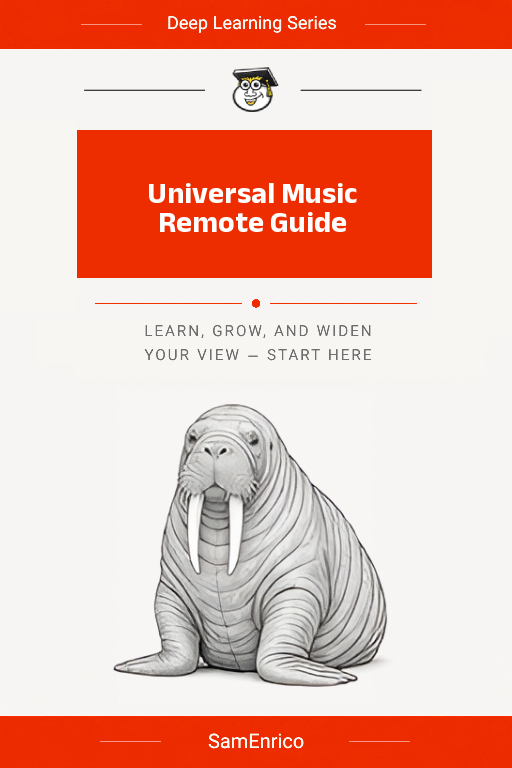
Non-FictionStudent's ShortcutMusic
Universal Music Remote Guide eBook
Apply for remote internships at Universal Music Gr
Apply for remote internships at Universal Music Group in artist development or label operations.
Formats
Free sample
Chapter 1: The Invisible Application...--The rejection arrived at 9:47 AM on a Tuesday. No name, no feedback, no human signature – just an automated email from a do-not-reply address telling you that after careful consideration, Universal Music Group had decided to move forward with other candidates. You read it three times, hoping you had missed a sentence somewhere, a hint of encouragement, a "but we'll keep your resume on file." There was nothing. Just the cold finality of a form letter.You weren't alone. Last year, Universal Music Group received over 120,000 applications for approximately 400 internship positions across its global operations.
That is a 0.33% acceptance rate – more competitive than Harvard, Yale, or Stanford. For remote-specific roles, the ratio was even steeper. The °1824 division alone received over 15,000 applications for 35 spots in its most recent cycle. Those are not encouraging numbers.But here is what the data also shows: nearly 90% of those rejected applicants made the same three mistakes. They applied through the portal and stopped there.
They submitted generic cover letters that could have been sent to any label. And most critically, they assumed their application would be read by a human being who would infer their passion, their taste, and their potential from a standard resume format designed for corporate jobs, not creative ones.This book exists because that assumption is wrong.The music industry has changed more in the last five years than it did in the previous thirty. Streaming platforms replaced radio as the primary discovery engine. Tik Tok became the new A&R department. And remote work, once unthinkable for a business built on relationships and late nights in studios, became not just possible but preferred for entire categories of roles.
Universal Music Group, the largest music company in the world, now hires interns who have never set foot in an office. They hire from Boise and Birmingham and Biloxi. They hire people who built their portfolios on Notion instead of their parents' basements. They hire people who figured out what this chapter is about to teach you: that the application you submit through the portal is not the application that gets you hired.The real application is invisible.It lives in the portfolio you build before you apply. It lives in the social media presence you curate six months before the internship posting goes live.
It lives in the network you cultivate without ever sending a cold email that begins with "I'm reaching out because." And it lives in the video you record not as a replacement for your cover letter, but as the evidence that you understand something most applicants never will: that remote creative work is not about where you are, but about what you can prove.This chapter is called The Invisible Application because that is the single most important concept you will learn from this book. Every chapter that follows – from decoding UMG's labyrinthine job portal to building a Weekly Wrap that makes your manager wonder how they ever functioned without you – is built on this foundation. But before we get to tactics, templates, and timelines, you need to understand why the old rules of applying no longer apply, and what has replaced them.Let us start with the problem.The Portal Is a Lie The Universal Music Group career portal – umusiccareers.com – looks like a solution. It presents itself as the front door to the company, the official channel through which all candidates must pass. And technically, that is true.
You will need to submit an application through that portal to be considered for any internship. But here is what the portal does not tell you: by the time your application reaches a human being, it has already been filtered, scored, and partially discarded by an Applicant Tracking System (ATS) that has no understanding of creativity, no appreciation for taste, and no ability to recognize potential.ATS software scans resumes for keywords, formatting, and structural consistency. It rejects resumes that use columns, tables, or images. It penalizes creative job titles like "Playlist Alchemist" in favor of standardized terms like "Playlist Curator." It looks for specific phrases pulled directly from the job description. And if your resume fails this automated triage, no human being will ever see it.This is the first reason the visible application fails.
You are not writing for a recruiter. You are writing for a piece of software that has never listened to a song for pleasure.The second reason is volume. A single remote internship posting at UMG can receive two thousand applications in forty-eight hours. Even if the ATS passes twenty percent of those to a human recruiter, that is four hundred resumes to review. The recruiter will spend an average of six seconds on each one.
Six seconds to decide whether you move forward or join the rejection pile.In six seconds, a recruiter cannot read your carefully crafted paragraphs about your passion for music. They cannot appreciate the nuance of your cover letter's third paragraph. They can, however, register whether your resume makes an immediate visual impact, whether your portfolio link is prominently displayed, and whether your opening bullet points demonstrate specific, quantifiable results rather than vague responsibilities.The third reason is the most painful: the portal is designed to protect the company from liability, not to discover talent. Every question, every required field, every character limit exists to create a standardized, auditable, legally defensible hiring process. That is not cynicism – that is the reality of corporate human resources.
The portal is not your enemy, but it is not your ally either. It is a filter. And you need to understand exactly how it filters so you can build an application that passes through it without being stripped of everything that makes you interesting.The Shift No One Told You About Between 2020 and 2024, the music industry added over 80,000 remote and hybrid jobs that did not exist before the pandemic. Universal Music Group, initially resistant to distributed work, discovered that certain functions actually performed better remotely. Playlist curation, streaming analytics, digital marketing, creative operations, and trend research – these roles require deep focus, data analysis, and asynchronous collaboration.
None of them require a desk in Santa Monica.The °1824 division, UMG's internal creative solutions team, was built from the ground up as a remote-first operation. They recruit young people from across the country, not because they want to save money on office space, but because they believe that cultural insights come from everywhere, not just the coastal music hubs. An intern in Tulsa might be the first person to notice a new rap scene emerging in Oklahoma City. A student in Ohio might spot a Tik Tok trend three days before it reaches Los Angeles. Geographic diversity is not a diversity initiative for °1824 – it is a strategic advantage.This shift created a paradox.
The barriers to entry – the requirement that you live in New York, Los Angeles, or Nashville – have crumbled. But new barriers have risen in their place. You no longer need to be in the right city, but you do need to demonstrate that you can do the work without someone looking over your shoulder. You no longer need expensive internships that only wealthy families could…
This is the end of the free sample. Get the eBook to keep going. Buy now
About this book
Details
- Author
- Smoot Cassondra
- Publisher
- SamEnrico
- Language
- English
- Genre
- Non-Fiction, Student's Shortcut, Music
- Released
- 2026-05-30
- Pages (approx.)
- 134
- Available as
- eBook, Audiobook

Read better in the ZLOADR app
Your eBooks on your phone or tablet. Sign in with your SamEnrico account and start reading.
More by Smoot Cassondra
 Staffing Agency Transaction AnalysisSmoot Cassondra$11.99
 183 Day Rule AvoidingSmoot Cassondra$11.99
 Engineers Guide to Creative ThinkingSmoot Cassondra$11.99
 Arnold Palmer Army StorySmoot Cassondra$11.99
 The Amazon Forest VictimSmoot Cassondra$11.99
 Innocence Project Identification CasesSmoot Cassondra$11.99
 Alcohol and Cancer RiskSmoot Cassondra$11.99
 Checking OCD GuideSmoot Cassondra$11.99
 The Great Bitcoin Heist: How a Rogue Trader Bankrupted Mt. GoxSmoot Cassondra$11.99
 The King and the Crown: The Divorce That Shook Middle Eastern FootballSmoot Cassondra$11.99
 How to Produce a Hot PlateSmoot Cassondra$11.99
 A Collector's Handbook to the Ford Zodiac Ii 206eSmoot Cassondra$11.99
You may also like
 Hong Kong Handover 1997Dunn Johnnie$11.99
 Zumba For Postnatal Recovery CourseNeal Christian$11.99
 Zumba for BeginnersLadner Nikia$11.99
 YouTube Comment Mining GuideHumes Pandora$12.99
 Worry Box MeditationCarlin Rudy$11.99
 Workplace Stress MeditationNguyen Lynn$11.99
 Workplace Stress and Sleep RepairHawley Ivory$11.99
 Workplace Perfectionism CureDelaney Jeffry$11.99
 Workplace Injustice Anger GuideWallen Isabelle$11.99
 Work Addiction and Burnout LinkGreenwood Ester$11.99
 Women in Yoga and WellnessBeattie Galina$11.99
 Women in Stand Up ComedyChun Evangeline$11.99