
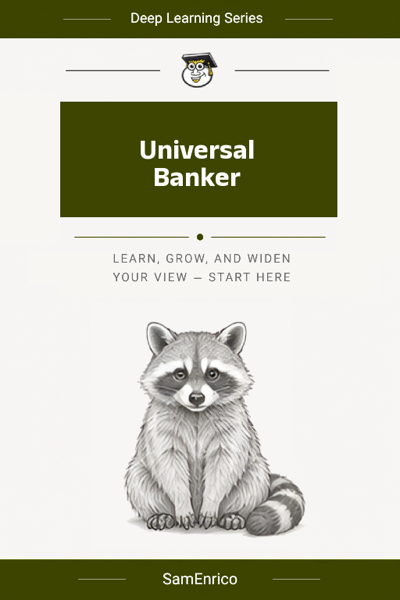
Non-FictionInformativeEducational
Universal Banker eBook
A Coursebook on Universal Banker
A Coursebook on Universal Banker
Formats
Free sample
Chapter 1: The Teller’s Funeral...--The first time Maria saw the email, she almost deleted it as spam. The subject line read: “Your Role Is Changing — Mandatory Training.” Maria had been a teller at First Community Bank for fifteen years. She knew where the old cash vault stuck (the third drawer from the left), knew which customers wanted their receipts folded (Mr. Henderson, every Tuesday), and knew that she could balance her drawer to the penny faster than anyone on her shift. She was good at her job.
But on that Tuesday morning in October, her manager, Derek, called her into the small conference room — the one with the flickering fluorescent light and the coffee stain shaped like Ohio on the carpet.“Maria, have a seat,” Derek said, not looking up from his tablet.Maria sat. She had seen this movie before. Two tellers from the downtown branch had been called into similar meetings last spring. They now worked at a car dealership and a dental office.“We’re eliminating the teller position at this branch,” Derek said. “Effective in sixty days.”The room did not spin.
The flickering light did not suddenly fix itself. Maria simply felt the floor drop out from under her, that sensation of falling that happens entirely inside your chest.“But,” Derek continued, finally looking up, “we are creating a new role. Universal Banker. And we want you to be the first one trained for it.”Maria blinked. “What’s a Universal Banker?”Derek smiled.
“It’s the job that’s going to save your career — if you’re willing to learn it.”What Maria did not know that morning — what she would discover over the next six months — was that the death of the traditional teller line was not a tragedy. It was an opportunity. The banks that figured this out would thrive. The tellers who figured it out would double their income, build real careers, and never worry about automation replacing them. The ones who didn’t would be left behind, cashed out like a forgotten savings account from the 1980s.This chapter is about why that email arrived in Maria’s inbox — and in millions of inboxes just like hers across the country.
It is about the quiet funeral of the old way of banking and the explosive birth of something new. By the end of this chapter, you will understand not only why the Universal Banker model is inevitable, but also why it is the single best career move you can make in retail banking today.The Graveyard Shift: What Happened to the Teller Line Let us begin with a number that should terrify anyone who still believes the old model works: forty-seven percent.According to data from the Federal Reserve and several major banking studies, branch foot traffic has declined by an average of 47 percent over the past decade. In some urban markets, the drop is closer to 60 percent. The reasons are not mysterious. The smartphone in your pocket can now do what used to require a ten-minute wait in line, a signature card, and a handshake with a teller named Carol.
Mobile check deposit alone has eliminated billions of branch visits. You can deposit a check at 11 PM in your pajamas. Why would you drive across town to do it at 11 AM in business casual?But foot traffic is only the headline. The real story is underwater, where the currents are stronger.Margins have collapsed. For decades, banks made money the old-fashioned way: take deposits at near-zero interest (or, in the old days, actually zero), lend those deposits out at five, six, seven percent, and pocket the difference.
That spread — the net interest margin — was the lifeblood of retail banking. In the 1990s and early 2000s, a healthy bank might enjoy a margin of four to five percent. Today, after years of near-zero interest rates from the Federal Reserve, followed by rapid increases that crushed bond values, the average net interest margin for community and regional banks hovers between 2.5 and 3.2 percent. That does not sound like a small difference, but in banking, basis points are everything. A one percent drop in margin on a billion dollars in deposits is ten million dollars in lost revenue.
Every. Single. Year.When margins shrink, banks do two things. First, they raise fees — overdraft fees, monthly maintenance fees, ATM fees, paper statement fees. (You have noticed this.
Everyone has noticed this.) Second, they cut costs. And the single largest variable cost in retail banking, after real estate, is people.For decades, the teller line was considered untouchable. You could not run a branch without warm bodies smiling at customers and counting cash. But then two things happened simultaneously. First, the cash recycler — a machine that counts, dispenses, and secures cash automatically — became affordable for even small community banks.
A cash recycler costs about 15,000to15,000 to 15,000to25,000 per unit, less than the annual salary of one full-time teller, and it never calls in sick, never takes a lunch break, and never makes a counting error. Second, the Interactive Teller Machine (ITM) — an ATM with a live video screen that connects to a remote banker — made it possible for a single employee in a central location to handle the transactions of ten branches simultaneously.The math became brutal and undeniable. A branch with four tellers and two platform bankers (the people who open accounts and take loan applications) cost the bank approximately 400,000peryearinsalariesandbenefitsalone,notcountingthespace,thecomputers,thetraining,andtheturnovercosts.Thatsamebranch,convertedtoapodofthree Universal Bankersrotatingbetweenteller,greeter,andplatformduties,costabout400,000 per year in salaries and benefits alone, not counting the space, the computers, the training, and the turnover costs. That same branch, converted to a pod of three Universal Bankers rotating between teller, greeter, and platform duties, cost about 400,000peryearinsalariesandbenefitsalone,notcountingthespace,thecomputers,thetraining,andtheturnovercosts.Thatsamebranch,convertedtoapodofthree Universal Bankersrotatingbetweenteller,greeter,andplatformduties,costabout225,000 — and generated more revenue because every single employee was trained to sell, not just process.The teller line, as a separate species of bank employee, was headed for extinction. The only question was how fast.The Birth of the Universal Banker: A Solution in Search of a Problem The Universal Banker model did not emerge from a single moment of genius.
It evolved over about fifteen years, driven by a handful of banks that were willing to experiment when their competitors were not.The earliest adopters were credit unions, which have always been more agile than banks due to their cooperative structure and exemption from some federal taxes that burden traditional banks. Credit unions began cross-training their front-line staff in the early 2000s, long before the term "Universal Banker" entered the industry lexicon. They called them "member service representatives" and gave them the authority to open accounts, process deposits, and even approve small loans — all at the same desk. The results were immediate: shorter wait times, higher member satisfaction, and dramatically lower labor costs per transaction.Big banks noticed. But big banks are like aircraft carriers — they turn slowly, with great expense and great resistance from entrenched departments.
The teller managers did not want to give up their territory. The platform managers did not want to share their commission plans. The compliance department worried about liability. For years, the Universal…
This is the end of the free sample. Get the eBook to keep going. Buy now
About this book
Details
- Author
- Keaton Stanton
- Publisher
- SamEnrico
- Language
- English
- Genre
- Non-Fiction, Informative, Educational
- Released
- 2026-05-11
- Pages (approx.)
- 154
- Available as
- eBook, Audiobook

Read better in the ZLOADR app
Your eBooks on your phone or tablet. Sign in with your SamEnrico account and start reading.
More by Keaton Stanton
 Treasure Finding Dream Symbols WorkbookKeaton Stanton$11.99
 Assertiveness Practice JournalKeaton Stanton$11.99
 OKRs for Philanthropy GoalsKeaton Stanton$11.99
 Cocaine Sleep Repair ProtocolKeaton Stanton$11.99
 Lawyers and Judges in Alcohol RecoveryKeaton Stanton$11.99
 The Visionary Streets of L’Enfant: Designing the American CapitalKeaton Stanton$11.99
 Understanding Immunodeficiency, PrimaryKeaton Stanton$17.99
 Stakeholder Silence BreakerKeaton Stanton$12.99
 Farm Revenue Optimization AIKeaton Stanton$12.99
 How to Start a Brine Production Business (Beginners Guide)Keaton Stanton$11.99
You may also like
 Hong Kong Handover 1997Dunn Johnnie$11.99
 Zumba For Postnatal Recovery CourseNeal Christian$11.99
 Zumba for BeginnersLadner Nikia$11.99
 YouTube Comment Mining GuideHumes Pandora$12.99
 Worry Box MeditationCarlin Rudy$11.99
 Workplace Stress MeditationNguyen Lynn$11.99
 Workplace Stress and Sleep RepairHawley Ivory$11.99
 Workplace Perfectionism CureDelaney Jeffry$11.99
 Workplace Injustice Anger GuideWallen Isabelle$11.99
 Work Addiction and Burnout LinkGreenwood Ester$11.99
 Women in Yoga and WellnessBeattie Galina$11.99
 Women in Stand Up ComedyChun Evangeline$11.99