
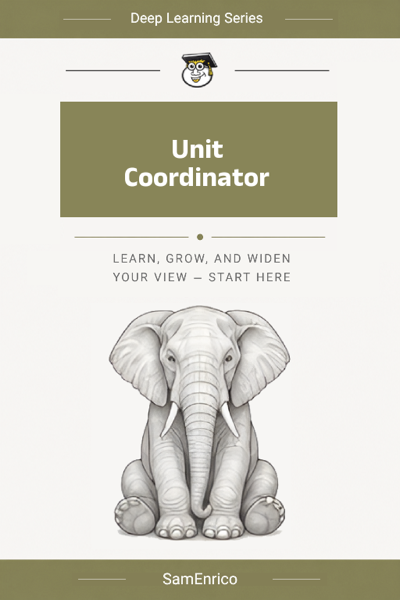
Unit Coordinator eBook
A Coursebook on Unit Coordinator
by Chong Freddy
A Coursebook on Unit Coordinator
Formats
Free sample
Chapter 1: The $50,000 Secret...--Most people walk past the nursing station without a second glance. They see a desk, some computers, a few people on telephones. They have no idea that behind that cluttered counter sits one of the most misunderstood, underappreciated, and financially rewarding entry points in modern healthcare.You are about to learn a secret that most career counselors do not know, that few hospital administrators will admit, and that virtually no guidance counselor ever mentions to high school students. The secret is this: You do not need a medical degree to be indispensable in a hospital. You do not need to clean wounds, start IVs, or lift patients.
You need to be organized, detail-obsessed, and calm under pressure. And if you develop those skills, hospitals will pay you a middle-class wage, offer you benefits, and promote you into careers that most people assume require a college diploma.This chapter will tell you everything you need to know about why the Unit Coordinator exists, why hospitals are desperate for you right now, and how you can claim this career without student debt, without prior experience, and without waiting for permission.The Most Important Person on the Floor Every hospital floor has a rhythm. It starts early, usually around 6:45 AM, when the night shift is tired and the day shift is caffeinating. The charge nurse reviews the patient assignment. The nursing assistants check vital signs.
The physicians arrive for morning rounds, clutching printed lists or staring at tablets. And behind it all, sitting at the desk that faces the hallway, is the Unit Coordinator.Ask a doctor who runs the floor, and they will say the charge nurse. Ask a nurse who runs the floor, and they will say no one. But ask anyone who has worked in a hospital for more than six months, and they will point to the same person. The Unit Coordinator does not have a clinical license.
The Unit Coordinator does not have a fancy title. But the Unit Coordinator knows where every order is, which patient is moving to which room, when transport is coming, and why the lab result for room 312 has not appeared yet.In the chaos of a hospital, information is more valuable than almost anything else. A surgeon with perfect hands cannot operate without a consent form. A nurse with twenty years of experience cannot medicate without an order. A pharmacist with a doctorate cannot dispense without a verification.
The Unit Coordinator is the person who ensures that the information flows to the right place at the right time. And when that happens, patients live. When it fails, patients suffer.This is not hyperbole. The Joint Commission, which accredits hospitals across the United States, has repeatedly identified communication failures as the leading root cause of sentinel events—unexpected patient deaths or serious injuries. Not incompetent doctors.
Not faulty equipment. Communication failures. An order that was written but never seen. A lab result that was called but never documented. A transfer that was ordered but never communicated to the receiving floor.
A discharge that was completed but never reported to the primary care physician.Every single one of those failures could have been prevented by a skilled Unit Coordinator.From Ward Clerk to Information Manager The role has existed in some form since hospitals became complex organizations. In the early twentieth century, the job was called "ward clerk" or "floor secretary," and it involved typing, filing, and answering telephones. The work was clerical, repetitive, and low-paid. A ward clerk was expected to be fast with a typewriter and pleasant on the phone. Nothing more.The transformation began in the 1970s, as hospital care became more specialized and the volume of paperwork exploded.
Medicare introduced prospective payment systems. Insurance companies demanded more documentation. Regulatory agencies required more forms. Suddenly, nurses were spending hours on paperwork instead of at the bedside. Nursing leaders recognized the problem: asking a highly trained clinical professional to fill out forms and call the lab was a catastrophic waste of talent.The solution was to professionalize the ward clerk role.
Hospitals began calling the position "Health Unit Coordinator" or "Unit Secretary" and expanding the responsibilities. Instead of just typing and filing, Unit Coordinators were trained to interpret medical terminology, transcribe physician orders, and manage the flow of diagnostic tests. The job was no longer clerical. It was informational.The digital revolution accelerated this transformation. Electronic Medical Records (EMRs) did not eliminate the need for Unit Coordinators.
They changed it. Instead of filing paper charts, modern UCs navigate complex software systems, validate orders entered by physicians, and troubleshoot the inevitable glitches that occur when digital systems fail. The job now requires critical thinking, not just typing speed.Yet despite this professionalization, the role remains remarkably unknown. Most people have never heard of a Unit Coordinator. Career websites rarely mention it.
High school counselors do not recommend it. This obscurity is your advantage. While thousands of people compete for every nursing school slot, the Unit Coordinator career path remains wide open.The Post-COVID Desperation The COVID-19 pandemic did something unexpected to hospital staffing. It did not just burn out nurses, though it certainly did that. It exposed how dependent hospitals had become on a fragile workforce that was already stretched thin before the crisis began.During the pandemic, nurses who left the bedside did not return.
Some retired early. Some moved to outpatient clinics. Some left healthcare entirely. Those who remained were asked to do more with less. And one of the first things that fell away was clerical work.
Nurses stopped answering phones. They stopped calling the lab. They stopped tracking down transport. They stopped doing anything that was not directly related to patient care.Hospital administrators watched this happen and drew a simple conclusion: They could not ask nurses to do clerical work anymore. Not because nurses were unwilling, but because nurses were unhirable.
The labor market had shifted. If a hospital wanted to attract and retain nurses, it had to protect their time. Every hour a nurse spent on a telephone was an hour they were not doing clinical work. And clinical work was the only work that required a nursing license.This realization triggered a wave of investment in Unit Coordinator positions. Hospitals that had previously treated UCs as low-wage clerks suddenly saw them as essential infrastructure.
They raised pay. They added benefits. They created career ladders. They started recruiting candidates with no experience and training them internally.The timing could not be better for you. By the time you finish this book, the pandemic-era hiring surge will still be underway.
Hospitals are competing for talent in ways they never did before. Signing bonuses for Unit Coordinators are becoming common. Shift differentials for nights and weekends are rising. And the supply of qualified candidates remains stubbornly low.What You Will Earn Let us talk about numbers. Vague promises about "good pay" are meaningless.
You need specific, verifiable figures that you can take to a bank or repeat in a salary negotiation.According to data from the Bureau of Labor Statistics, the median annual wage for medical secretaries and administrative assistants—the category that includes Unit Coordinators—was approximately 38,000inrecentyears.Butthatmedianmasksenormousvariation.Entry−levelpositionsinruralareasmaystartat38,000…
This is the end of the free sample. Get the eBook to keep going. Buy now
About this book
Details
- Author
- Chong Freddy
- Publisher
- SamEnrico
- Language
- English
- Genre
- Non-Fiction, Informative, Educational
- Released
- 2026-05-11
- Pages (approx.)
- 153
- Available as
- eBook, Audiobook

Read better in the ZLOADR app
Your eBooks on your phone or tablet. Sign in with your SamEnrico account and start reading.
More by Chong Freddy
 Emotional Intelligence Self CareChong Freddy$11.99
 The Caregiver Lung Disease GuideChong Freddy$11.99
 Legal Career Failure FearChong Freddy$11.99
 Carson Editor Relationship Memoir GuideChong Freddy$11.99
 Anticholinergic Medications Cognitive RiskChong Freddy$11.99
 Frostbound: The Troll Queen’s GambitChong Freddy$11.99
 Frozen Secrets: The Forgotten Antarctic Explorers of the Age of DiscoveryChong Freddy$11.99
 Understanding Follicular LymphoreticulomaChong Freddy$17.99
 Founder Storytelling ManualChong Freddy$12.99
 AI Cash Flow ForecastingChong Freddy$12.99