
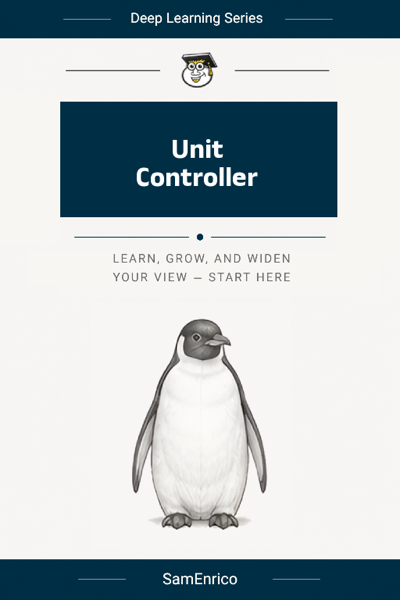
Unit Controller eBook
A Coursebook on Unit Controller
A Coursebook on Unit Controller
Formats
Free sample
Chapter 1: The Bridge Builder’s Dilemma...--The phone rang at 11:47 on a Tuesday night. On the other end was the plant manager, his voice a mixture of exhaustion and panic. "We just got the preliminary numbers," he said. "We missed the quarter by eighteen million dollars."The Unit Controller, six weeks into the role, pulled up the dashboard. Every operational metric was green.
Production volume had exceeded target by four percent. On-time delivery was ninety-six percent. Quality rejects were at an all-time low. The plant had never run better."How is that possible?" she asked."Corporate says our cost allocation changed," he replied. "The IT department restated their service charges back six months.
Something about server usage. There's nothing we can do. It's already booked."She hung up and stared at the screen. The plant had not become less efficient. No machine had broken.
No worker had slowed. No customer had complained. And yet, according to the financial system, the plant had destroyed eighteen million dollars of shareholder value.This is the bridge builder's dilemma.The Unit Controller sits at the most vulnerable intersection in any organization: between the operational reality of what actually happens on the ground and the financial abstraction of how that reality appears on a spreadsheet. When those two realities diverge—and they diverge more often than anyone wants to admit—the Unit Controller is the one who must explain why. Not the plant manager, who will point to the green operational metrics.
Not the CFO, who will point to the red financial statements. The Unit Controller stands in the middle, one foot in the world of things and people, the other foot in the world of numbers and reports, and must make them tell the same story.Most people who hold this title do not understand that this is their job. They think they are accountants who happen to work in a specific location. They think their value lies in closing the books faster, formatting reports more cleanly, or catching transposition errors before the CFO sees them. These are necessary skills, but they are not the essence of the role.
The essence is building and maintaining a bridge between two worlds that naturally want to drift apart.This chapter establishes the fundamental architecture of that bridge. It defines the three levels of organizational direction, situates the Unit Controller within that framework, introduces the principle of goal congruence as the bridge's structural integrity, and closes with a warning that will echo through every subsequent chapter: without a functioning bridge, the smartest people in the organization will make the dumbest collective decisions, and the Unit Controller will be blamed for all of them.The Three Levels of Organizational Direction Every organization of any size engages in three distinct types of activity, each with a different time horizon, different decision-makers, and different information requirements. Confusing these levels is the single most common source of control failures. The Unit Controller's first duty is to understand which level they are operating in at any given moment and to speak the appropriate language for that level.Strategic Planning: The What and Why Strategic planning answers two questions: "What business should we be in?" and "What should we stop doing?" This is the domain of the C-suite—the CEO, CFO, COO, and Board of Directors—along with corporate strategy teams. Strategic planning horizons typically span three to ten years.
The outputs are decisions about entering or exiting markets, acquiring or divesting business units, launching or killing product lines, and allocating capital across competing investment opportunities.Strategic planning is characterized by high uncertainty, low precision, and enormous consequence. A strategic decision to enter the Chinese market might involve hundreds of millions of dollars of investment based on forecasts that are at best educated guesses. A strategic decision to exit a product line might strand millions of dollars of inventory and trigger layoffs. Because the stakes are high and the data is uncertain, strategic planning relies heavily on judgment, experience, and debate.Importantly for the Unit Controller, strategic planning is not where most management control systems operate. The Controller does not design controls for the Board's strategic retreat.
The Controller does not build variance reports for the CEO's five-year plan. Strategic planning is intentionally loose, flexible, and qualitative. Attempting to apply tight management controls at the strategic level strangles the very debate and exploration that strategy requires.Operational Control: The How Operational control answers the question: "Are we performing individual tasks correctly, safely, and efficiently?" This is the domain of frontline supervisors, team leads, and individual workers. Operational control horizons span hours, days, and weeks. The outputs are specific: did the machine produce at the rated speed?
Did the customer service representative follow the call script? Did the warehouse picker select the correct item? Did the nurse administer the medication at the correct time?Operational control is characterized by low uncertainty, high precision, and immediate consequence. A machine that runs too slow reduces today's output. A call that deviates from the script might violate compliance.
A mis-picked item reaches the wrong customer tomorrow. Because the tasks are well-understood and repeatable, operational controls can be—and should be—tight, specific, and automated where possible.Operational control is not where the Unit Controller spends most of their time either. The Controller does not stand on the factory floor with a stopwatch. The Controller does not listen to recorded customer calls for script compliance. Those are the jobs of production supervisors and quality assurance teams.
However, the Unit Controller must understand operational controls well enough to know when they are working and when they are failing—because operational failures eventually become financial failures.Management Control: The Bridge Itself Management control answers the question that neither strategic planning nor operational control can answer on their own: "Are we using organizational resources efficiently to execute the approved strategy?" This is the exclusive domain of the Unit Controller. Management control horizons span months and quarters. The outputs are budgets, forecasts, variance analyses, performance scorecards, incentive systems, and the entire apparatus of financial accountability.Management control is characterized by moderate uncertainty, moderate precision, and distributed consequence. Unlike strategic planning, management control operates on a time horizon where events are still uncertain but within a narrower range. Unlike operational control, management control aggregates across many individual tasks rather than inspecting each one.
The consequence of a management control failure is not a single mis-picked item but a systematic misallocation of resources over time.This is where the bridge is built. The Unit Controller takes the strategic plan—the Board's decision to enter the Chinese market, for example—and translates it into measurable targets for the China business unit: revenue targets, expense budgets, headcount caps, capital expenditure limits. Then, as operational results come in, the Controller aggregates those results into management reports that tell the C-suite whether the strategy is working. The China unit's revenue is growing at fifteen percent annually, but its costs are growing at twenty-five percent. The margin is compressing.
The strategy needs adjustment.Without the Unit Controller's bridge, the C-suite would have no idea whether their strategic decisions were actually being executed. They would hear only anecdotes—the one successful sales…
This is the end of the free sample. Get the eBook to keep going. Buy now
About this book
Details
- Author
- Hackett Lucretia
- Publisher
- SamEnrico
- Language
- English
- Genre
- Non-Fiction, Informative, Educational
- Released
- 2026-05-09
- Pages (approx.)
- 146
- Available as
- eBook, Audiobook

Read better in the ZLOADR app
Your eBooks on your phone or tablet. Sign in with your SamEnrico account and start reading.
More by Hackett Lucretia
 Managing Caregiver Role ReversalHackett Lucretia$11.99
 Remote Onboarding Comms GuideHackett Lucretia$11.99
 The Gambling Self Ban GuideHackett Lucretia$11.99
 The Breast Cancer Palliative GuideHackett Lucretia$11.99
 Metta For First RespondersHackett Lucretia$11.99
 The Trial of the Phantom of Buenos Aires: The Spy Who Fooled a NationHackett Lucretia$11.99
 Understanding Spasticity Mental RetardationHackett Lucretia$17.99
 Valuation Discount UpdatesHackett Lucretia$12.99
 Supply Chain Climate InsuranceHackett Lucretia$12.99
 How to Start a Civil Service College Business (Beginners Guide)Hackett Lucretia$11.99