
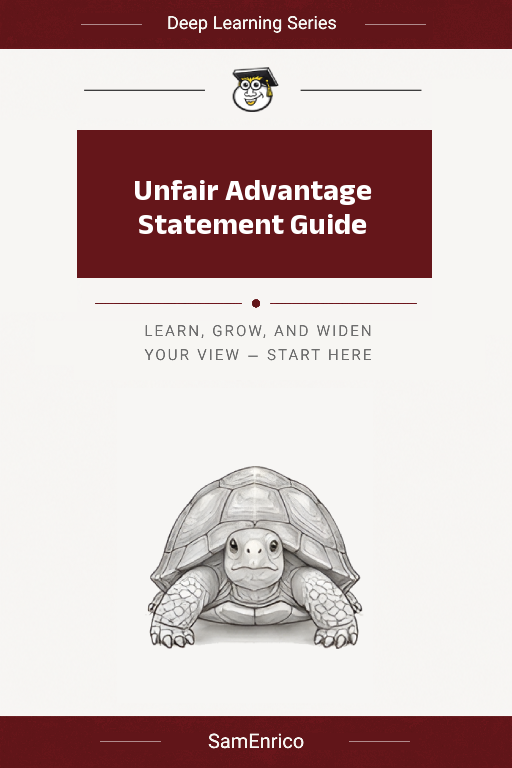
Unfair Advantage Statement Guide eBook
Articulate your unique access skills or network th
Articulate your unique access skills or network that competitors cannot easily copy or buy.
Formats
Free sample
Chapter 1: The Copycat’s Delight...--If you have ever woken up at 3:00 AM wondering how long it will take your competitors to copy your latest pricing model, feature update, or service package, you are not paranoid. You are paying attention.The uncomfortable truth is that most business advantages have a shelf life shorter than a carton of milk in a desert sun. You launch something brilliant. You celebrate. You breathe a sigh of relief.
And then, somewhere in a fluorescent-lit office across town or across the ocean, a competitor opens a spreadsheet and begins the quiet work of reverse-engineering everything you just did. Within ninety days—sometimes ninety hours—they release a copycat version. Sometimes it is worse than yours. Sometimes it is better. Often, it is just cheap enough to make your heart sink.This is the Commoditization Trap, and it has devoured more ambitious businesses than outright failure ever has.I have watched this happen dozens of times.
A software company builds a revolutionary feature. Within six months, three competitors have identical functionality listed on their pricing pages. A consulting firm develops a proprietary methodology. Within a year, every other firm in their niche has renamed and rebranded the exact same steps. A real estate agent creates a unique buyer guarantee.
Within a quarter, every agent within fifty miles has copied the language verbatim, changing only the name at the bottom.The pattern is so predictable that it has become a grim joke in boardrooms: “Innovate, differentiate, then watch Amazon steal it.” But the joke is not funny when it is your revenue on the line.Most business strategy books will tell you to solve this problem by being “better.” Better service. Better quality. Better customer experience. And they are not wrong, exactly. Being better is good.
Being better is necessary. But being better is also temporary. Being better is a race without a finish line. Because no matter how good you become, someone, somewhere, is waking up determined to be better than you by next Thursday.This book begins with a radically different premise: Stop trying to be better. Start trying to be uncopyable.The difference between “better” and “uncopyable” is not a matter of degree.
It is a matter of kind. Better is a feature war fought on ground where competitors can stand. Uncopyable is an entirely different battlefield—one where your competitors cannot even find the entrance.I learned this distinction the hard way. Early in my career, I built a small agency that did excellent work. We had glowing testimonials.
We had case studies. We had a methodology that we had trademarked and codified into a thick onboarding binder. I was proud of that binder. I slept with it under my pillow, figuratively speaking.Then a competitor hired one of my former junior employees. That employee did not steal our binder.
She did not need to. She simply remembered the steps. Within two months, that competitor had published a white paper with a methodology that was, for all practical purposes, identical to ours. They had changed the colors and the acronym. Everything else was a carbon copy.I was furious.
I was devastated. And then I was humbled, because I realized something that changed my entire professional trajectory: I had built nothing that could not be copied. I had confused “hard work” with “uniqueness.” I had confused “good” with “uncopyable.”That realization led me on a five-year journey through hundreds of businesses, thousands of conversations, and a deep immersion in the research on sustainable competitive advantage. I studied companies that had survived decades of intense competition. I interviewed salespeople who never lost a deal to price.
I analyzed professionals who commanded premium rates despite offering services that, on paper, looked identical to what their competitors offered.What I found surprised me. The uncopyable businesses were not necessarily the biggest, the richest, or the most technologically advanced. They were not even the ones with the most aggressive marketing. Instead, they shared a quiet, almost boring characteristic: their advantage was rooted in things that competitors could not reverse-engineer, could not hire their way into, and could not buy.Specifically, they had mastered one or more of what I call the Three Pillars of Unfair Access: proprietary networks (relationships built over years that could not be replicated with a CRM), insider skills (capabilities learned through rare experiences, not online courses), and scarcer experience (life or career events that shaped their judgment in ways no competitor could fake).These pillars are the foundation of everything that follows in this book. We will explore each of them in detail in Chapter 2.
But for now, I want you to understand a single, non-negotiable truth: if your advantage can be listed on a features comparison chart, it can be copied. If your advantage can be described in a job posting, it can be hired. If your advantage can be learned from a You Tube tutorial, it can be stolen.The only sustainable advantage is the advantage that lives inside your specific combination of who you know, what you have survived, and what you can do that others cannot easily learn.The Myth of the Better Mousetrap There is a famous aphorism often misattributed to Ralph Waldo Emerson: “Build a better mousetrap, and the world will beat a path to your door.” It is a beautiful sentiment. It is also almost entirely false.The world will not beat a path to your door. At best, the world will glance at your door, then glance at the three identical doors that opened last week, and then buy from whoever offers the lowest shipping cost.
The better mousetrap myth persists because it flatters our engineering instincts. We want to believe that excellence wins. And excellence does win—temporarily. But temporary winning is not the same as sustainable success.Consider the history of consumer electronics. The first company to release a digital music player was not Apple.
The first company to release a smartphone was not Apple. The first company to release a tablet computer was not Apple. Apple won not because it was first, not because it was cheapest, and not even because it was technically “best” by every engineering metric. Apple won because it built an uncopyable ecosystem of hardware, software, content licensing, and retail experience that competitors could not replicate without years of investment across multiple domains simultaneously.Notice the key phrase: multiple domains simultaneously. A single advantage is easy to copy.
A single advantage is a single point of failure. But three advantages woven together—access plus skill plus experience—become a cord that is nearly impossible to sever.Most businesses make the fatal error of building their strategy around a single, copyable advantage. They focus on price. Or they focus on speed. Or they focus on a single feature.
And then they spend their entire existence in a defensive crouch, waiting for the next competitor to match them.The alternative—the path this book will teach you—is to build your strategy around the intersection of your unique access, your rare skills, and your scarcer experiences. That intersection is the only place where true uncopyability lives.The Difference Between Superior and Uncopyable Let me…
This is the end of the free sample. Get the eBook to keep going. Buy now
About this book
Details
- Author
- Rosenthal Darrick
- Publisher
- SamEnrico
- Language
- English
- Genre
- Non-Fiction, First 30 Days
- Released
- 2026-06-01
- Pages (approx.)
- 145
- Available as
- eBook, Audiobook

Read better in the ZLOADR app
Your eBooks on your phone or tablet. Sign in with your SamEnrico account and start reading.
More by Rosenthal Darrick
 Single Person Recovery GuideRosenthal Darrick$11.99
 Gambling and Suicide RiskRosenthal Darrick$11.99
 Held at GunpointRosenthal Darrick$11.99
 Meditation For CatastrophizingRosenthal Darrick$11.99
 High Stress Survival for ParamedicsRosenthal Darrick$11.99
 Online Learning Stress GuideRosenthal Darrick$11.99
 Bankruptcy Public RelationsRosenthal Darrick$11.99
 The Mirai Botnet TakeoverRosenthal Darrick$11.99
 Hatshepsut: The Architect Queen Who Built a Legacy in StoneRosenthal Darrick$11.99
 R.K. Narayan: The Words That Painted India's SoulRosenthal Darrick$11.99
 Growing DactylisRosenthal Darrick$11.99
 The Mineral Guide to AzuriteRosenthal Darrick$11.99
You may also like
 Hong Kong Handover 1997Dunn Johnnie$11.99
 Zumba For Postnatal Recovery CourseNeal Christian$11.99
 Zumba for BeginnersLadner Nikia$11.99
 YouTube Comment Mining GuideHumes Pandora$12.99
 Worry Box MeditationCarlin Rudy$11.99
 Workplace Stress MeditationNguyen Lynn$11.99
 Workplace Stress and Sleep RepairHawley Ivory$11.99
 Workplace Perfectionism CureDelaney Jeffry$11.99
 Workplace Injustice Anger GuideWallen Isabelle$11.99
 Work Addiction and Burnout LinkGreenwood Ester$11.99
 Women in Yoga and WellnessBeattie Galina$11.99
 Women in Stand Up ComedyChun Evangeline$11.99