
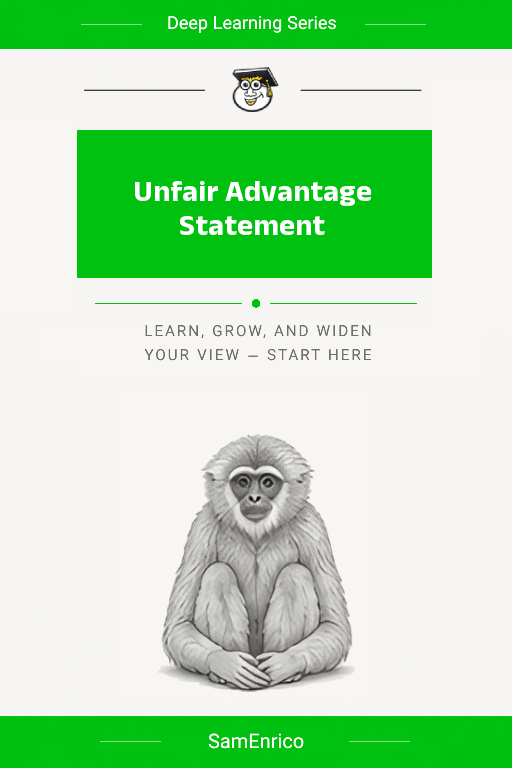
Non-FictionFirst 30 DaysAdvantageCompetitive Edge
Unfair Advantage Statement eBook
Identify what makes you uniquely capable to succee
by Warren Tracy
Identify what makes you uniquely capable to succeed.
Formats
Free sample
Chapter 1: The Fairness Delusion--–- The first time someone told me "life isn't fair," I was eight years old, standing on a soccer field with mud on my knees, having just lost a game because the other team's striker was a full head taller than anyone on our side. My coach patted my shoulder and muttered those four words like they were supposed to make me feel better. They didn't. They made me furious. But here's what took me another twenty years to understand: that anger wasn't useless.
It was misdirected. I wasn't angry because life was unfair. I was angry because I had been taught to expect fairness, and that expectation was the real lie.Every successful person I have ever met—founders, executives, artists, athletes—shares one uncomfortable trait. They stopped believing in the level playing field. Not because they became cynical, but because they became observant.
They noticed that the people winning around them weren't necessarily the hardest workers, the smartest people, or the most deserving by any moral metric. They were the people who had something the others didn't, whether they earned it or not. And instead of resenting that fact, they asked a different question: "What do I have that others don't, and how do I use it?"This chapter is not a pep talk. It is not going to tell you that you can do anything you set your mind to, because that statement is demonstrably false. You cannot do anything.
Neither can I. Neither can anyone. What you can do is identify what you uniquely possess—by birth, by accident, by effort, or by sheer luck—and deploy that asset strategically in a game where most people are still playing by rules that don't exist.We are going to dismantle the myth of meritocracy, expose the hidden cost of playing fair, and introduce the single most important tool you will ever own: your Unfair Advantage Statement. By the end of this chapter, you will stop asking "How can I earn this fairly?" and start asking "What do I have that others don't, and how can I use it legally and ethically to win?"The Meritocracy Myth Let me start with a confession. I used to believe in meritocracy the way people believe in gravity—as an unassailable law of nature.
Work hard. Play fair. Follow the rules. Your rewards will come. This belief is not just naive.
It is actively harmful because it blinds you to the actual mechanics of success.Consider the data. Research from Northwestern University's Kellogg School of Management followed thousands of entrepreneurs over a decade and found that the single strongest predictor of startup success was not intelligence, not work ethic, not even the quality of the idea. It was the founder's access to a network of mentors who had previously built successful companies. That network was almost never earned by the founder in the present moment. It was inherited, borrowed, or stumbled upon through circumstances that had nothing to do with merit.Or consider the famous study by economists Raj Chetty and his colleagues at Harvard, which tracked millions of inventors in the United States.
They found that a child's likelihood of becoming an inventor was massively predicted by whether they grew up in a neighborhood with other inventors—not because of genetics, but because of exposure. A child who lived near a patent-holding family was significantly more likely to file patents themselves, regardless of their own innate ability. The advantage was geographic and social, not personal.I am not telling you this to depress you. I am telling you this to free you. If success were purely meritocratic, you would have no choice but to grind harder than everyone else and hope for the best.
But success is not meritocratic. It is asymmetric. And asymmetry means you have options that have nothing to do with out-working anyone.Meritocracy is a beautiful ideal. It is also a lie. The sooner you stop expecting the world to be fair, the sooner you can start playing the game that actually exists.The Hidden Cost of Playing Fair When you insist on playing fair, you are not being virtuous.
You are being predictable. And in any competitive environment, predictability is a death sentence.Let me give you an example. Imagine two coffee shops. Shop A roasts their own beans, sources directly from a small farm in Colombia that their owner discovered while backpacking in college, and has a lease locked in at a rate from ten years ago that no competitor could replicate today. Shop B buys commodity beans from a distributor, rents at market rate, and competes entirely on customer service and latte art.Shop B is playing fair.
They are working hard. They are doing everything right by the standards of conventional business advice. And they are losing. Not because they are worse at making coffee, but because they are playing a game Shop A already won before opening its doors. Shop A's advantages—the farm relationship, the cheap lease—had nothing to do with daily effort.
They were structural. Asymmetric. Unfair.Here is the uncomfortable truth that most self-help books will never tell you: playing fair is a tax on the ambitious. It is a set of self-imposed rules that only you are following. Your competitors, whether they admit it or not, are using every advantage they have, earned or unearned.
When you refuse to use yours, you are not being moral. You are being unarmed.I have watched talented entrepreneurs spend years trying to "earn" their way into rooms they could have entered immediately if they had simply acknowledged the advantages they already possessed. I have watched job seekers send hundreds of applications into the void while a former classmate with weaker skills but better connections walked into a dream role. I have watched artists struggle in obscurity, insisting that "the work should speak for itself," while less talented peers who understood networking and positioning built thriving careers.The common thread in all these stories is not a lack of ability. It is a refusal to accept that ability is only one variable in a multi-variable equation.
The other variables—location, lineage, timing, capital, status, and what I call serendipity surface area—are not less important. They are often more important. Ignoring them is not humility. It is strategic suicide.Asymmetry: The Only Game Worth Playing Let me introduce a concept that will run through every chapter of this book: asymmetry. In game theory, an asymmetric contest is one where players do not start with the same resources, information, or options.
Most people assume asymmetry is unfair in the pejorative sense—that it needs to be corrected. That assumption is wrong. Asymmetry is simply reality. The question is not whether you have asymmetries. The question is whether you know what they are and whether you are using them.Think about the people you know who have achieved remarkable success.
Not the ones who grinded their way to a middle-class existence, but the ones who genuinely broke through. Chances are, each of them had something that others in their field did not. Maybe they had family money that…
This is the end of the free sample. Get the eBook to keep going. Buy now
About this book
Details
- Author
- Warren Tracy
- Publisher
- SamEnrico
- Language
- English
- Genre
- Non-Fiction, First 30 Days, Advantage, Competitive Edge
- Released
- 2026-06-07
- Pages (approx.)
- 148
- Available as
- eBook, Audiobook

Read better in the ZLOADR app
Your eBooks on your phone or tablet. Sign in with your SamEnrico account and start reading.
More by Warren Tracy
 The Daily Loci Practice PlanWarren Tracy$11.99
 Emotional Intelligence Complete GuideWarren Tracy$11.99
 Spain Remote Tax GuideWarren Tracy$11.99
 Seasonal Affective SleepWarren Tracy$11.99
 Mindfulness Meditation for Imposter SyndromeWarren Tracy$11.99
 Bipolar College Student GuideWarren Tracy$11.99
 Gut Microbiome Testing GuideWarren Tracy$11.99
 Public Speaking Loci CourseWarren Tracy$11.99
 Alpha Lipoic Acid GuideWarren Tracy$11.99
 The Deep Silence: The Great Pacific Garbage Patch's Predatory EcosystemWarren Tracy$11.99
 The Billionaire’s Bargain: How a Tech Mogul Reshaped Global EducationWarren Tracy$11.99
 Enkidu's Last Stand: The Wild Man Who Tamed a GodWarren Tracy$11.99
You may also like
 Hong Kong Handover 1997Dunn Johnnie$11.99
 Zumba For Postnatal Recovery CourseNeal Christian$11.99
 Zumba for BeginnersLadner Nikia$11.99
 YouTube Comment Mining GuideHumes Pandora$12.99
 Worry Box MeditationCarlin Rudy$11.99
 Workplace Stress MeditationNguyen Lynn$11.99
 Workplace Stress and Sleep RepairHawley Ivory$11.99
 Workplace Perfectionism CureDelaney Jeffry$11.99
 Workplace Injustice Anger GuideWallen Isabelle$11.99
 Work Addiction and Burnout LinkGreenwood Ester$11.99
 Women in Yoga and WellnessBeattie Galina$11.99
 Women in Stand Up ComedyChun Evangeline$11.99