
Non-FictionSelf-HelpEmergency Finance
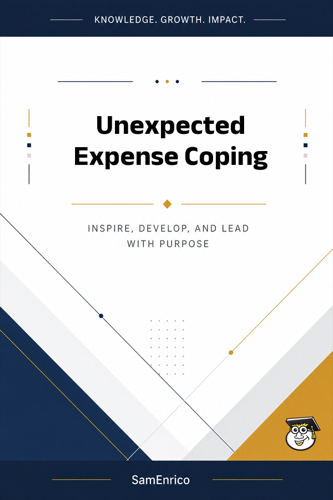
Unexpected Expense Coping eBook
Handles emergency costs without financial collapse
Handles emergency costs without financial collapse.
Formats
Free sample
Chapter 1: The $400 Lie--I watched a woman cry in my emergency room over a twelve-dollar copay.Not because she didn't have twelve dollars. She had four hundred dollars in her checking account. That was the line. That was the number she had internalized as the difference between being a responsible adult and being a failure. If she spent that twelve dollars, she would dip below four hundred.
And below four hundred, in her mind, was where irresponsible people lived.So she sat in the examination room, sweating through a fever of 102 degrees, holding a prescription for antibiotics that would cost her twelve dollars at the pharmacy counter, and she cried. Not from the fever. From the shame.I have thought about that woman every single day for the last eight years.Not because her case was unusual. In fact, it was the most ordinary thing I saw in my decade as an emergency room nurse. I watched people refuse life-saving medications, delay critical procedures, and discharge themselves against medical advice with conditions that would kill them within weeks.
Not because they couldn't afford the care. Because they could not afford to feel like failures.The four hundred dollars in the checking account had become a moral boundary. Above it: good person. Below it: bad person. And they would rather risk death than cross that line.This is not a book about budgeting.
It is not a book about getting rich slowly, or cutting out lattes, or any of the other gentle, reasonable advice that has failed you for years. This is a book about survival. About what happens when the unexpected arrives at your door with a bill in its hand. About how you can face that moment without shame, without paralysis, and without financial collapse.And it starts with the single most dangerous lie in personal finance.The Lie That Keeps You Trapped The lie is this: financially responsible people do not have emergencies. Or rather, they have them so rarely and are so well-prepared that the emergencies barely register as disruptions.
They have six months of expenses in a savings account. They have insurance deductibles covered. They have a plan.Everything about this lie is designed to make you feel like a failure.I have treated plane crash survivors. I have treated tornado victims. I have treated people who walked out of buildings that were actively falling down around them.
And here is what I can tell you with absolute certainty: the people who survive emergencies are not the ones with the most resources. They are the ones who refuse to freeze.Survival psychology has identified ten behaviors that separate survivors from victims in any crisis. These same ten behaviors apply to financial emergencies with stunning precision. And the first and most important behavior is this: see clearly.Seeing clearly means recognizing that a financial emergency is not a judgment on your character. It is data.
It is information about your system. And systems can be fixed.The woman with the twelve-dollar copay could not see clearly. She saw a test of her worthiness, and she was failing it. She did not see a problem to be solved. She saw a mirror reflecting back someone she did not want to be.The second survival behavior is: move now.In any emergency, the people who freeze die.
The people who act, even imperfectly, live. The woman with the twelve-dollar copay froze. She froze for forty-five minutes in my examination room. In that time, her fever climbed, her infection spread, and her options narrowed. The twelve-dollar copay was not the problem.
The freezing was the problem.Let me tell you about two families. Same medical bill. Five thousand dollars. Same insurance. Same hospital.
Same week.The First Family: The Spiral The first family received the bill on a Saturday. The husband opened it, turned pale, and set it on the kitchen counter. He told his wife they would "deal with it on Monday."On Monday, they did not deal with it. On Monday, they hid it under a stack of mail.By Wednesday, they had stopped opening any mail at all. The credit card bills were piling up.
The mortgage statement arrived. They put that unopened on top of the pile.By the end of the month, they had received a second notice from the hospital. This one said "past due." They felt a wave of nausea and put it on the pile.By the third month, the bill had gone to collections. Their credit score dropped eighty points. The interest rates on their credit cards increased.
Their car payment went up at the next refinancing.By the sixth month, they were behind on their mortgage. Not because of the medical bill itself. Because of the cascade. Because freezing in the first week led to avoiding in the second week, which led to hiding in the third week, which led to a slow-motion collapse that could have been stopped at any point with a single phone call.They filed for bankruptcy fourteen months after receiving the original bill. The medical debt was less than ten percent of what they owed at that point.
The rest was the cost of freezing.The Second Family: The Response The second family received the same bill on the same Saturday. The wife opened it, read it, and said out loud: "Well, that's annoying."Then she did something the first family did not do. She called the hospital billing department. Not on Monday. Not next week.
She called within the hour.This is the One-Call Rule, and it is the single most important action you will ever take in a financial crisis: call the person you owe money to before they call you. Before the past due notice. Before collections. Before the spiral begins.She said: "I received a bill for five thousand dollars. I cannot pay that amount.
What are my options?"The billing representative, who had been trained to expect angry, defensive, or avoidant patients, was caught off guard by the directness. She offered a payment plan. One hundred dollars a month for fifty months. Zero percent interest.The wife said: "That is still more than I can pay right now. Do you have financial assistance forms?"She filled out the forms that afternoon.
Her household income qualified her for a seventy percent reduction. The new bill was fifteen hundred dollars.She set up an automatic payment of fifty dollars a month for thirty months. The bill was paid in full, on time, without drama, without shame, without freezing.The only difference between these two families was not income. Not education. Not access to resources.
The only difference was mindset and action.One family saw a judgment. The other saw a problem.One family froze. The other family moved.One family collapsed. The other family handled it.The Ten Principles of Financial Survival After a decade in the ER and another five years coaching families through financial crises, I have distilled survival psychology into ten principles that apply directly to your money.These are not theoretical. They are not aspirational.
They are behaviors that have been tested in the worst possible conditions, from plane crashes to terrorist attacks to the…
This is the end of the free sample. Get the eBook to keep going. Buy now
About this book
Details
- Author
- Schreiber Chantelle
- Publisher
- SamEnrico
- Language
- English
- Genre
- Non-Fiction, Self-Help, Emergency Finance
- Released
- 2026-06-10
- Pages (approx.)
- 132
- Available as
- eBook, Audiobook

Read better in the ZLOADR app
Your eBooks on your phone or tablet. Sign in with your SamEnrico account and start reading.
More by Schreiber Chantelle
 Travel Anxiety MeditationSchreiber Chantelle$11.99
 Who Benefited From Hoffa Death GuideSchreiber Chantelle$11.99
 The Fear of Email ReprimandSchreiber Chantelle$11.99
 Commitment OKRs GuideSchreiber Chantelle$11.99
 Twitter Outrage Comparison CycleSchreiber Chantelle$11.99
 Job Loss for VeteransSchreiber Chantelle$11.99
 Catholic Priest Anti Nuke ActivistSchreiber Chantelle$11.99
 The Architects of Timbuktu: Designing the City of GoldSchreiber Chantelle$11.99
 How to Become a ProspectorSchreiber Chantelle$11.99
 Generative AI Marketing ROI WorkbookSchreiber Chantelle$12.99
 Boss Microaggression WorkbookSchreiber Chantelle$12.99
 How to Produce Plastic Product Making MachinerySchreiber Chantelle$11.99
You may also like
 Hong Kong Handover 1997Dunn Johnnie$11.99
 Zumba For Postnatal Recovery CourseNeal Christian$11.99
 Zumba for BeginnersLadner Nikia$11.99
 YouTube Comment Mining GuideHumes Pandora$12.99
 Worry Box MeditationCarlin Rudy$11.99
 Workplace Stress MeditationNguyen Lynn$11.99
 Workplace Stress and Sleep RepairHawley Ivory$11.99
 Workplace Perfectionism CureDelaney Jeffry$11.99
 Workplace Injustice Anger GuideWallen Isabelle$11.99
 Work Addiction and Burnout LinkGreenwood Ester$11.99
 Women in Yoga and WellnessBeattie Galina$11.99
 Women in Stand Up ComedyChun Evangeline$11.99