
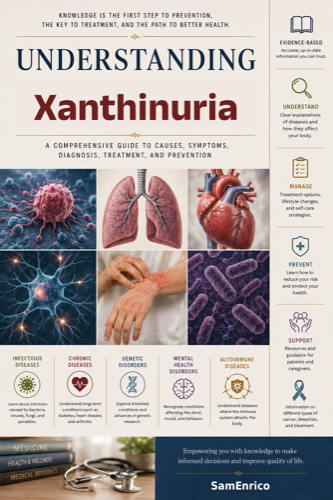
Non-FictionInformativeEducational
Understanding Xanthinuria eBook
This disease publication, published by SamEnrico,
This disease publication, published by SamEnrico, covers Understanding Xanthinuria
Formats
Free sample
Chapter 1: The Purine Puzzle...--The first time Sarah noticed the orange glow in her infant son’s diaper, she assumed it was a fluke—perhaps something he had eaten, though he was only three months old and exclusively breastfed. The second time, she mentioned it to the pediatrician, who dismissed it as “probably nothing.” The third time, she took a photograph and began keeping a journal. By the time Liam was eight months old, Sarah had seen four different doctors, been told three times that she was an anxious first-time mother, and watched her son pass a kidney stone the size of a grain of rice—an event that required an emergency room visit, intravenous fluids, and a referral to a pediatric nephrologist who finally asked a question no one had thought to ask: “Has anyone ever checked his uric acid level?”That question changed everything. Liam’s uric acid level was not just low; it was nearly undetectable. And that single laboratory value—often dismissed as harmless or even beneficial—was the first clue in a diagnostic mystery that would eventually lead to a diagnosis of hereditary xanthinuria.
Liam’s story is not unique. In fact, it is disturbingly typical. Patients with xanthinuria, one of the rarest inherited disorders of metabolism, almost always endure a years-long diagnostic odyssey before receiving an accurate diagnosis. Along the way, they may suffer preventable kidney damage, undergo unnecessary procedures, and carry the emotional weight of being told, repeatedly, that their symptoms are “all in their head.”This chapter exists to ensure that you do not have the same experience. Before we can discuss how to recognize, diagnose, or treat xanthinuria, we must first understand what it is at the most fundamental level.
That understanding begins with a simple question: What are purines, and why does your body care so much about how it breaks them down?To grasp xanthinuria—a condition defined by the accumulation of a substance called xanthine and the simultaneous deficiency of a substance called uric acid—you must first understand the normal purine degradation pathway. Think of this pathway as a factory assembly line with several stations. At each station, a specific worker (an enzyme) performs a specific task. When all workers are present and functioning correctly, raw materials enter the factory and finished products exit without issue. In the case of purine metabolism, the “raw materials” are purines from your diet and from the normal turnover of your body’s own cells.
The “finished product” is uric acid, a compound that is largely soluble in urine and is safely excreted from your body every time you urinate.But what happens when one of the workers fails to show up for work? What happens when a critical enzyme is missing, present in insufficient quantities, or structurally damaged so that it cannot perform its job? The assembly line backs up. Intermediate products accumulate. And in the case of xanthinuria, the substance that accumulates—xanthine—is poorly soluble, prone to forming crystals, and capable of causing significant damage to the kidneys, urinary tract, and other organs.
Understanding this pathway is not an academic exercise. It is the key to understanding every symptom, every diagnostic test, and every treatment decision you will encounter throughout this book.The Building Blocks of Life: What Are Purines?Before we can understand how the purine degradation pathway goes wrong in xanthinuria, we must first understand what purines are and why they matter so much to human biology. The word “purine” may sound like a chemical term best left to biochemists, but purines are actually central to your existence. Every cell in your body contains purines. Every time your cells divide, replicate their DNA, or produce energy, they rely on purines.
Without purines, life as we know it would be impossible.Purines are nitrogen-containing organic compounds that serve as the structural backbone for several critical molecules in the body. The two most important purines are adenine and guanine. These two molecules are the “A” and “G” in the famous DNA alphabet (A, T, C, G). When your cells divide and replicate their DNA, they must have an adequate supply of adenine and guanine to build new strands of genetic material. But purines are not confined to DNA.
They are also essential components of RNA (where they serve a similar genetic information-carrying role), ATP (adenosine triphosphate, the primary energy currency of the cell), NAD and FAD (coenzymes involved in hundreds of metabolic reactions), and cyclic AMP (a signaling molecule that helps cells respond to hormones and other external signals).In short, purines are everywhere. And because they are everywhere, your body has developed sophisticated systems for managing them. You obtain purines from two primary sources. The first is endogenous production—your body synthesizes purines from scratch, primarily in the liver, using simple precursor molecules like amino acids, carbon dioxide, and formate. This is a complex, energy-intensive process that requires multiple enzymes and is tightly regulated to ensure that you produce neither too many nor too few purines.
The second source is dietary intake—the food you eat contains purines, particularly meat, fish, poultry, organ meats, and certain vegetables and legumes. When you digest and absorb these foods, the purines they contain enter your bloodstream and must be processed by the same metabolic pathways that handle endogenously produced purines.Given how essential purines are, you might wonder why your body does not simply recycle them indefinitely. The answer is that purines, like all molecules in the body, undergo wear and tear. DNA strands break and are repaired. Cells die and are replaced.
ATP is used and must be regenerated. Over time, purines become damaged or are incorporated into molecules that are destined for destruction. Rather than allowing these used purines to accumulate to toxic levels, your body has a carefully orchestrated degradation pathway that breaks them down into simpler, more easily excreted molecules. That pathway ends with uric acid.The Normal Purine Degradation Pathway: A Step-by-Step Journey Imagine you are following a single purine molecule—let us say a molecule of guanine that was originally part of a DNA strand in a liver cell. That liver cell has reached the end of its lifespan and is being broken down by the body’s recycling systems.
The guanine molecule is released into the cellular cytoplasm, where it encounters a series of enzymes that will progressively break it down into smaller and smaller pieces.The first step in the degradation pathway involves the removal of an amino group (a process called deamination), converting guanine into xanthine. Wait—did we just arrive at xanthine already? Yes. Guanine is converted directly to xanthine by the enzyme guanine deaminase. Similarly, another purine called hypoxanthine (which comes from the breakdown of adenine) is also converted to xanthine, but by a different enzyme called xanthine oxidase (which we will discuss in detail momentarily).
For our purposes, the important takeaway is that xanthine sits at a critical junction in the purine degradation pathway. It is the last intermediate before the final product, uric acid.From xanthine, the pathway proceeds to uric acid. This conversion is catalyzed by an enzyme with two names—xanthine dehydrogenase (XDH) and xanthine oxidase (XO)…
This is the end of the free sample. Get the eBook to keep going. Buy now
About this book
Details
- Author
- Branham Shirly
- Publisher
- SamEnrico
- Language
- English
- Genre
- Non-Fiction, Informative, Educational
- Released
- 2026-06-02
- Pages (approx.)
- 156
- Available as
- eBook, Audiobook

Read better in the ZLOADR app
Your eBooks on your phone or tablet. Sign in with your SamEnrico account and start reading.
More by Branham Shirly
 Robin Williams Voices InsideBranham Shirly$11.99
 The Difficult Talk Script BookBranham Shirly$11.99
 Teen Rejection Sensitivity GuideBranham Shirly$11.99
 Hypnic Jerk Reduction GuideBranham Shirly$11.99
 The Seizure Prevention WithdrawalBranham Shirly$11.99
 The Iron Fist of the Southern Cross: Australia's Forgotten Boxing LegendBranham Shirly$11.99
 User Testing for Non Tech PeopleBranham Shirly$12.99
 Fintech CAC OptimizationBranham Shirly$12.99
 How to Start a Basic Slag (ground) Business (Beginners Guide)Branham Shirly$11.99
 K-pop Global Domination: BTS Military Service EraBranham Shirly$11.99
You may also like
 Hong Kong Handover 1997Dunn Johnnie$11.99
 Zumba For Postnatal Recovery CourseNeal Christian$11.99
 Zumba for BeginnersLadner Nikia$11.99
 YouTube Comment Mining GuideHumes Pandora$12.99
 Worry Box MeditationCarlin Rudy$11.99
 Workplace Stress MeditationNguyen Lynn$11.99
 Workplace Stress and Sleep RepairHawley Ivory$11.99
 Workplace Perfectionism CureDelaney Jeffry$11.99
 Workplace Injustice Anger GuideWallen Isabelle$11.99
 Work Addiction and Burnout LinkGreenwood Ester$11.99
 Women in Yoga and WellnessBeattie Galina$11.99
 Women in Stand Up ComedyChun Evangeline$11.99