
Non-FictionInformativeEducational
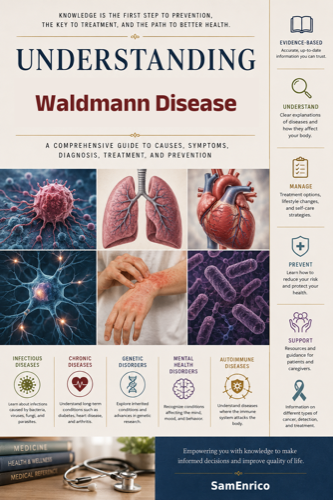
Understanding Waldmann Disease eBook
This disease publication, published by SamEnrico,
by Aviles Mindi
This disease publication, published by SamEnrico, covers Understanding Waldmann Disease
Formats
Free sample
Chapter 1: The Protein Thief...--The first time three-year-old Liam’s feet swelled into what his mother called “little balloons,” the pediatrician in rural Ohio said it was probably a reaction to something in the grass. It was late spring, pollen season, and Liam had been playing barefoot. The swelling went down with antihistamines and some rest. The family moved on.Three months later, Liam’s ankles looked like bread dough—puffy, pitted, and cool to the touch. His face had changed too, his eyelids appearing full and heavy each morning, like a boxer the day after a fight.
His mother, Sarah, a sharp-eyed former nurse, felt something was deeply wrong. The pediatrician ordered basic labs: complete blood count, comprehensive metabolic panel, urinalysis. Everything came back normal except for one number: total protein, borderline low.“Kids can run low,” the pediatrician said. “Let’s recheck in six weeks.”Six weeks became twelve. Liam’s belly began to protrude—not the cute toddler paunch, but a tight, fluid-filled distension that made his ribs flare outward.
He stopped growing. At age three, he was still wearing 18-month pants. His daycare reported that he seemed “tired all the time” and had missed seventeen days in four months due to ear infections, sinus infections, and one frightening episode of pneumonia that required hospitalization.Sarah kept a binder. She brought it to every appointment: growth charts, lab results, photographs of Liam’s swelling on different mornings, a food diary, a symptom log. She had highlighted the low protein and low lymphocyte count from three separate blood draws.
She had printed articles from Pub Med about something called “protein-losing enteropathy.”Four specialists later—general pediatrics, infectious disease, nephrology, cardiology—a young gastroenterology fellow named Dr. Chen sat down with Sarah and said something no one had said before: “I think your son’s gut is leaking protein.”That sentence changed everything.The Mystery That Needed a Name If you are reading this book, you or someone you love has likely endured a similar odyssey. You have watched doctors shrug, scratch their heads, order the same tests twice, and offer theories that collapsed under the slightest scrutiny. You have been told it might be “just viral,” “idiopathic” (a word that often means “we don’t know”), or, worst of all, “possibly psychosomatic.” You have felt the unique loneliness of chasing a diagnosis for a disease so rare that most physicians will never see a single case in their entire careers.Waldmann’s disease—formally known as Primary Intestinal Lymphangiectasia—is that rare. Leading experts estimate fewer than 200 confirmed cases have been reported in the global medical literature since Dr.
Thomas Waldmann first described the condition in 1961. To put that number in perspective: a typical large academic medical center might see one case every five to ten years. A community hospital may go fifty years without a single diagnosis. For every patient who receives the correct diagnosis, countless others remain undiagnosed, misdiagnosed, or told that their symptoms “don’t fit any known pattern.”Yet rare does not mean fictional. For the patients and families living with this condition, the scarcity of medical knowledge is not a relief—it is an additional burden.
You become the expert by necessity. You learn to translate medical jargon, to spot which doctors are curious versus which are dismissive, to carry your own copies of imaging reports, and to gently educate the emergency room physician who has never heard of your disease. This book is written for you.But before we dive into the science, the management strategies, and the daily realities of living with Waldmann’s disease, we must start where Dr. Waldmann himself started: with a patient who did not fit any known category, and with a question that seemed impossibly simple yet carried revolutionary implications.Where is all the protein going?The 1961 Discovery That Changed Lymphatic Medicine In the late 1950s, Dr. Thomas Waldmann was a young investigator at the National Institutes of Health (NIH), a sprawling research hospital in Bethesda, Maryland, where difficult and unusual cases were sent from across the country.
He was studying patients with unexplained low protein levels—specifically low albumin, the most abundant protein in human blood. Albumin acts like a molecular sponge, holding fluid within blood vessels. When albumin drops too low, fluid seeps out into surrounding tissues, causing the kind of swelling Sarah saw in her son Liam.The conventional wisdom at the time was that low protein levels were either due to the body not making enough protein (liver disease or malnutrition) or the body losing protein through the kidneys (nephrotic syndrome) or through open wounds (burns, severe skin conditions). But Waldmann encountered a patient who did not fit any of these categories. A young woman had profound swelling, low albumin, low antibodies, and low lymphocytes—but her liver was healthy, her kidneys functioned normally, and she had no significant skin breakdown.Waldmann asked a simple, elegant question: What if the protein is leaking into the gut?To test this hypothesis, he used a then-novel technique involving a radioactive tracer.
He injected a labeled protein into the patient’s bloodstream and then measured how much of that tracer appeared in the stool over the next several days. The results were dramatic. A healthy person loses very little protein through the gastrointestinal tract—perhaps 5 to 10 grams per day, most of which is broken down and recycled. Waldmann’s patient was losing more than 60 grams of protein per day into her stool. The gut was not digesting and absorbing protein normally; it was acting like a sieve, pouring the body’s essential building blocks into the toilet.But why was the gut leaking?Waldmann performed a series of intestinal biopsies, a procedure that was still relatively new and technically challenging.
Under the microscope, he saw something striking: the small intestinal villi—the tiny fingerlike projections that absorb nutrients—were bloated and distorted. Inside them, the central lymphatic channels (called lacteals) were abnormally dilated, like overinflated balloons. In some areas, these dilated lacteals had ruptured, spilling their protein-rich lymph directly into the intestinal lumen.He had discovered a new disease: Primary Intestinal Lymphangiectasia. The medical community would later informally name it Waldmann’s disease in his honor.What This Book Is—And What It Is Not Before we go further, let me be clear about what you are holding.This book is a comprehensive guide to understanding Waldmann’s disease. It synthesizes the most current clinical evidence, including the 2025 French National Diagnosis and Care Protocol, which represents the most rigorous attempt yet to standardize diagnosis and management for this ultra-rare condition.
It integrates case reports, expert consensus, patient advocacy resources, and the lived experiences of individuals and families navigating this disease.This book is written for three audiences:Patients who want to understand their own bodies, advocate effectively for their care, and live as fully as possible despite a chronic, incurable condition.Family members and caregivers who need practical tools, emotional support, and a clear roadmap for helping their loved one thrive.Healthcare providers—gastroenterologists, pediatricians, internists, dietitians, and nurses—who may see only one or two cases in their careers and need a reliable, evidence-based reference.This book is not a replacement…
This is the end of the free sample. Get the eBook to keep going. Buy now
About this book
Details
- Author
- Aviles Mindi
- Publisher
- SamEnrico
- Language
- English
- Genre
- Non-Fiction, Informative, Educational
- Released
- 2026-05-07
- Pages (approx.)
- 160
- Available as
- eBook, Audiobook

Read better in the ZLOADR app
Your eBooks on your phone or tablet. Sign in with your SamEnrico account and start reading.
More by Aviles Mindi
 TM For Menopause GuideAviles Mindi$11.99
 The Wrongful Conviction FearAviles Mindi$11.99
 In Law Stress Relationship GuideAviles Mindi$11.99
 Manufactured Homes in RetirementAviles Mindi$11.99
 The Child Suicide Grief GuideAviles Mindi$11.99
 The Lioness of the Sahel: The Untold Love and War of Queen Yaa AsantewaaAviles Mindi$11.99
 Madrid vs Direct FilingAviles Mindi$12.99
 Angel Investor Dilution GuideAviles Mindi$12.99
 Sales Account CoordinatorAviles Mindi$11.99
 How to Start a Bathing Caps Made of Plastic Business (Beginners Guide)Aviles Mindi$11.99
You may also like
 Hong Kong Handover 1997Dunn Johnnie$11.99
 Zumba For Postnatal Recovery CourseNeal Christian$11.99
 Zumba for BeginnersLadner Nikia$11.99
 YouTube Comment Mining GuideHumes Pandora$12.99
 Worry Box MeditationCarlin Rudy$11.99
 Workplace Stress MeditationNguyen Lynn$11.99
 Workplace Stress and Sleep RepairHawley Ivory$11.99
 Workplace Perfectionism CureDelaney Jeffry$11.99
 Workplace Injustice Anger GuideWallen Isabelle$11.99
 Work Addiction and Burnout LinkGreenwood Ester$11.99
 Women in Yoga and WellnessBeattie Galina$11.99
 Women in Stand Up ComedyChun Evangeline$11.99