
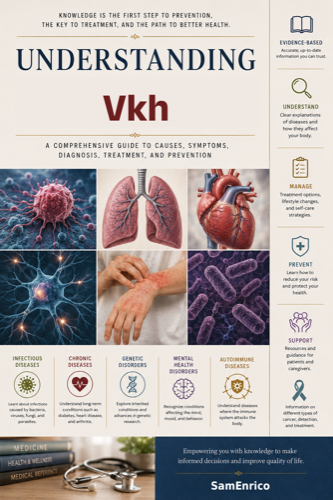
Non-FictionInformativeEducational
Understanding Vkh eBook
This disease publication, published by SamEnrico,
This disease publication, published by SamEnrico, covers Understanding Vkh
Formats
Free sample
Chapter 1: The Great Imitator...--–- Imagine waking up one morning with what feels like the worst flu of your life. Your head pounds, your neck is stiff, your skin feels hot with fever, and every light in the house seems unbearably bright. You drag yourself to the emergency room, where a tired doctor listens for thirty seconds, writes "viral syndrome" on your chart, and sends you home with instructions to rest and drink fluids. Three days later, your vision blurs. Five days after that, you cannot read the text on your phone.
Seven days after that, you are legally blind in both eyes. And no one can tell you why.This is not a horror story. This is the typical first chapter of the Vogt-Koyanagi-Harada disease experience for thousands of patients worldwide. The disease that bears the names of three physicians who never met each other—Vogt in Switzerland, Koyanagi in Japan, Harada in Japan—is one of medicine's great chameleons. It presents as meningitis, then as uveitis, then as vitiligo, then as hearing loss.
It is the disease that every ophthalmologist fears missing and every emergency room doctor has never heard of. And if you are reading this book, it is likely the disease that has already turned your life upside down.This chapter is called "The Great Imitator" because VKH does not have a single face. It has many. It mimics viral illnesses, autoimmune disorders, and even psychiatric conditions. It has been misdiagnosed as migraine, anxiety, meningitis, sarcoidosis, sympathetic ophthalmia, and even mass hysteria.
Patients have been referred to psychiatrists before ophthalmologists. They have been treated for sinus infections while their retinas were detaching. They have been told, "It's all in your head," when in fact, the inflammation was very real and very much in their eyes, ears, and brain.The purpose of this chapter—and this entire book—is to ensure that you never become one of those stories. Whether you are a newly diagnosed patient, a concerned family member, a medical student, or a physician who has just encountered your first case of VKH, this chapter will give you the foundation you need to understand what this disease is, what it is not, and why recognizing it early is the single most important factor in preserving vision.What Is VKH, Really?At its core, Vogt-Koyanagi-Harada disease is an autoimmune disorder. That means your immune system—the same system that fights off colds, heals wounds, and protects you from cancer—has made a catastrophic error in identification.
It has decided that certain cells in your body are enemies that must be destroyed. The specific target? Melanocytes.Melanocytes are the pigment-producing cells of your body. They are found in your skin, giving it color. They are found in your hair follicles, determining whether you are blonde, brunette, or a redhead.
They are found in the uvea of your eye—the middle layer that includes the iris, the ciliary body, and the choroid. They are found in the inner ear, where they help maintain the fluid balance necessary for hearing. And they are found in the meninges, the protective membranes that surround your brain and spinal cord.When the immune system attacks these melanocytes, the resulting inflammation produces the four groups of symptoms that define VKH:Ocular symptoms – inflammation of the uvea (uveitis), the choroid (choroiditis), the retina (retinitis), and the optic nerve (optic neuritis). This is the most dangerous manifestation because it can lead to permanent vision loss.Neurological symptoms – headache, neck stiffness, fever, and nausea caused by inflammation of the meninges (meningitis). These are often the first symptoms to appear, which is why VKH is so frequently misdiagnosed as a viral illness.Auditory symptoms – tinnitus (ringing in the ears), vertigo (spinning sensation), and hearing loss caused by inflammation of the inner ear.
These symptoms are often mild at first and easily dismissed.Integumentary symptoms – vitiligo (white patches of skin), poliosis (white patches of hair, including eyelashes and eyebrows), and alopecia (hair loss). These typically appear weeks to months after the eye inflammation, as the immune system continues its attack on melanocytes throughout the body.The Autoimmune Theory: Why Your Body Betrays Itself To understand why the immune system makes this catastrophic error, you need to understand a little bit about how immunity works. Your immune system has a remarkable ability to distinguish between "self" (your own cells) and "non-self" (bacteria, viruses, fungi, parasites, and foreign tissue). It learns this distinction early in life, during fetal development and infancy. Cells that would attack your own body are normally eliminated or suppressed.But sometimes this system breaks down.
The exact cause of the breakdown in VKH is not fully understood, but researchers have identified several contributing factors.First, there is a genetic predisposition. The strongest genetic link is to a gene called HLA-DRB1*0405. This gene is part of the human leukocyte antigen system, which helps your immune system recognize which cells belong in your body and which do not. People with this specific variant of the gene are significantly more likely to develop VKH than people without it. However—and this is crucial—most people with the gene never develop VKH.
The gene creates susceptibility, not destiny.Second, there is an environmental trigger. Something has to set off the immune response. The leading theory is that a viral infection—possibly Epstein-Barr virus, cytomegalovirus, or an unknown virus—infects melanocytes or cells that resemble melanocytes. The immune system attacks the virus, but in the process, it learns to attack melanocytes themselves. This is called "molecular mimicry": the virus looks enough like a melanocyte that the immune system confuses the two.Third, there is a loss of immune regulation.
In healthy people, special cells called regulatory T cells keep the immune system in check. They prevent it from overreacting and attacking the body's own tissues. In people with VKH, these regulatory T cells may be fewer in number or less effective. The immune system attacks and keeps attacking, even after the original trigger is gone.The result is a self-perpetuating cycle of inflammation. The immune system attacks melanocytes.
The damaged melanocytes release more inflammatory signals. Those signals recruit more immune cells. Those cells attack more melanocytes. And on and on, until powerful medications are used to break the cycle.The Four Stages of VKH: A Roadmap for What Comes Next One of the most useful ways to understand VKH is to divide it into four stages. These stages are not always perfectly distinct, and not every patient experiences every stage.
But they provide a framework for understanding what is happening in your body and what to expect next.Stage 1: The Prodromal Phase This is the earliest stage, lasting from a few days to a few weeks. The hallmark of the prodromal phase is neurological symptoms: headache (often severe and throbbing), fever (usually low-grade, under 101°F), nausea (sometimes with vomiting), and neck stiffness (as if you had meningitis, which in a sense you do). Some patients also experience periorbital pain—a deep ache behind or around the eyes.The auditory symptoms often begin during this stage as well. Tinnitus may start as a faint ringing that comes and goes. Vertigo may feel like…
This is the end of the free sample. Get the eBook to keep going. Buy now
About this book
Details
- Author
- Lunsford Makeda
- Publisher
- SamEnrico
- Language
- English
- Genre
- Non-Fiction, Informative, Educational
- Released
- 2026-06-02
- Pages (approx.)
- 154
- Available as
- eBook, Audiobook

Read better in the ZLOADR app
Your eBooks on your phone or tablet. Sign in with your SamEnrico account and start reading.
More by Lunsford Makeda
 Legacy Of Lifelong Learning HandbookLunsford Makeda$11.99
 The Digital ReconstructionLunsford Makeda$11.99
 Strategic Downsizing for Retirement Cash FlowLunsford Makeda$11.99
 Spin Low Impact High IntensityLunsford Makeda$11.99
 The Corporate Veil Protection GuideLunsford Makeda$11.99
 The Silk Road Betrayal: How a Princess Changed the Course of the Mongol EmpireLunsford Makeda$11.99
 Professional FootballerLunsford Makeda$11.99
 Chile Startup Visa PR GuideLunsford Makeda$12.99
 Terms for International UsersLunsford Makeda$12.99
 How to Start a Niger Seed Growing Business (Beginners Guide)Lunsford Makeda$11.99
You may also like
 Hong Kong Handover 1997Dunn Johnnie$11.99
 Zumba For Postnatal Recovery CourseNeal Christian$11.99
 Zumba for BeginnersLadner Nikia$11.99
 YouTube Comment Mining GuideHumes Pandora$12.99
 Worry Box MeditationCarlin Rudy$11.99
 Workplace Stress MeditationNguyen Lynn$11.99
 Workplace Stress and Sleep RepairHawley Ivory$11.99
 Workplace Perfectionism CureDelaney Jeffry$11.99
 Workplace Injustice Anger GuideWallen Isabelle$11.99
 Work Addiction and Burnout LinkGreenwood Ester$11.99
 Women in Yoga and WellnessBeattie Galina$11.99
 Women in Stand Up ComedyChun Evangeline$11.99