
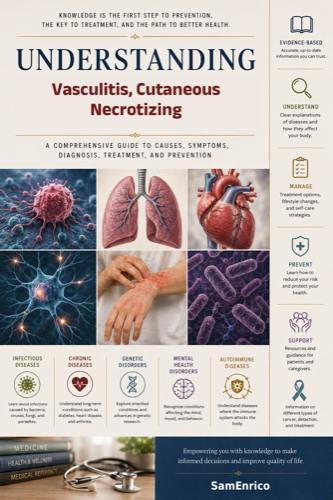
Non-FictionInformativeEducational
Understanding Vasculitis, Cutaneous Necrotizing
This disease publication, published by SamEnrico,
This disease publication, published by SamEnrico, covers Understanding Vasculitis, Cutaneous Necrotizing
Formats
About this book
Free sample
Chapter 1: The Vessel Betrayed...--–- The human body hosts over 60,000 miles of blood vessels—a network so vast it could circle the Earth twice. Each day, this intricate pipeline delivers oxygen, nutrients, and immune cells to every square inch of skin, from the scalp to the tips of the toes. But when this system turns against itself, the consequences appear not in the heart or the brain, but on the surface we all see: the skin. A patient wakes up to find strange, purple spots on their ankles that do not blanch when pressed. Within days, those spots evolve into painful ulcers, then into black, leathery patches of dead tissue.
The skin, the body’s largest organ and first line of defense, is dying from the inside out. This is not an infection. This is not a clot. This is vasculitis—specifically, the cutaneous necrotizing form—and understanding it requires us to answer a deceptively simple question: why would the body deliberately destroy its own blood vessels?The Distinction That Saves Lives: Inflammation vs. Occlusion Before any clinician can diagnose, treat, or even recognize cutaneous necrotizing vasculitis, they must master a fundamental binary concept that underpins every chapter of this book.
The distinction is simple in theory but frequently blurred in practice: necrotizing inflammation of the vessel wall versus non-inflammatory occlusion of the vessel lumen.True vasculitis, at its core, is an inflammatory process. Neutrophils, the body’s first-responder white blood cells, invade the vessel wall. They release enzymes, generate reactive oxygen species, and in the process, destroy the structural integrity of the artery, arteriole, capillary, or venule. This inflammation leads to fibrinoid necrosis—a term that will appear repeatedly throughout this text—where the normal layered architecture of the vessel wall is replaced by an amorphous, eosinophilic, smudgy material that stains bright pink on routine histology. The vessel leaks red blood cells into the surrounding tissue (producing palpable purpura), and eventually, the vessel thromboses, cutting off blood supply to the skin.
The result is ischemia, ulceration, and necrosis.In contrast, a vasculopathy (occlusive disease without inflammation) produces the same end result—tissue death—but…
This is the end of the free sample. Get the eBook to keep going. Buy now
Contents
- Chapter 1
- Chapter 2
- Chapter 3
- Chapter 4
- Chapter 5
- Chapter 6
- Chapter 7
- Chapter 8
- Chapter 9
- Chapter 10
- Chapter 11
- Chapter 12
Details
- Author
- Mailman Pattie
- Publisher
- SamEnrico
- Language
- English
- Genre
- Non-Fiction, Informative, Educational
- Released
- 2026-05-06
- Pages (approx.)
- 160
- Available as
- eBook, Audiobook

Read better in the ZLOADR app
Your eBooks on your phone or tablet. Sign in with your SamEnrico account and start reading.
More by Mailman Pattie
 Anger At Neighbors GuideMailman Pattie$11.99
 Mindset Shift from Grades to GrowthMailman Pattie$11.99
 Law Enforcement TheoriesMailman Pattie$11.99
 The German Student Visa GuideMailman Pattie$11.99
 Spin Class Etiquette and SafetyMailman Pattie$11.99
 Storm Over the Sands: The Scud Missiles and the Gulf War's Hidden WarMailman Pattie$11.99
 Light Bosse Pink Mahogany HarvestingMailman Pattie$11.99
 Matrix Organization Promotion CaseMailman Pattie$12.99Matrix Organization Promotion CaseMailman Pattie$12.99Matrix Organization Promotion CaseMailman Pattie$12.99Matrix Organization Promotion CaseMailman Pattie$12.99Matrix Organization Promotion CaseMailman Pattie$12.99
You may also like
 Hong Kong Handover 1997Dunn Johnnie$11.99
 Zumba For Postnatal Recovery CourseNeal Christian$11.99
 Zumba for BeginnersLadner Nikia$11.99
 YouTube Comment Mining GuideHumes Pandora$12.99
 Worry Box MeditationCarlin Rudy$11.99
 Workplace Stress MeditationNguyen Lynn$11.99
 Workplace Stress and Sleep RepairHawley Ivory$11.99
 Workplace Perfectionism CureDelaney Jeffry$11.99
 Workplace Injustice Anger GuideWallen Isabelle$11.99
 Work Addiction and Burnout LinkGreenwood Ester$11.99
 Women in Yoga and WellnessBeattie Galina$11.99
 Women in Stand Up ComedyChun Evangeline$11.99