
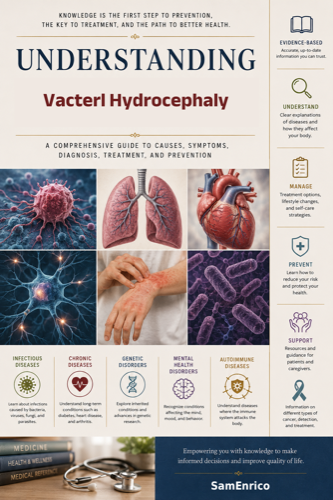
Non-FictionInformativeEducational
Understanding Vacterl Hydrocephaly eBook
This disease publication, published by SamEnrico,
This disease publication, published by SamEnrico, covers Understanding Vacterl Hydrocephaly
Formats
Free sample
Chapter 1: Beyond the Acronym...--The phone rings on a Tuesday afternoon. You are perhaps sitting in a hospital cafeteria, or maybe you have just been discharged from the obstetrician’s office, or perhaps you are alone in a car in a parking lot, having stepped outside to take the call in private. The voice on the other end says words you have never heard before: “VACTERL association with hydrocephalus.” The line crackles. You ask for the spelling. You write it down on a napkin, a receipt, the back of your hand.
Then you hang up and realize you have no idea what those letters mean, except that the doctor’s tone was careful, measured, and you are now standing on a cliff edge between two worlds: the one before the phone call and the one after.This chapter exists to catch you as you fall into that new world. It will not soften the complexity of VACTERL-H, nor will it promise easy answers. What it will do is provide a complete, honest, and clinically accurate map of this condition—what it is, what it is not, how it has been misunderstood in the past, and how modern medicine has fundamentally changed the prognosis for children born with it. By the end of this chapter, you will understand not just the acronym but the living reality behind it: the seven categories of anomalies, the specific nature of hydrocephalus in this syndrome, the critical difference between isolated VACTERL and VACTERL-H, and why the shift from thinking of this as an “association” to understanding it as a “syndrome” matters for your child’s treatment.Let us begin with the letters themselves, because they are the first thing anyone learns and the first thing everyone forgets to explain.The Anatomy of an Acronym: What VACTERL Actually Means VACTERL is not a diagnosis in the traditional sense. It is a descriptive acronym, a shorthand that physicians use to say, “This child has a specific cluster of birth defects involving at least three of the following seven body systems.” Each letter stands for a category of anomaly, and while the acronym is fixed, the expression of each anomaly exists on a wide spectrum—from barely noticeable to life-altering.
Understanding each letter is the foundation upon which everything else in this book rests.V – Vertebral Anomalies The spine is the body’s central scaffold, and in VACTERL-H, that scaffold is often irregular. Vertebral anomalies include hemivertebrae (triangular vertebrae that form on only one side), butterfly vertebrae (cleft down the middle), fused vertebrae (two or more bones grown together), and missing vertebrae entirely. These defects can occur anywhere from the neck (cervical spine) to the tailbone (sacrum), but they are most common in the thoracic (mid-back) and lumbar (lower back) regions. A child might have one hemivertebra that causes no measurable problem, or they might have a cascade of fused vertebrae that leads to progressive scoliosis. Importantly, vertebral anomalies are almost never an emergency.
They are discovered on the newborn X-ray that is done to look for other issues, and they are managed over years, not days, with monitoring for curve progression, bracing if necessary, and surgery only for severe, progressive curves that risk lung function. In the panicked first days after diagnosis, parents often seize on the spinal defects as the most frightening because they are visible on imaging. But take a breath: the spine is the least urgent of the VACTERL anomalies in the newborn period. It will wait.A – Anal Anomalies The anus is the endpoint of the gastrointestinal tract, and in VACTERL-H, that endpoint may not have formed correctly. Anal anomalies exist on a spectrum from imperforate anus (no anal opening at all, the most common and most severe form) to anal stenosis (a narrow opening that allows some stool passage) to a cloaca (a single common channel for the rectum, urethra, and vagina in females).
In a newborn with imperforate anus, the first sign is often dramatic: the baby does not pass meconium (the first stool) within the first 24 hours of life, and examination reveals no anal opening. This is a surgical emergency, but not in the “hours to live” sense—rather, it is an urgent evaluation to determine whether the rectum ends high (above the levator ani muscle) or low (below it). Low anomalies can often be repaired with a primary anoplasty in the newborn period. High anomalies require a staged approach: a temporary colostomy (diverting stool to a bag on the abdominal wall) in the first days of life, followed by a posterior sagittal anorectoplasty (PSARP) at 2–4 months of age, then colostomy closure several weeks later. The long-term outcomes for anal anomalies have improved dramatically over the past two decades, with most children achieving fecal continence by school age, though chronic constipation remains a universal challenge (addressed in detail in Chapter 9).C – Cardiac Anomalies The heart is the most time-sensitive of all the VACTERL anomalies, second only to hydrocephalus in its potential to cause death or disability if missed.
Cardiac defects occur in 30–50% of children with VACTERL-H, and the most common are ventricular septal defect (VSD), a hole between the two lower chambers of the heart, and atrial septal defect (ASD), a hole between the two upper chambers. Less common but more serious defects include tetralogy of Fallot (a combination of four defects causing blue spells), truncus arteriosus (a single great vessel instead of two), and hypoplastic left heart syndrome (underdevelopment of the left side). The newborn physical exam may reveal a murmur, but not always—small VSDs can be silent. That is why every child with suspected VACTERL-H needs an echocardiogram within the first 48 hours of life, regardless of whether a murmur is heard. Small VSDs and ASDs may close spontaneously in the first year of life; moderate defects require surgical repair before 6 months to prevent pulmonary hypertension; large defects require surgery in the first few weeks.
The cardiac defect is often the second surgery after the VP shunt, and the timing is coordinated so that the child is stable enough for cardiopulmonary bypass but not so delayed that irreversible lung damage occurs. If you take one thing from this section, let it be this: do not let anyone postpone the echocardiogram.T – Tracheoesophageal Anomalies The trachea (windpipe) and the esophagus (food tube) develop from adjacent structures in the embryo, and when development goes awry, they can form abnormal connections called tracheoesophageal fistulas (TEF). The most common type in VACTERL-H is esophageal atresia with distal TEF: the upper esophagus ends in a blind pouch, and the lower esophagus connects to the trachea. This is a surgical emergency in the first 24–48 hours of life. The signs are classic: a newborn who drools copiously, chokes with feeds, cannot pass a nasogastric tube beyond a certain distance, and develops respiratory distress from stomach acid passing through the fistula into the lungs.
The surgery involves dividing the fistula, mobilizing the esophagus, and stitching the two ends together. It is a major operation, often lasting 3–5 hours, and the recovery is prolonged because esophageal anastomoses are prone to leakage, stricture (narrowing), and reflux. Post-operatively, the baby will be intubated (on a breathing machine) for several…
This is the end of the free sample. Get the eBook to keep going. Buy now
About this book
Details
- Author
- Dawkins Vanna
- Publisher
- SamEnrico
- Language
- English
- Genre
- Non-Fiction, Informative, Educational
- Released
- 2026-05-11
- Pages (approx.)
- 155
- Available as
- eBook, Audiobook

Read better in the ZLOADR app
Your eBooks on your phone or tablet. Sign in with your SamEnrico account and start reading.
More by Dawkins Vanna
 Study Break Recovery GuideDawkins Vanna$11.99
 Anger Advantages DisadvantagesDawkins Vanna$11.99
 Affirmation Reminder SystemDawkins Vanna$11.99
 Affluenza Recovery WorkbookDawkins Vanna$11.99
 The HGH Anti Aging Clinic GuideDawkins Vanna$11.99
 The Silent Operatives: Mime and Espionage in the Golden Age of Australia/New ZealandDawkins Vanna$11.99
 10 Ways to Use Flax Seeds (Recipe Book)Dawkins Vanna$11.99
 Promotion Case Peer Data GuideDawkins Vanna$12.99
 BOP Energy Product GuideDawkins Vanna$12.99
 Information Systems Security ConsultantDawkins Vanna$11.99
You may also like
 Hong Kong Handover 1997Dunn Johnnie$11.99
 Zumba For Postnatal Recovery CourseNeal Christian$11.99
 Zumba for BeginnersLadner Nikia$11.99
 YouTube Comment Mining GuideHumes Pandora$12.99
 Worry Box MeditationCarlin Rudy$11.99
 Workplace Stress MeditationNguyen Lynn$11.99
 Workplace Stress and Sleep RepairHawley Ivory$11.99
 Workplace Perfectionism CureDelaney Jeffry$11.99
 Workplace Injustice Anger GuideWallen Isabelle$11.99
 Work Addiction and Burnout LinkGreenwood Ester$11.99
 Women in Yoga and WellnessBeattie Galina$11.99
 Women in Stand Up ComedyChun Evangeline$11.99