
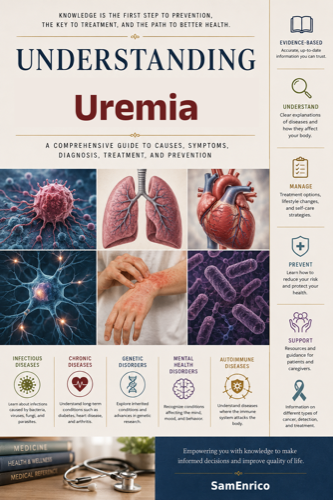
Non-FictionInformativeEducational
Understanding Uremia eBook
This disease publication, published by SamEnrico,
by Cho Barbra
This disease publication, published by SamEnrico, covers Understanding Uremia
Formats
Free sample
Chapter 1: The Silent Flood...--–- The human body is a master of adaptation, but every system has its breaking point. For the kidneys, that breaking point arrives not with a dramatic collapse but with a silent, progressive flood—a retention of wastes so gradual that patients often cannot pinpoint when they first felt unwell. This is the paradox of uremia: it creeps like a rising tide, yet when symptoms finally break the surface, the body is already in crisis.Understanding uremia begins with a fundamental shift in perspective. Most people—and even some clinicians—mistakenly believe that uremia simply means "urine in the blood." The word itself derives from the Greek ouron (urine) and haima (blood), but this etymology is dangerously misleading. Uremia is not the presence of urine in the bloodstream; rather, it is a complex, multisystem syndrome caused by the progressive retention of dozens of organic wastes, electrolytes, acids, and hormones that the failing kidneys can no longer eliminate.
To call it "urine in the blood" is like calling a hurricane "a little bit of rain." It misses the catastrophic breadth of the condition.This chapter establishes the biochemical foundation of uremia, tracing the journey from healthy kidney function to the earliest detectable changes in blood chemistry, and finally to the clinical syndrome that affects virtually every organ system. We will explore why the glomerular filtration rate (GFR) is the single most important number in nephrology, why the concept of a "threshold" is both useful and nuanced, and why some patients continue to suffer even after starting dialysis—a phenomenon known as the residual syndrome. Finally, we will examine the emerging role of the gut in generating uremic toxins, a discovery that has opened entirely new avenues for treatment.By the end of this chapter, the reader will understand that uremia is not an event but a process—a metabolic avalanche that begins silently, accelerates relentlessly, and, if unchecked, ends in death. But within that grim trajectory lies the hope of early recognition and intervention. The flood can be slowed.
The tide can be turned. First, however, we must understand what we are fighting.The Kidney's Essential Betrayal To understand uremia, one must first appreciate what healthy kidneys do. The two fist-sized organs sitting just below the rib cage perform a staggering array of functions that extend far beyond the popular notion of "filtering blood." Each kidney contains approximately one million nephrons, the functional units that process 120 to 150 quarts of blood daily, producing one to two quarts of urine. But filtration is only the beginning.Healthy kidneys maintain electrolyte balance, carefully regulating sodium, potassium, calcium, phosphorus, and magnesium. They control acid-base status by excreting hydrogen ions and regenerating bicarbonate.
They produce hormones: erythropoietin, which stimulates red blood cell production; renin, which regulates blood pressure; and the active form of vitamin D (calcitriol), which governs calcium absorption and bone health. They also clear a wide array of metabolic wastes, including urea (from protein breakdown), creatinine (from muscle metabolism), uric acid (from purine metabolism), and hundreds of other organic compounds, many of which have no known physiological function and are simply toxic if allowed to accumulate.When the kidneys begin to fail, they do not fail uniformly. Nephrons are lost one by one, and the remaining nephrons undergo hypertrophy—they enlarge and work harder to compensate. This compensatory mechanism is both a blessing and a curse. It allows the body to maintain near-normal blood chemistry even when kidney function has fallen by 50% or more.
But this silent compensation also delays diagnosis. Patients with stage 2 or 3 chronic kidney disease (CKD) often have no symptoms whatsoever, even though their kidneys are working at only 60–80% of normal capacity.The betrayal is that the kidneys do not sound an alarm. They simply work harder until they can no longer keep up. And when that moment arrives, the flood begins.The GFR Threshold: Why Fifteen Is the Magic Number The glomerular filtration rate (GFR) is the rate at which the kidneys filter blood, measured in milliliters per minute per 1.73 square meters of body surface area. A normal GFR in a young healthy adult is approximately 120–130 m L/min.
CKD is staged based on GFR, from stage 1 (normal GFR but evidence of kidney damage) through stage 5 (GFR less than 15 m L/min).Stage 5 CKD is synonymous with kidney failure, but it is not synonymous with uremia. Uremia is the clinical syndrome that develops when GFR falls low enough that the kidneys can no longer maintain metabolic homeostasis. For most patients, that threshold is a GFR persistently below 15 m L/min. However, the clinician must understand an essential nuance: the threshold varies.Some patients develop uremic symptoms at GFRs of 20 m L/min or even higher. This is particularly true for elderly patients, those with diabetes, patients with rapid declines in kidney function (where the body has not had time to adapt), and those with significant proteinuria or comorbid conditions.
Conversely, some young patients with slowly progressive kidney disease, particularly those with congenital or cystic kidney diseases, may remain relatively asymptomatic until GFR falls below 10 m L/min or even lower. The body's adaptive capacity is remarkable—but it is not infinite.Why does 15 m L/min represent the typical threshold? At this level of function, the remaining nephrons are working at near-maximal capacity. The filtration fraction (the proportion of blood plasma that is filtered across the glomerulus) becomes abnormally high, and the remaining nephrons begin to suffer from hyperfiltration injury—a self-perpetuating cycle that accelerates further decline. More importantly, at GFRs below 15 m L/min, the kidneys can no longer maintain adequate clearance of protein-bound wastes (discussed in Chapter 2) and middle molecules, even with maximal compensatory hypertrophy.The term "symptoms explode below 15 m L/min" is clinically useful but requires qualification.
Patients rarely wake up one morning with full-blown uremia. Rather, they experience a gradual accumulation of symptoms: fatigue that was once "just getting older" becomes debilitating; a metallic taste that was "probably something I ate" becomes constant; itching that was "dry skin" becomes generalized and intractable. The explosion is not an event but an acceleration—a point on the curve where the slope steepens dramatically.The Residual Syndrome: Why Dialysis Is Not a Cure One of the most important concepts in modern nephrology—and one that patients often find most difficult to accept—is the residual syndrome. This term describes the persistence of uremic symptoms and metabolic abnormalities in patients who are receiving what is objectively considered "adequate" dialysis.A patient on thrice-weekly hemodialysis who achieves a Kt/V (a measure of dialysis adequacy, discussed in Chapter 10) of 1.4 or higher is, by all objective measures, receiving excellent care. Their blood urea nitrogen (BUN) and creatinine levels drop dramatically during each treatment.
Their electrolyte abnormalities are corrected. Their fluid overload is managed. Yet many of these patients continue to feel fatigued, nauseated, cognitively impaired, and generally unwell. Some actually feel worse immediately after dialysis—a phenomenon known as post-dialysis fatigue.Why does this happen? The answer lies in the limitations of standard hemodialysis, which we will explore in depth in Chapter 10, but the fundamental explanation belongs here.
Standard hemodialysis is extraordinarily effective at removing small, water-soluble molecules like urea and creatinine. However, it is far less effective…
This is the end of the free sample. Get the eBook to keep going. Buy now
About this book
Details
- Author
- Cho Barbra
- Publisher
- SamEnrico
- Language
- English
- Genre
- Non-Fiction, Informative, Educational
- Released
- 2026-06-02
- Pages (approx.)
- 160
- Available as
- eBook, Audiobook

Read better in the ZLOADR app
Your eBooks on your phone or tablet. Sign in with your SamEnrico account and start reading.
More by Cho Barbra
 Mexican Business NegotiationCho Barbra$11.99
 Self Talk Rewire GuideCho Barbra$11.99
 Urban Treatment ResourcesCho Barbra$11.99
 Retirement Purpose Reinvention GuideCho Barbra$11.99
 The FTC Influencer Disclosure GuideCho Barbra$11.99
 The Silk Road Pioneers: The Lost Black Caravans of the SaharaCho Barbra$11.99
 How to Become a Plaster-die MakerCho Barbra$11.99
 Certification for First Time ExportersCho Barbra$12.99
 Low Income MVP GuideCho Barbra$12.99
 Freelance Digital Marketing ServicesCho Barbra$11.99
You may also like
 Hong Kong Handover 1997Dunn Johnnie$11.99
 Zumba For Postnatal Recovery CourseNeal Christian$11.99
 Zumba for BeginnersLadner Nikia$11.99
 YouTube Comment Mining GuideHumes Pandora$12.99
 Worry Box MeditationCarlin Rudy$11.99
 Workplace Stress MeditationNguyen Lynn$11.99
 Workplace Stress and Sleep RepairHawley Ivory$11.99
 Workplace Perfectionism CureDelaney Jeffry$11.99
 Workplace Injustice Anger GuideWallen Isabelle$11.99
 Work Addiction and Burnout LinkGreenwood Ester$11.99
 Women in Yoga and WellnessBeattie Galina$11.99
 Women in Stand Up ComedyChun Evangeline$11.99