
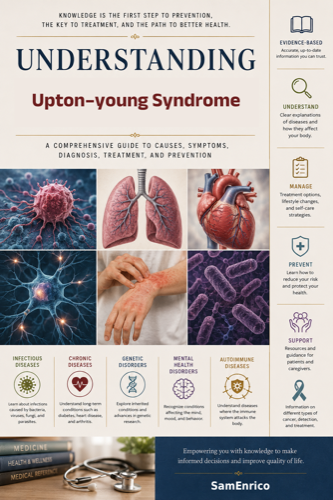
Non-FictionInformativeEducational
Understanding Upton–young Syndrome eBook
This disease publication, published by SamEnrico,
by Sharp Andrea
This disease publication, published by SamEnrico, covers Understanding Upton–young Syndrome
Formats
Free sample
Chapter 1: The Diagnosis No One Knew...–- The phone rang at 11:47 on a Tuesday morning. Sarah, a thirty-four-year-old graphic designer from Ohio, recognized the number. It was the genetic counselor from the university hospital, the one she had been waiting to hear from for six months. Her hands were shaking as she answered. “We have the results,” the counselor said.
“Your son Liam has a mutation in the [Gene X] gene. This confirms a diagnosis of Upton–Young Syndrome.”Sarah had never heard those three words together. Upton. Young. Syndrome.
They sounded like a law firm or a defunct department store, not a genetic condition that would define her son’s life. She asked the obvious question: “What is that?”The counselor paused. “It’s a rare neurocutaneous disorder. We don’t see many cases. I’m going to email you some articles.”Some articles.
Sarah read them that night, sitting at her kitchen table after Liam had gone to bed. The articles were dense, full of words she had to look up: autosomal recessive, melanocytic nevi, hypotonia, variable expressivity. She read about a triad of symptoms: cognitive impairment, multiple moles, muscle weakness. She looked at the photos of affected children—their backs covered in brown spots, some in wheelchairs, some with walkers. She thought of Liam’s back, covered in moles.
She thought of how he had been late to walk, how he still fell more than other kids his age, how his teachers said he learned differently. She started to cry.This is not how a diagnosis is supposed to happen. A diagnosis is supposed to be an end point, a moment of clarity, a key that unlocks the door to understanding. But for rare diseases like Upton–Young Syndrome, the diagnosis is often just the beginning of a new kind of odyssey—one where the family knows more than the doctors, where the patient becomes the expert, where the medical literature is a handful of case reports and the support group is a Facebook page with forty members.This chapter is about that moment. The moment when a family hears a name they have never heard before.
It is about why that name has been missing from medical textbooks for decades. About why families have to travel to three, four, five specialists before anyone connects the dots. About why a syndrome characterized by a striking triad of symptoms—cognitive impairment, multiple moles, and muscle weakness—remained invisible to a medical system that prides itself on pattern recognition.Upton–Young Syndrome is rare. But it is not invisible. It has been hiding in plain sight, misdiagnosed as neurofibromatosis, dismissed as atypical moles, or not diagnosed at all because no one had the courage to say “I don’t know, but I will find out.”This is the story of that syndrome and the families who live with it.
Their names have been changed, but their stories are true.The Triad That Should Have Given It Away Let us start with the core of the syndrome. Upton–Young Syndrome is defined by three clinical features that appear together, though not always at the same time. This triad is the key to diagnosis, and yet it is the triad that has been missed for decades.First: cognitive impairment. The intellectual disability in Upton–Young Syndrome ranges from mild to moderate. In practical terms, this means affected individuals typically have IQs between 50 and 70.
They are not profoundly disabled. They can learn, but they learn differently. They have strengths in visual memory and concrete tasks. They have weaknesses in abstract reasoning, executive function, and processing speed. A child with UYS may be able to build a complex Lego structure from a diagram but cannot follow a three-step verbal instruction.
This uneven profile is characteristic, but it is also subtle. Many affected children are diagnosed with “specific learning disability” or “developmental delay of unknown etiology” years before the syndrome is recognized.Second: multiple melanocytic nevi. These are not the common moles that most people have a dozen of. They are smaller, more numerous, and more uniform in color. They typically begin to appear between ages one and three—not at birth, which distinguishes them from congenital nevi.
They continue to appear throughout childhood, often reaching hundreds or even thousands by adolescence. They are distributed across the trunk and proximal extremities, sparing the palms, soles, and mucous membranes. They are benign. There is no definitive evidence that these nevi have a higher risk of malignant transformation than common acquired moles. But there are so many of them that annual dermatologic examination is a reasonable precaution.Third: neuromuscular involvement.
This is the feature that often brings the child to medical attention first, though it is rarely recognized as part of a syndrome. In infancy, the child presents with hypotonia—low muscle tone. The baby feels “floppy” when held. It may have difficulty feeding because the muscles of the mouth and tongue are weak. It may be late to achieve motor milestones: rolling over, sitting unsupported, crawling, walking.
The hypotonia often improves with physical therapy, but muscle weakness persists. The weakness is proximal—the shoulders and hips are more affected than the hands and feet. A child with UYS may have difficulty climbing stairs, rising from a seated position on the floor, or keeping up with peers on the playground. For most patients, the weakness is stable throughout childhood and into adulthood. But a subset experience slowly progressive weakness, losing function they once had.
The natural history is not yet fully understood.Three features. Cognitive impairment. Moles. Weakness. Any one of them alone is common.
All three together should be a diagnostic thunderbolt. But for most families, it is a whisper.The Diagnostic Odyssey: Why It Takes Years Sarah saw twelve doctors over six years before she got the call. A pediatrician, a neurologist, a dermatologist, a developmental pediatrician, an orthopedist, a physiatrist, a geneticist (the first one, who ordered the wrong test), a second geneticist, a second neurologist, a second dermatologist, a child psychologist, and finally the genetic counselor who delivered the diagnosis. Twelve doctors. Six years.
One correct answer.This is not unusual. A study of rare disease patients in the United States found that the average time from symptom onset to diagnosis is nearly five years. For ultra-rare diseases like Upton–Young Syndrome, it can be twice that.Why does it take so long?First, the syndrome is genuinely rare. The estimated prevalence is between 1 in 500,000 and 1 in 2,000,000 live births. A general pediatrician may see one case in an entire career.
A neurologist may see two or three. A dermatologist may never see one. Rare diseases are, by definition, not top of mind.Second, the symptoms appear gradually, not all at once. The nevi appear between ages one and three. The cognitive impairment may not be apparent until the child enters school and falls behind peers.
The hypotonia is present from infancy but may be attributed to “benign congenital hypotonia” or “clumsiness.” By the time all three features are present, years have passed. No single specialist sees the whole picture. The dermatologist sees the moles and says “not concerning.” The neurologist sees the…
This is the end of the free sample. Get the eBook to keep going. Buy now
About this book
Details
- Author
- Sharp Andrea
- Publisher
- SamEnrico
- Language
- English
- Genre
- Non-Fiction, Informative, Educational
- Released
- 2026-05-11
- Pages (approx.)
- 126
- Available as
- eBook, Audiobook

Read better in the ZLOADR app
Your eBooks on your phone or tablet. Sign in with your SamEnrico account and start reading.
More by Sharp Andrea
 The Religious Shame GuideSharp Andrea$11.99
 Life Purpose Vision Board GuideSharp Andrea$11.99
 Growth Mindset For ImmigrantsSharp Andrea$11.99
 ADHD Stimulant AbuseSharp Andrea$11.99ADHD Stimulant AbuseSharp Andrea$11.99
 CrossFit WOD Recovery GuideSharp Andrea$11.99
 The Desert Gambit: Rommel's Phantom War in the SandsSharp Andrea$11.99
 Pre Seed Fundraising EventsSharp Andrea$12.99
 Smallholder Export CertificationsSharp Andrea$12.99
 How to Start a Petroleum Refineries BusinessSharp Andrea$11.99
 Food GardeningSharp Andrea$11.99
You may also like
 Hong Kong Handover 1997Dunn Johnnie$11.99
 Zumba For Postnatal Recovery CourseNeal Christian$11.99
 Zumba for BeginnersLadner Nikia$11.99
 YouTube Comment Mining GuideHumes Pandora$12.99
 Worry Box MeditationCarlin Rudy$11.99
 Workplace Stress MeditationNguyen Lynn$11.99
 Workplace Stress and Sleep RepairHawley Ivory$11.99
 Workplace Perfectionism CureDelaney Jeffry$11.99
 Workplace Injustice Anger GuideWallen Isabelle$11.99
 Work Addiction and Burnout LinkGreenwood Ester$11.99
 Women in Yoga and WellnessBeattie Galina$11.99
 Women in Stand Up ComedyChun Evangeline$11.99