
Non-FictionInformativeEducational
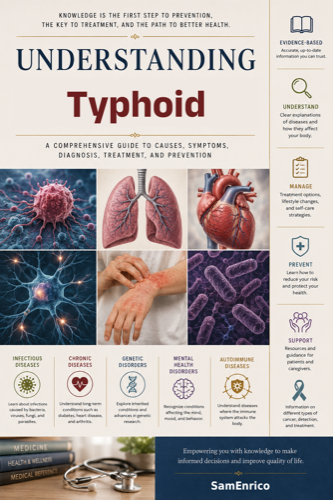
Understanding Typhoid eBook
This disease publication, published by SamEnrico,
by Roldan Chara
This disease publication, published by SamEnrico, covers Understanding Typhoid
Formats
Free sample
Chapter 1: The Dinner That Killed a Family--The call came in at 2:17 on a Tuesday morning.Dr. Fatima Khan, the senior infectious disease physician on call at Pakistan Institute of Medical Sciences in Islamabad, had been asleep for barely ninety minutes when her pager erupted. She had learned, over fifteen years of practicing medicine in one of the world's most chaotic public hospitals, that pages in the dead of night were never good news. But this one was different. This one would haunt her."Four members of same family.
Fever, altered mental status, two with gastrointestinal bleeding. ETA ten minutes."She pulled on her white coat and walked toward the emergency department, already running through the possibilities. Viral hemorrhagic fevers? Dengue was everywhere that year. Crimean-Congo hemorrhagic fever was always a possibility in rural Pakistan.
But four from the same family suggested something else. Something transmissible. Something in their home, their food, their water.The ambulances arrived together, as if the family had planned their descent into hell as a coordinated operation. The father came first, strapped to a stretcher, his eyes open but unseeing—a vacant, thousand-yard stare that Dr. Khan had learned to recognize as the look of someone who had left their body before their body had finished dying.
His blood pressure was 80 over 40. His abdomen was distended, rigid, and when the emergency medical technician pulled back the sheet, Dr. Khan saw what she had been hoping not to see: a fine, salmon-colored rash scattered across his trunk, each spot barely larger than a pinprick, blanching under pressure.Rose spots.She had seen them perhaps a dozen times in her career. Each time, her heart sank.The grandmother came next. Seventy-two years old, diabetic, already hypotensive.
She was moaning something in a dialect of Pashto that the nurse could not understand, but the meaning was clear enough: she was dying. Her oxygen saturation was 82 percent on room air. Her abdomen, like the father's, was rigid and distended.The toddler arrived in the arms of a screaming mother who was, herself, clearly ill. The mother would later be admitted as the fifth family member, but in the chaos of that moment, she refused to let go of her son. The boy was three years old.
He was seizing.The tenth patient from that single family—the cook—would never arrive at all. She had no symptoms, no fever, no rash, no pain. She felt perfectly fine. She would go home that night and cook for another family the next day, never knowing that she was one of the most dangerous people in Islamabad.Within seventy-two hours, the father would be in the operating room, his small intestine perforated in three places, fecal matter spilling into his peritoneal cavity like a slow, unstoppable poison. The grandmother would never leave the ICU.
The toddler would survive but would lose 40 percent of his body weight and spend six weeks learning to walk again.The cause: typhoid fever. Not the typhoid of history textbooks, not the typhoid of Joseph Bazalgette's London or the tenements of early 20th-century New York. This was modern typhoid. Extensively drug-resistant typhoid. Typhoid that had already defeated chloramphenicol, ampicillin, co-trimoxazole, ciprofloxacin, and ceftriaxone.
Typhoid that laughed at the standard treatments hanging in bright bags on the hospital pharmacy shelves.The cook, whose name was never released to protect her privacy, was a chronic carrier. She had recovered from a mild typhoid infection five years earlier—a few days of fever that she had treated with herbal teas and paracetamol, never seeing a doctor, never receiving a course of antibiotics. The bacteria had colonized her gallbladder, forming a biofilm on a small stone that she did not even know she had. She shed millions of bacteria in her feces every single day. She worked as a cook.
She did not always wash her hands.The family had ordered takeout to celebrate Eid. The cook had prepared their food. The rest was a matter of biology, not bad luck.This book is about that cook. And about that family. And about you.Because here is the truth that most Westerners do not know, that most travel clinics do not emphasize, that most general practitioners would not recognize if it walked into their examination rooms: typhoid fever is not a Victorian disease.
It is not a relic of a pre-antibiotic past. It is not something that only happens to people who trek in Nepal or volunteer in orphanages in Kolkata.Typhoid is a modern, rapidly evolving, drug-resistant pathogen that has already breached the borders of the wealthiest nations on earth. In the last decade alone, there have been outbreaks in Los Angeles (linked to a food handler at a upscale restaurant), in London (traced to a street food vendor), in Melbourne (a single family gathering that sickened eighteen people). The only reason these outbreaks did not make international headlines is that they were contained—barely—by robust public health systems that many countries are now dismantling.And here is the even more uncomfortable truth: you are more likely to catch typhoid than you think. Not in the statistical, abstract, one-in-a-million sense.
In the real, visceral, the-person-next-to-you-at-the-buffet sense. Every time you eat food prepared by someone whose hands you cannot see, you are placing your trust in that person's hygiene, that person's health status, that person's gallbladder. Most of the time, that trust is warranted. But when it is not, the consequences can be catastrophic.Understanding Typhoid, The Resurgent Threat of an Ancient Disease is not a textbook. It is not a dry recitation of epidemiological statistics, though you will find those here.
It is not a clinical manual for infectious disease specialists, though they may learn something from its pages. It is, instead, a detective story, a warning, a guide, and a call to action. It is the story of a bacterium that has evolved to become one of the most successful pathogens in human history. It is the story of the humans who have fought it—sometimes heroically, sometimes incompetently, always incompletely. And it is the story of the future: a future in which typhoid may once again become a routine cause of death in wealthy countries if we do not pay attention.Before we go any further, let us be precise about what we are talking about.
Typhoid fever is caused by a specific bacterium: Salmonella enterica serovar Typhi, often abbreviated as S. Typhi. It is a close relative of the bacteria that cause common food poisoning (Salmonella Typhimurium and Salmonella Enteritidis), but it is fundamentally different in one crucial way: S. Typhi is exquisitely adapted to humans. It has no significant animal reservoir.
It cannot survive for long outside the human body. It lives in us, spreads through us, and depends entirely on us for its continued existence on this planet.There is a related group of bacteria called Salmonella Paratyphi A, B, and C, which cause a clinically indistinguishable illness called paratyphoid fever. Together, typhoid and paratyphoid are referred to as enteric fever. For the purposes of this book, when we say "typhoid," we are usually including paratyphoid unless otherwise specified, because the differences matter much more to a…
This is the end of the free sample. Get the eBook to keep going. Buy now
About this book
Details
- Author
- Roldan Chara
- Publisher
- SamEnrico
- Language
- English
- Genre
- Non-Fiction, Informative, Educational
- Released
- 2026-05-23
- Pages (approx.)
- 147
- Available as
- eBook, Audiobook

Read better in the ZLOADR app
Your eBooks on your phone or tablet. Sign in with your SamEnrico account and start reading.
More by Roldan Chara
 Your Name Influence TechniqueRoldan Chara$11.99
 Self Talk Transformation WorkbookRoldan Chara$11.99
 Promotion Denial Anger GuideRoldan Chara$11.99Promotion Denial Anger GuideRoldan Chara$11.99
 Benzodiazepine Taper PlanRoldan Chara$11.99
 The Middlesex School LifeRoldan Chara$11.99
 Wellington's Gambit: The Mastermind of the Peninsular WarRoldan Chara$11.99
 How to Start a Petrol Station Pump Business (Beginners Guide)Roldan Chara$11.99
 London Angel Investor GuideRoldan Chara$12.99
 VAT Policy Outlook 2026Roldan Chara$12.99
 Dropshipping Store Business LaunchRoldan Chara$11.99
You may also like
 Hong Kong Handover 1997Dunn Johnnie$11.99
 Zumba For Postnatal Recovery CourseNeal Christian$11.99
 Zumba for BeginnersLadner Nikia$11.99
 YouTube Comment Mining GuideHumes Pandora$12.99
 Worry Box MeditationCarlin Rudy$11.99
 Workplace Stress MeditationNguyen Lynn$11.99
 Workplace Stress and Sleep RepairHawley Ivory$11.99
 Workplace Perfectionism CureDelaney Jeffry$11.99
 Workplace Injustice Anger GuideWallen Isabelle$11.99
 Work Addiction and Burnout LinkGreenwood Ester$11.99
 Women in Yoga and WellnessBeattie Galina$11.99
 Women in Stand Up ComedyChun Evangeline$11.99