
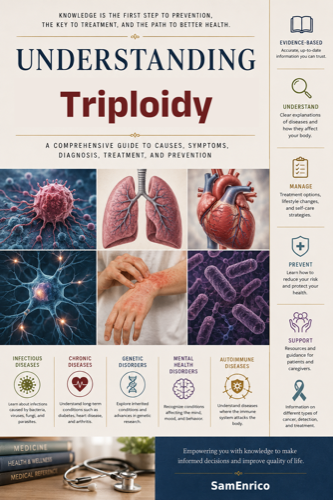
Non-FictionInformativeEducational
Understanding Triploidy eBook
This disease publication, published by SamEnrico,
This disease publication, published by SamEnrico, covers Understanding Triploidy
Formats
Free sample
Chapter 1: More Than Chromosomes...--The call always comes when you least expect it. Perhaps it arrives in a hushed consultation room with fluorescent lights buzzing overhead, the genetic counselor’s voice gentle but her words clinical. Perhaps it appears as a flagged result on a patient portal late at night, numbers and percentages that make no sense because nothing about this moment was supposed to make sense. Or perhaps it comes during a routine ultrasound, when the technician grows quiet, excuses herself, and returns with a physician whose expression has already begun the conversation before any words are spoken. “We’ve found something concerning,” they say.
And in that instant, your entire understanding of pregnancy, of parenthood, of the future you had begun to imagine, fractures into before and after.This book is for everyone who has received that call. It is for the parents who heard the word “triploidy” and felt their world shrink around an unfamiliar string of syllables. It is for the grandmothers who want to understand what their daughter is going through. It is for the obstetricians, midwives, genetic counselors, and nurses who guide families through this devastating diagnosis and wish they had a single, compassionate, comprehensive resource to recommend. It is for the grieving siblings who will one day ask why their baby brother or sister never came home.
And it is for the researchers and students who seek to understand a condition that, while universally fatal, teaches us profound lessons about human development, genetics, and the limits and possibilities of prenatal medicine.Understanding triploidy requires walking two paths simultaneously. One path is purely medical: chromosomes, cellular mechanisms, ultrasound findings, genetic testing, and clinical management. The other path is deeply human: grief, love, impossible decisions, the sacred work of memory-making, and the slow, non-linear journey toward healing after a loss that society often fails to acknowledge. This book refuses to separate these paths. You cannot understand triploidy without understanding both, and you cannot write a helpful guide that sacrifices cold science for warm sentiment or, conversely, that presents data without acknowledging the human beings for whom that data represents their child.Let us begin, then, with the most fundamental question: What is triploidy?At its simplest level, triploidy is a chromosomal condition in which a developing baby has 69 chromosomes instead of the typical 46.
To understand why this matters, we need to briefly review basic genetics. Human cells are normally diploid, meaning they contain two sets of 23 chromosomes—one set inherited from the biological mother and one set from the biological father. These 46 chromosomes carry all the genetic instructions necessary for the development, growth, and functioning of a human being. When a sperm and an egg fuse at conception, each contributes a haploid set—meaning a single set of 23 chromosomes—and together they form a genetically complete diploid embryo.Triploidy disrupts this elegant symmetry. In triploidy, the embryo receives an entire extra haploid set of 23 chromosomes, for a total of 69 chromosomes.
This extra set can come from either parent, and as we will explore in depth in Chapter 2, the parental origin dramatically affects how the condition presents clinically. But the core problem is this: human development is exquisitely calibrated to function with exactly two copies of each chromosome. Having three copies of every single chromosome—an extra complete set—creates a global imbalance in gene expression that fundamentally derails normal embryonic and fetal development. There is no gene-specific therapy, no surgical intervention, no postnatal treatment that can correct this. The developmental disruptions are simply too widespread and too profound.This brings us to the first and most important medical fact about triploidy: it is uniformly and universally fatal.
No baby with full triploidy has ever survived to live outside the womb for more than a few hours or, in extremely rare cases, days. The condition is not compatible with extrauterine life. This is not a matter of medical advancement or future hope; the biological barriers are insurmountable with current or foreseeable technology. Understanding this reality is painful, but it is also essential. When parents understand that triploidy is universally lethal, they are spared the false hope that sometimes accompanies other chromosomal conditions.
They can focus their energy on what matters most: making informed decisions about the pregnancy, protecting their own physical and mental health, and creating meaning and memory around a baby whose life will be brief.However, it is equally important to understand that “universally fatal” does not mean “uniformly brief.” Triploidy is not a single disease with a single trajectory. As we will explore in Chapter 6, the two genetic subtypes—digynic (maternal origin) and diandric (paternal origin)—have dramatically different presentations and pregnancy outcomes. Most triploid pregnancies end in spontaneous miscarriage during the first trimester, often before the woman even knows she is pregnant. But some continue into the second trimester, and a very small number reach the third trimester before ending in stillbirth or death shortly after delivery. The digynic (maternal origin) subtype, in particular, is more likely to progress into the second trimester, sometimes well into the second half of pregnancy.
This means that some parents carry their baby for many months after receiving a lethal diagnosis, navigating the complex emotional terrain of continuing a pregnancy they know will not end with a living child.This nuance is crucial. If the medical community simply says “triploidy is always fatal and usually ends in early miscarriage,” parents who find themselves at 18 or 24 or 30 weeks may feel confused or betrayed. They may wonder if their doctor was wrong, if there is hope after all. There is not. But the timeline matters enormously for medical management, for decision-making, and for emotional preparation.
Throughout this book, we will be precise about these distinctions while never losing sight of the underlying truth: triploidy is a lethal condition.Understanding what triploidy is also requires understanding what it is not. One of the most common sources of confusion is the difference between triploidy and trisomy. The terms sound similar, and both involve extra chromosomal material, but they are fundamentally different. Trisomy refers to the presence of one extra copy of a single chromosome. Down syndrome, for example, is trisomy 21: three copies of chromosome 21 instead of the usual two.
Edwards syndrome is trisomy 18. Patau syndrome is trisomy 13. In all of these conditions, the total chromosome count is 47 (not 69), and the extra genetic material is limited to one specific chromosome. Some trisomies are compatible with life, though they involve significant medical and developmental challenges. Triploidy, by contrast, involves an extra copy of every single chromosome.
That global imbalance is what makes triploidy universally fatal while some trisomies are not.Another source of confusion involves the term “partial mole” or “partial hydatidiform mole.” As we will discuss in detail in later chapters, the diandric (paternal origin) subtype of triploidy is associated with abnormal placental development characterized by cystic changes in the placental tissue. This is called a partial hydatidiform mole, and it carries distinct maternal health risks, including a significantly elevated risk of preeclampsia and a small but real risk of persistent gestational trophoblastic disease (GTN) after the pregnancy ends. However, not all triploidy involves a partial mole. The digynic (maternal origin) subtype…
This is the end of the free sample. Get the eBook to keep going. Buy now
About this book
Details
- Author
- Theriault Amberly
- Publisher
- SamEnrico
- Language
- English
- Genre
- Non-Fiction, Informative, Educational
- Released
- 2026-06-02
- Pages (approx.)
- 147
- Available as
- eBook, Audiobook

Read better in the ZLOADR app
Your eBooks on your phone or tablet. Sign in with your SamEnrico account and start reading.
More by Theriault Amberly
 TRIZ For Engineers GuideTheriault Amberly$11.99
 Mediterranean SustainabilityTheriault Amberly$11.99
 Building Healthy Intimacy PatternsTheriault Amberly$11.99
 Public Commitment TechniqueTheriault Amberly$11.99
 The France CV and Resume GuideTheriault Amberly$11.99
 The Luminary Minds of Africa: Black Nobel Laureates in ScienceTheriault Amberly$11.99
 How to Start a Cigars (retail) Business (Beginners Guide)Theriault Amberly$11.99
 Repatriating Franchise ProfitsTheriault Amberly$12.99
 African SaaS YC ApplicationTheriault Amberly$12.99
 Class AssistantTheriault Amberly$11.99
You may also like
 Hong Kong Handover 1997Dunn Johnnie$11.99
 Zumba For Postnatal Recovery CourseNeal Christian$11.99
 Zumba for BeginnersLadner Nikia$11.99
 YouTube Comment Mining GuideHumes Pandora$12.99
 Worry Box MeditationCarlin Rudy$11.99
 Workplace Stress MeditationNguyen Lynn$11.99
 Workplace Stress and Sleep RepairHawley Ivory$11.99
 Workplace Perfectionism CureDelaney Jeffry$11.99
 Workplace Injustice Anger GuideWallen Isabelle$11.99
 Work Addiction and Burnout LinkGreenwood Ester$11.99
 Women in Yoga and WellnessBeattie Galina$11.99
 Women in Stand Up ComedyChun Evangeline$11.99