
Non-FictionInformativeEducational
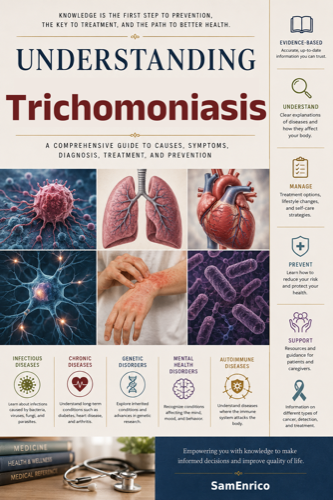
Understanding Trichomoniasis eBook
This disease publication, published by SamEnrico,
by Dow Loma
This disease publication, published by SamEnrico, covers Understanding Trichomoniasis
Formats
Free sample
Chapter 1: The Invisible Invader...–- It begins with a question you’ve probably never thought to ask. What if the most common sexually transmitted infection you’ve never heard of has been living inside your body—or the body of someone you love—for months or even years, causing damage in complete silence?Imagine waking up one morning with an unusual odor. Not the sharp, fishy smell you’ve read about online. Not the thick, clumpy discharge that sends you running to the pharmacy for an antifungal cream. Something different.
Something you can’t quite name. The odor is faint but persistent. The discharge, if there is any at all, is thin and slightly yellow-green. Maybe you feel a vague itching. Maybe urination stings just a little.
Or maybe—and this is the most common scenario by a wide margin—you feel absolutely nothing.This is the paradox of Trichomonas vaginalis, the single-celled protozoan parasite that causes trichomoniasis. It is simultaneously the most widespread curable sexually transmitted infection on the planet and the one most shrouded in ignorance, misdiagnosis, and misplaced shame. It infects an estimated 156 million people globally each year, surpassing chlamydia and gonorrhea combined. Yet ask ten randomly selected people what “trichomoniasis” means, and nine will give you a blank stare. The tenth might remember the word from a long-forgotten high school health class slide, filed away under “weird STIs that probably don’t matter.”But trichomoniasis does matter.
It matters enormously. It matters for the pregnant woman who goes into labor at thirty-two weeks, never knowing that a silent parasite weakened the membranes around her baby. It matters for the young woman who tests “negative for everything” three times while her symptoms persist, told by well-meaning doctors that “it’s probably just bacterial vaginosis again.” It matters for the man who carries the infection for a year without a single symptom, unknowingly passing it to every partner he sleeps with. And it matters for the couple whose relationship crumbles under the weight of mutual accusations—“You must have cheated!”—when neither one did.This book exists because silence is not safety. Silence is where trichomoniasis thrives.Let’s start with the basics of what we’re dealing with.
Trichomonas vaginalis belongs to a group of organisms called protozoa—single-celled eukaryotes, meaning their cells have a nucleus like our own cells do, unlike bacteria which lack organized nuclei. Under a microscope, the parasite appears as a plump, pear-shaped cell measuring approximately 7 to 23 micrometers in length. For perspective, that’s about one-tenth the width of a human hair. Despite its microscopic size, it is remarkably complex. Four whip-like structures called flagella sprout from its anterior end, beating in coordinated waves that propel the parasite through viscous fluids like vaginal discharge and seminal fluid.
A fifth flagellum runs backward along its body, embedded in an undulating membrane that ripples like a snake’s belly, providing additional motility in tight spaces.The parasite has no cyst stage. Unlike intestinal parasites such as Giardia or Cryptosporidium, which can survive for weeks in water or on surfaces by forming hardy cyst walls, Trichomonas vaginalis exists only as a fragile trophozoite—the active, feeding, reproducing form. Outside the human body, it dies within minutes to a few hours at most. It cannot survive drying, cannot withstand extreme temperatures, and requires a warm, moist, anaerobic (low-oxygen) environment to thrive. This biological fragility is the reason trichomoniasis is almost exclusively a sexually transmitted infection.
You cannot catch it from a toilet seat. You cannot catch it from a swimming pool. You cannot catch it from sharing towels, sheets, or bathing suits. These myths persist because they offer psychological comfort—the idea that one could acquire an STI through casual contact is terrifying—but they have no basis in biology. The parasite is exquisitely adapted to one environment and one environment only: the human urogenital tract.Once inside that environment, however, Trichomonas vaginalis becomes a formidable adversary.
The parasite adheres to squamous epithelial cells lining the vagina, cervix, urethra, and sometimes the prostate using specialized surface proteins called adhesins. Among the most studied are AP65, AP51, and AP33. These adhesins recognize and bind to specific receptor molecules on human cell surfaces—think of them as molecular keys fitting perfectly into human locks. Once attached, the parasite does not simply sit passively. It begins to damage its host through multiple mechanisms simultaneously.First, the physical act of attachment triggers localized inflammation.
The human immune system recognizes the parasite as foreign and mounts a response, flooding the infected area with white blood cells (neutrophils and macrophages) and inflammatory signaling molecules called cytokines (IL-6, IL-8, and TNF-alpha in particular). This inflammation is responsible for many of the classic symptoms—itching, burning, redness, and discomfort—but it also causes collateral damage to healthy tissue. Inflammatory cells release enzymes and free radicals intended to kill the parasite, but these same weapons damage the surrounding epithelial cells.Second, Trichomonas vaginalis secretes its own destructive enzymes. Proteases—enzymes that break down proteins—are released from specialized organelles called hydrogenosomes (the parasite’s energy-producing structures, which function like primitive mitochondria). These proteases degrade the extracellular matrix that holds epithelial cells together, creating microscopic gaps in the protective barrier of the urogenital lining.
They also degrade immunoglobulins (antibodies) that would otherwise neutralize the parasite, essentially disarming the immune system’s most specific weapons. One particularly well-studied protease, called Tv MP50, has been shown to degrade human hemoglobin, allowing the parasite to scavenge iron for its own metabolism while simultaneously causing microbleeding in the infected tissues—hence the punctate hemorrhages seen in “strawberry cervix.”Third, the parasite consumes and destroys epithelial cells directly through a process called phagocytosis. Trichomonas vaginalis can engulf fragments of human cells, digesting them internally for nutrition. Electron microscope studies have captured stunning images of the parasite’s undulating membrane wrapping around blebs of human cellular material, pulling them into food vacuoles where they are dissolved by hydrolytic enzymes.The result of this three-pronged attack is a compromised epithelial barrier, chronic low-grade inflammation, and a state of increased susceptibility to other infections. This last point is critical and will be explored in depth later in this book.
For now, understand this: a person with untreated trichomoniasis does not simply have a parasite. They have an open door for HIV, HPV, and other sexually transmitted pathogens.The Myths That Keep Us Silent Before we go further, let’s clear the air. Trichomoniasis is surrounded by a constellation of myths, many of which persist even in medical settings. Some of these myths cause direct harm by delaying diagnosis and treatment. Others cause indirect harm by fueling stigma and shame.
Let’s dismantle the most dangerous ones right now.Myth #1: Trichomoniasis always causes symptoms. This is perhaps the most destructive myth. In reality, approximately 85% of infected men and 50-60% of infected women have no symptoms at the time of diagnosis. They are silent carriers, completely unaware that they are infected and infectious. This asymmetry—men far more likely to be asymptomatic than women—is the engine that drives the epidemic.
A man with no symptoms may carry the parasite for months or years, passing it to every female partner. Those…
This is the end of the free sample. Get the eBook to keep going. Buy now
About this book
Details
- Author
- Dow Loma
- Publisher
- SamEnrico
- Language
- English
- Genre
- Non-Fiction, Informative, Educational
- Released
- 2026-05-11
- Pages (approx.)
- 147
- Available as
- eBook, Audiobook

Read better in the ZLOADR app
Your eBooks on your phone or tablet. Sign in with your SamEnrico account and start reading.
More by Dow Loma
 The Credit Stealing CoworkerDow Loma$11.99
 Values And Mission Alignment Psychological Safety Connection HandbookDow Loma$11.99
 Toxic Workplace Anger PlanDow Loma$11.99
 Forgiving a Narcissist GuideDow Loma$11.99
 The Designer's Creative BlockDow Loma$11.99
 The Great Barrier Reef's Silent Scream: How One Heatwave Erased 500 Years of CoralDow Loma$11.99
 AWS Devops EngineerDow Loma$11.99
 Strategyzer Remote GuideDow Loma$12.99
 Franchisee Training Across CulturesDow Loma$12.99
 How to Start a Camping Vehicles (used) (wholesale) Business (Beginners Guide)Dow Loma$11.99
You may also like
 Hong Kong Handover 1997Dunn Johnnie$11.99
 Zumba For Postnatal Recovery CourseNeal Christian$11.99
 Zumba for BeginnersLadner Nikia$11.99
 YouTube Comment Mining GuideHumes Pandora$12.99
 Worry Box MeditationCarlin Rudy$11.99
 Workplace Stress MeditationNguyen Lynn$11.99
 Workplace Stress and Sleep RepairHawley Ivory$11.99
 Workplace Perfectionism CureDelaney Jeffry$11.99
 Workplace Injustice Anger GuideWallen Isabelle$11.99
 Work Addiction and Burnout LinkGreenwood Ester$11.99
 Women in Yoga and WellnessBeattie Galina$11.99
 Women in Stand Up ComedyChun Evangeline$11.99