
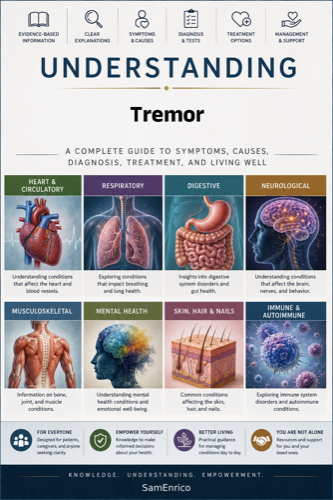
Non-FictionInformativeEducational
Understanding Tremor eBook
This condition publication, published by SamEnrico
This condition publication, published by SamEnrico, covers Understanding Tremor
Formats
Free sample
Chapter 1: Beyond the Shakes...--–- Margaret had been playing the piano since she was six years old. For fifty-two years, her fingers had danced across the keys with a precision that required no conscious thought—the way most people breathe or blink. She could close her eyes and feel the muscle memory in her hands, the way each fingertip knew exactly where to land, how much pressure to apply, when to lift and when to linger. The piano was not an instrument she played; it was an extension of her nervous system, a prosthetic voice for emotions that words could never capture.Then, one Tuesday afternoon in October, she poured tea for a friend who had come to visit. Nothing about the day was remarkable.
The tea was Earl Grey, the same brand she had been drinking for decades. The cup was her favorite ceramic mug, glazed in a deep cobalt blue that her youngest daughter had made in a pottery class. She lifted the teapot—a simple, everyday motion performed thousands of times—and watched in confusion as the stream of amber liquid veered wildly to the left, splashing across the saucer and pooling on the polished wood of the dining table."I'm so sorry," she said, laughing it off. "I must be more tired than I thought."But the tremor did not go away. It appeared the next morning when she tried to write a grocery list.
It appeared the following week when she reached for a book on her nightstand. It appeared at the dinner table when she tried to bring a forkful of pasta to her mouth, the food tumbling back onto the plate before it reached her lips. And it appeared, most devastatingly, when she sat down at her beloved Steinway and tried to play Chopin. Her right hand, which had once executed trills with mechanical perfection, now produced a wavering, uncertain sound—not the music she intended, but something else entirely. Something that sounded, to her ears, like a body betraying its owner.Margaret's story is not unique.
It is, in fact, so common that it has become a kind of silent epidemic—millions of people around the world experiencing the same bewildering loss of control, the same slow erosion of competence, the same mounting frustration of a body that will no longer follow instructions. And yet, when Margaret went to her doctor, she was told something that millions of others have also been told: "It's probably just stress." Or, "You're getting older; these things happen." Or, most damaging of all, "I think you might have the beginning stages of Parkinson's disease."She did not have Parkinson's. She had Essential Tremor—the most common movement disorder in the world, affecting an estimated seven to ten million Americans alone, roughly four times the number of people with Parkinson's disease. But like the vast majority of those seven to ten million people, she had never heard of it. And neither, it turned out, had her general practitioner.The Myth We All Believe There is a pervasive, almost unshakable belief in our culture that any involuntary shaking must be a sign of Parkinson's disease.
This belief is reinforced by Hollywood (where tremulous hands are the visual shorthand for a character with a degenerative neurological condition), by the media (where every politician or celebrity observed with a shaky hand is immediately speculated to have Parkinson's), and by well-meaning family members who have seen one too many public service announcements. The result is a population that is simultaneously terrified of the wrong disease and profoundly ignorant of the actual one.Essential Tremor (ET) is not Parkinson's disease. The two conditions are neurologically distinct, clinically different, and respond to completely different treatments. They do not even primarily affect the same parts of the brain. Parkinson's is a disorder of the basal ganglia—structures deep within the brain that are responsible for initiating and smoothing voluntary movement.
Essential Tremor is primarily a disorder of the cerebellum and the thalamus—the brain's coordination center and its sensory relay station. To confuse them is not just a harmless mistake; it is a medical error that can lead to years of unnecessary medications, inappropriate treatments, and delayed access to therapies that might actually help.And yet, misdiagnosis is rampant. Studies suggest that up to fifty percent of people with Essential Tremor are initially told they have Parkinson's disease. They are prescribed dopamine replacement medications that do nothing for their tremor (because ET does not involve dopamine deficiency) but may cause serious side effects, including nausea, dizziness, confusion, and, in some cases, impulse control disorders such as pathological gambling or hypersexuality. They spend months or years believing they have a progressive, debilitating neurodegenerative disease that will eventually rob them of their ability to walk, talk, and think clearly—a terrifying prospect that is completely inaccurate for the vast majority of ET patients.This book exists to correct that error, and to do so much more.What This Chapter Will Accomplish Before we dive into the anatomy, the diagnosis, the treatments, and the strategies that will fill the remaining chapters of this book, we must first establish a shared understanding of what we are actually talking about.
This chapter has four goals:First, to define tremor in clear, precise terms—not the vague, colloquial understanding of "shaking," but a clinically meaningful definition that distinguishes tremor from other movement disorders like tics, myoclonus, and chorea.Second, to introduce the biopsychosocial model of tremor, which will serve as the organizing framework for the entire book. This model recognizes that tremor is not merely a mechanical problem of faulty neural signals, but a condition with physical, emotional, and social dimensions that must all be addressed for successful management.Third, to explore the lived experience of tremor in honest, unflinching detail—not to frighten the reader, but to validate the frustration, embarrassment, and grief that often accompany this condition. If you are reading this book because you or someone you love has tremor, you need to know that your emotional response is normal, expected, and shared by millions of others.Fourth, to set realistic expectations for what this book can and cannot do. It cannot cure tremor. No book can, because no cure currently exists for most tremor disorders.
But this book can provide a comprehensive roadmap for understanding, diagnosing, managing, and living well with tremor. It can help you distinguish between the tremors that matter and the tremors that don't. It can give you the vocabulary and the tools to advocate for yourself in a medical system that often fails patients with movement disorders. And it can, perhaps most importantly, help you reclaim a sense of agency and hope in the face of a condition that can feel deeply disempowering.Let us begin with the basics.What Is a Tremor, Exactly?In clinical terms, a tremor is a rhythmic, involuntary oscillatory movement of a body part. Let us unpack each element of that definition.Rhythmic means that the movement follows a regular, repeating pattern.
This is what distinguishes tremor from other involuntary movements. A tic, for example, is typically a sudden, brief, non-rhythmic movement—a shoulder shrug, a throat…
This is the end of the free sample. Get the eBook to keep going. Buy now
About this book
Details
- Author
- Ambrose Cameron
- Publisher
- SamEnrico
- Language
- English
- Genre
- Non-Fiction, Informative, Educational
- Released
- 2026-05-06
- Pages (approx.)
- 150
- Available as
- eBook, Audiobook

Read better in the ZLOADR app
Your eBooks on your phone or tablet. Sign in with your SamEnrico account and start reading.
More by Ambrose Cameron
 Keto For Cancer Metabolic TherapyAmbrose Cameron$11.99
 Anger De escalation for CoworkersAmbrose Cameron$11.99
 Time Boundaries GuideAmbrose Cameron$11.99
 Enmeshed Family Self BoundariesAmbrose Cameron$11.99
 Stay at Home Parent GamblingAmbrose Cameron$11.99
 Underground Cave System TheoryAmbrose Cameron$11.99
 Therapist Guide To Nightmare RescriptingAmbrose Cameron$11.99
 Professor Communication TipsAmbrose Cameron$11.99
 The Healers of Nubia: The Lost Medical Wisdom of the Kushite KingdomAmbrose Cameron$11.99
 Armada: The Storm That Shattered Spain's DreamAmbrose Cameron$11.99
 How to Produce Golf ToysAmbrose Cameron$11.99
 How to Produce Spoon RestsAmbrose Cameron$11.99
You may also like
 Hong Kong Handover 1997Dunn Johnnie$11.99
 Zumba For Postnatal Recovery CourseNeal Christian$11.99
 Zumba for BeginnersLadner Nikia$11.99
 YouTube Comment Mining GuideHumes Pandora$12.99
 Worry Box MeditationCarlin Rudy$11.99
 Workplace Stress MeditationNguyen Lynn$11.99
 Workplace Stress and Sleep RepairHawley Ivory$11.99
 Workplace Perfectionism CureDelaney Jeffry$11.99
 Workplace Injustice Anger GuideWallen Isabelle$11.99
 Work Addiction and Burnout LinkGreenwood Ester$11.99
 Women in Yoga and WellnessBeattie Galina$11.99
 Women in Stand Up ComedyChun Evangeline$11.99