
Non-FictionInformativeEducational
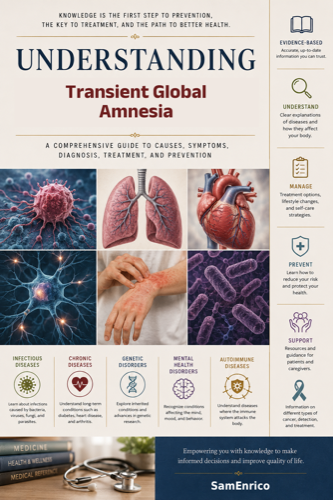
Understanding Transient Global Amnesia eBook
This disease publication, published by SamEnrico,
This disease publication, published by SamEnrico, covers Understanding Transient Global Amnesia
Formats
Free sample
Chapter 1: The Vanishing Hour...--The last thing he remembered was the smell of cut grass. Frank, a 62-year-old retired firefighter, had spent the morning mowing his lawn under a bright June sun. He remembered the pull cord on the mower, the weight of the sweaty grass clippings in the bag, and the satisfaction of a job done. Then he walked inside his house, looked at his wife of 38 years, and asked, "What are we having for dinner?"She told him it was 10:17 in the morning.He looked at her with genuine confusion, then concern, then a flicker of fear. "No," he said slowly, as if she were the one not understanding.
"I just finished work. It's 6 PM."That was the first loop. Over the next hour, Frank would ask the same question—"What time is it?"—approximately forty-seven times. Each time, his wife answered patiently. Each time, he reacted with the same genuine surprise, the same dawning confusion, the same quiet fear.
Between questions, he was perfectly himself: he joked about the neighbor's overgrown bushes, correctly identified every tool in the garage, and even quoted a line from his favorite John Wayne movie. But every ninety seconds, the reset button pressed. The last ten minutes vanished as if they had never existed. His brain had become a sieve, and time was running straight through it.By the time the paramedics arrived, Frank was sitting calmly on the couch, drinking a glass of water, and asking for the fourth time whether the ambulance was for him. He knew his name.
He knew his wife's face. He knew how to swallow, how to stand, how to shake hands with the emergency medical technician. But when the EMT asked, "Do you remember what happened this morning?" Frank smiled apologetically and said, "I was at work. I think. Did something happen?"This is Transient Global Amnesia.
It is one of the strangest, most frightening, and most misunderstood conditions in all of medicine. And Frank, like approximately five people out of every hundred thousand each year, was about to experience something that would terrify his family, puzzle his doctors, and ultimately—completely, miraculously, inexplicably—disappear.The Most Terrifying Thing You've Never Heard Of Let us be honest about something from the very first page: if you are reading this book because you or someone you love has just experienced an episode of Transient Global Amnesia, you are likely still trembling. Not from cold. Not from exhaustion. From fear.
Because watching a healthy, sharp, capable person suddenly lose the ability to form new memories—while remaining perfectly awake and otherwise functional—is a special kind of horror. It is not the dramatic horror of a seizure or the obvious alarm of a stroke. It is quieter, stranger, and in some ways more unsettling. The person you love is still there. They can talk to you.
They can walk to the bathroom. They can tell you their birthday and their mother's maiden name. But ask them what they had for breakfast, ask them why the paramedics are in the living room, ask them if they remember the conversation you just finished thirty seconds ago, and you will see it: the flicker of effort, the pause, the polite confusion, and then the same question they already asked three minutes earlier.This is not dementia. This is not a stroke. This is not a psychiatric breakdown.
This is not a seizure. This is not a concussion. This is not drug intoxication. This is not "just anxiety." And most importantly, for the vast majority of people who experience it, this is not permanent.Transient Global Amnesia, or TGA, is exactly what its name describes: a temporary (transient), complete (global), and isolated loss of the ability to form new memories, accompanied by a variable loss of recent memories, lasting anywhere from one to twenty-four hours. During an episode, the person remains awake, alert, interactive, and capable of performing complex learned tasks.
They can drive a car (which is why family members must immediately take away the keys, as we will discuss in Chapter 11). They can cook a meal. They can hold a conversation. But ask them what they did five minutes ago, and the answer will be a blank stare or a guess based on context rather than actual recall. They are, in the haunting phrase used by neurologists, "living in an eternal present." Every moment feels like the first moment.
Every answer is new. Every question is the first time they have ever asked it.The Island of Memory Loss To understand TGA, we must first understand a simple but profound distinction in how the brain handles memory. Human memory is not a single thing. It is not a filing cabinet or a hard drive or a tape recorder. It is a collection of different systems, each with its own anatomy, its own chemistry, and its own vulnerability to injury.The type of memory that vanishes in TGA is called episodic memory.
This is the memory of events, of experiences, of the narrative of your own life. What did you have for breakfast? That is episodic memory. What did you do last weekend? Episodic.
What happened five minutes ago? Also episodic. This type of memory depends critically on a seahorse-shaped structure deep inside the brain called the hippocampus—Latin for "seahorse," named for its curved shape. The hippocampus is the recording device of your life. It takes the continuous stream of your experience and stamps it into long-term storage.
Without a functioning hippocampus, new experiences simply do not stick. They flow through the brain like water through a sieve, leaving no trace.But here is the crucial insight that separates TGA from almost every other neurological condition: other types of memory remain perfectly intact.Procedural memory —the memory of how to do things—is preserved. Frank could still tie his shoes, drive his car, and recite lines from a movie he had not seen in twenty years. These are skills and habits, not events. They are stored in different parts of the brain (the basal ganglia and cerebellum), and they do not depend on the hippocampus.Semantic memory —the memory of facts and general knowledge—is largely preserved.
Frank knew that fire trucks are red, that the capital of his state was the capital, and that water is wet. He knew his wife's name and his own name and the name of the president. General knowledge survived.Working memory —the ability to hold a small amount of information in mind for a few seconds—is preserved. Frank could repeat a phone number back to you immediately after hearing it. He could follow a three-step instruction.
But within a minute, that information was gone.This is the "Island of Memory Loss" that gives TGA its bizarre, almost science-fiction quality. The patient is surrounded by a sea of intact cognitive function, standing on a tiny island of pure episodic amnesia. They can do almost everything except remember that they are doing it.What TGA Is Not (A First Look)Because TGA is rare and because its symptoms are alarming, it is often confused with other conditions. A full differential diagnosis appears in Chapter 4, but…
This is the end of the free sample. Get the eBook to keep going. Buy now
About this book
Details
- Author
- Falls Kayleigh
- Publisher
- SamEnrico
- Language
- English
- Genre
- Non-Fiction, Informative, Educational
- Released
- 2026-06-02
- Pages (approx.)
- 157
- Available as
- eBook, Audiobook

Read better in the ZLOADR app
Your eBooks on your phone or tablet. Sign in with your SamEnrico account and start reading.
More by Falls Kayleigh
 Values And Mission Alignment Employee Engagement HandbookFalls Kayleigh$11.99
 Difficult Email Anger ManagementFalls Kayleigh$11.99
 Affirmations for GrandparentingFalls Kayleigh$11.99
 Family Betrayal ForgivenessFalls Kayleigh$11.99
 The Hormone Sleep Connection GuideFalls Kayleigh$11.99
 Hannibal's Gambit: The Strategic Genius of CarthageFalls Kayleigh$11.99
 How to Start a Down Production Business (Beginners Guide)Falls Kayleigh$11.99
 Business Plan for MicrobusinessFalls Kayleigh$12.99
 Akira Replaces Sketch GuideFalls Kayleigh$12.99
 Voice Recognition System TrainerFalls Kayleigh$11.99
You may also like
 Hong Kong Handover 1997Dunn Johnnie$11.99
 Zumba For Postnatal Recovery CourseNeal Christian$11.99
 Zumba for BeginnersLadner Nikia$11.99
 YouTube Comment Mining GuideHumes Pandora$12.99
 Worry Box MeditationCarlin Rudy$11.99
 Workplace Stress MeditationNguyen Lynn$11.99
 Workplace Stress and Sleep RepairHawley Ivory$11.99
 Workplace Perfectionism CureDelaney Jeffry$11.99
 Workplace Injustice Anger GuideWallen Isabelle$11.99
 Work Addiction and Burnout LinkGreenwood Ester$11.99
 Women in Yoga and WellnessBeattie Galina$11.99
 Women in Stand Up ComedyChun Evangeline$11.99