
Non-FictionInformativeEducational
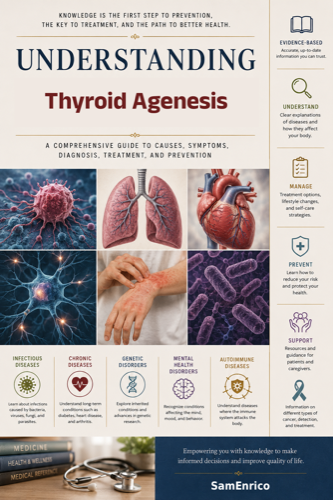
Understanding Thyroid Agenesis eBook
This disease publication, published by SamEnrico,
This disease publication, published by SamEnrico, covers Understanding Thyroid Agenesis
Formats
Free sample
Chapter 1: The Missing Butterfly...--The first time a parent hears the words “thyroid agenesis,” the room often goes silent. Not the peaceful silence of a sleeping newborn, but the heavy, suffocating quiet that follows an unexpected blow. The baby lies in the bassinet, pink-cheeked and perfect, ten fingers and ten toes, a full head of hair. Nothing about that tiny, squirming body suggests anything is wrong. And yet, the doctor is using words like “congenital,” “permanent,” and “lifelong treatment.” This is the paradox at the heart of thyroid agenesis: the most severe form of permanent congenital hypothyroidism wears a disguise.
It hides behind a healthy newborn’s smile.For parents, the disconnect is maddening. How can something so fundamental be missing when everything looks so normal? How does a baby survive without a gland that textbooks call the “master of metabolism”? The answer lies not in what is absent, but in what arrived early—a temporary gift from the mother that buys precious time. To understand thyroid agenesis, one must first understand the butterfly-shaped organ that never came to be.The Butterfly That Wasn’t: Understanding the Thyroid Gland In the human body, the thyroid gland sits low on the front of the neck, just below the Adam’s apple.
In a healthy adult, it weighs about 20 to 25 grams—roughly the size and shape of a butterfly, with two lobes (the wings) connected by a central isthmus (the body). Despite its modest size, this small gland produces hormones that influence virtually every cell, tissue, and organ in the body.The two primary hormones—thyroxine (T4) and triiodothyronine (T3)—act as the body’s thermostat and accelerator. They regulate how quickly the body uses energy, how fast the heart beats, how warm the body stays, and most critically for a developing baby, how the brain grows and wires itself. Without these hormones, metabolism slows to a crawl, body temperature drops, heart rate falters, and the developing brain cannot form the connections necessary for normal intelligence.Given this sweeping influence, one might assume that a baby born without a thyroid gland would be immediately and obviously unwell. But nature has an elegant workaround, and it begins months before birth.The Temporary Shield: How Maternal Hormones Mask the Absence During pregnancy, the mother’s thyroid does double duty.
Not only does it supply her own body’s needs, but it also sends a steady stream of thyroid hormone across the placenta to the growing fetus. This transfer begins around the 12th week of gestation and continues until delivery. For a fetus with thyroid agenesis, this maternal supply is a lifeline. Even though the baby’s own thyroid never formed, the mother’s hormones flood in, maintaining normal metabolism and protecting the developing brain throughout the critical months in utero.This is why virtually all babies with thyroid agenesis are born looking completely healthy. They have never known a moment without thyroid hormone—thanks entirely to their mother.
At birth, their cord blood may show normal or near-normal levels of T4, because the maternal supply has only just been cut off. The disguise holds, often for days or even weeks.But the mask does not last. Once the baby is born, the maternal hormone supply ceases. The newborn’s own thyroid—or in this case, the absence of it—must now take over. Without any thyroid tissue to produce T4, the baby’s levels begin to fall.
The body’s pituitary gland, sensing the drop, desperately signals the missing thyroid by releasing massive amounts of thyroid-stimulating hormone (TSH). This is the first clue that something is wrong, and it is why newborn screening saves lives.The Embryology of Absence: How the Thyroid Normally Forms To understand what went wrong in thyroid agenesis, one must look back to the first weeks of pregnancy, long before most mothers even know they are expecting. The thyroid gland does not simply appear in the neck. It embarks on a remarkable journey that begins high in the developing mouth.Around the third to fourth week of gestation, a small cluster of cells forms at the base of the future tongue, in an area called the foramen cecum. This cluster is known as the thyroid anlage—the primordial starting point of the gland.
Over the next several days, these cells begin to multiply and migrate downward, traveling through the developing neck along a pathway called the thyroglossal duct.By the seventh week of gestation, the migrating cells reach their final destination in the lower neck, just below the cricoid cartilage. There, they split into two lobes and form the characteristic butterfly shape. The thyroglossal duct normally degenerates and disappears, leaving behind only a small dimple on the tongue as a memory of the journey. The entire process, from the first cluster of cells to a fully formed gland, takes less than four weeks.In thyroid agenesis, this migration fails. Sometimes the cells never form at all.
Sometimes they form but never begin the journey downward. Sometimes they begin the migration but arrest so early that no functional tissue ever develops. In all cases, the result is the same: at the end of the seventh week, when the thyroid should have taken its place in the neck, there is nothing there. The thyroglossal duct may persist as a tiny remnant, but no functional thyroid tissue exists.This is not the same as having a small or underactive thyroid. It is not the same as having a thyroid that works poorly.
It is the complete and permanent absence of the gland itself.Agenesis vs. Hypoplasia vs. Ectopy: Why Precision Matters One of the most common sources of confusion for parents and even some clinicians is the distinction between different forms of congenital hypothyroidism. Not all cases are the same, and the differences have profound implications for treatment and prognosis.Thyroid agenesis (also called athyreosis) is the complete absence of any thyroid tissue. No gland formed.
No gland migrated. No cells remain anywhere in the body that can produce thyroid hormone. This is the most severe form of permanent congenital hypothyroidism. There is no backup, no residual function, and no possibility of “outgrowing” it. The patient will require lifelong levothyroxine therapy.Thyroid hypoplasia occurs when a thyroid gland forms but remains abnormally small.
It may be located in the correct position (in the neck) but is undersized and produces insufficient hormone. Some children with hypoplasia have enough residual function to produce partial amounts of thyroid hormone, though most still require treatment. The degree of insufficiency varies widely.Thyroid ectopy is perhaps the most interesting variant. In ectopy, the thyroid cells begin their migration but stop somewhere along the path—most commonly at the base of the tongue (lingual thyroid) or somewhere along the thyroglossal duct. These cells are functional; they produce thyroid hormone.
But because they are in the wrong location, they cannot produce enough to meet the body’s needs. Some patients with lingual thyroid have surprisingly high function, but most still require supplementation.Why does this distinction matter? Because a child with hypoplasia or ectopy has some remaining thyroid tissue, which may provide a baseline level of hormone production. In agenesis, there is…
This is the end of the free sample. Get the eBook to keep going. Buy now
About this book
Details
- Author
- Whitehurst Myles
- Publisher
- SamEnrico
- Language
- English
- Genre
- Non-Fiction, Informative, Educational
- Released
- 2026-06-02
- Pages (approx.)
- 148
- Available as
- eBook, Audiobook

Read better in the ZLOADR app
Your eBooks on your phone or tablet. Sign in with your SamEnrico account and start reading.
More by Whitehurst Myles
 Mortgage Broker Stress GuideWhitehurst Myles$11.99
 Envy and PerfectionismWhitehurst Myles$11.99
 The IBS and Pelvic Floor GuideWhitehurst Myles$11.99
 TM for Immune Health GuideWhitehurst Myles$11.99
 The Horse Loss Bereavement GuideWhitehurst Myles$11.99
 The Harmonic Visionary: Thomas Wiggins, the Blind Prodigy Who Redefined American MusicWhitehurst Myles$11.99
 Egypt Invoice Factoring GuideWhitehurst Myles$12.99
 How to Become a Dry-cell TesterWhitehurst Myles$11.99
 SDR Team LeadWhitehurst Myles$11.99
You may also like
 Hong Kong Handover 1997Dunn Johnnie$11.99
 Zumba For Postnatal Recovery CourseNeal Christian$11.99
 Zumba for BeginnersLadner Nikia$11.99
 YouTube Comment Mining GuideHumes Pandora$12.99
 Worry Box MeditationCarlin Rudy$11.99
 Workplace Stress MeditationNguyen Lynn$11.99
 Workplace Stress and Sleep RepairHawley Ivory$11.99
 Workplace Perfectionism CureDelaney Jeffry$11.99
 Workplace Injustice Anger GuideWallen Isabelle$11.99
 Work Addiction and Burnout LinkGreenwood Ester$11.99
 Women in Yoga and WellnessBeattie Galina$11.99
 Women in Stand Up ComedyChun Evangeline$11.99