
Non-FictionInformativeEducational
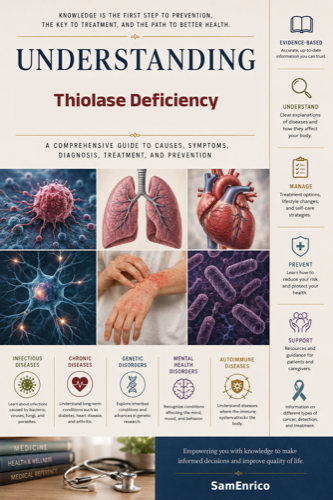
Understanding Thiolase Deficiency eBook
This disease publication, published by SamEnrico,
This disease publication, published by SamEnrico, covers Understanding Thiolase Deficiency
Formats
Free sample
Chapter 1: The Gatekeeper’s Silence...--The human body is a factory that never sleeps. Every second of every minute of every day, trillions of microscopic machines work in perfect coordination to keep you alive. They break down the food you eat, extract its energy, build new tissues, eliminate waste, and repair damage—all without a single conscious thought from you. This automated symphony is called metabolism, and for the vast majority of people, it plays flawlessly from birth to death. But for a small number of families around the world, that symphony hits a jarring, terrifying note.
The music doesn't stop entirely. It just... stumbles. And that stumble, that single broken instrument in the orchestra, can mean the difference between a healthy child and a medical emergency that appears out of nowhere, often disguised as something as ordinary as a stomach bug.This chapter is about that broken instrument. It's about the enzyme called thiolase, the role it plays in your body's energy production, and what happens when it fails to do its job.
More importantly, this chapter is the foundation upon which everything else in this book is built. If you don't understand how a healthy metabolism works, you will never truly understand why a child with Thiolase deficiency cannot skip breakfast, why a simple fever can become a life-threatening crisis, or why the dietary restrictions that seem so burdensome are actually the difference between thriving and suffering. So let us begin at the beginning. Let us enter the factory.The City Power Grid: A Metaphor for Your Metabolism Imagine, for a moment, that your body is a large city. This city has millions of residents (your cells), each one needing electricity to function.
The city's power grid is your metabolism. The fuel for this power grid comes from three sources, delivered daily through the food you eat: carbohydrates, fats, and proteins.Carbohydrates are like natural gas. They burn quickly and cleanly, providing immediate energy for the city's most urgent needs. When you eat a piece of bread or a banana, your body breaks it down into glucose, which enters your cells and is used right away. Any leftover glucose is stored in the liver as glycogen—think of this as a backup battery for the city, ready to be used between meals or during exercise.Fats are like coal.
They burn more slowly than carbohydrates, but they provide a much larger, more sustained energy supply. Your body stores fat in adipose tissue, and when you sleep or fast between meals, your city gradually switches from burning natural gas (glucose) to burning coal (fatty acids). This is normal, efficient, and healthy.Proteins are like the emergency supply of firewood. Your body prefers not to burn protein for energy because protein is primarily used for building and repairing structures—muscles, organs, enzymes, hormones, and immune cells. But in times of extreme fuel shortage (starvation, severe illness, or prolonged fasting), your body will reluctantly break down its own protein to keep the lights on.
This process is called catabolism, and in most people, it's a last-resort survival mechanism.In a healthy city, the power grid switches seamlessly between these fuel sources. When you eat, carbohydrates are used first. Between meals, fats take over. And if you were to fast for more than a day, your body would begin breaking down protein, but this would be a slow, controlled process. The key word here is controlled.Now, imagine that one of the substations in this city's power grid has a faulty circuit breaker.
This substation is responsible for processing a specific type of fuel—a combination of a particular amino acid (from protein) called isoleucine, and the breakdown products of fats called ketone bodies. When this substation fails, the fuel doesn't get processed. It backs up. It accumulates. And instead of producing clean energy, it produces toxic smoke that spreads through the city, poisoning the residents (your cells) and eventually causing a city-wide blackout.That faulty circuit breaker is a deficiency of the enzyme thiolase.
And the toxic smoke is a collection of organic acids that build up in the blood and urine, leading to a dangerous condition called metabolic acidosis.What Is an Enzyme, and Why Should You Care?Before we go any further, we need to talk about enzymes. If metabolism is the factory, enzymes are the workers on the assembly line. Each enzyme has a specific job, and it does that job over and over again, millions of times per second, without getting tired.Enzymes are proteins—long chains of amino acids folded into complex three-dimensional shapes. That shape is crucial because it creates a specific pocket, called the active site, where a particular molecule (the substrate) fits perfectly. Think of it as a lock and key.
The enzyme is the lock, and the substrate is the key. Only the right key fits into the lock, and when it does, the enzyme performs a chemical reaction on the substrate, transforming it into a new molecule (the product). Then the enzyme releases the product and is ready to do it all over again.This lock-and-key specificity is why your body can perform thousands of different chemical reactions simultaneously without confusion. The enzyme that breaks down alcohol is not the same as the enzyme that digests lactose. The enzyme that builds cholesterol is not the same as the enzyme that breaks down fat.
Each worker knows exactly which task to perform and which raw material to use.Now, consider what happens when a worker is missing from the assembly line. The raw materials pile up. The next worker in line has nothing to do because the previous step never happened. The product that was supposed to be made never appears. And the backlog of raw materials starts causing problems—sometimes toxic problems.This is exactly what happens in Thiolase deficiency.
The worker (thiolase) is either completely absent or severely impaired. The raw materials (specific breakdown products of isoleucine and ketone bodies) pile up. And the resulting backlog leads to the production of toxic organic acids that poison the body's cells.The Specific Worker: Introducing Thiolase The full name of the enzyme we're discussing is mitochondrial acetoacetyl-Co A thiolase. That's a mouthful, so throughout this book, we will simply call it thiolase. But let's break down that name because it tells us exactly where this worker lives and what it does.Mitochondrial means the enzyme lives inside the mitochondria.
The mitochondria are tiny structures inside your cells often called the "powerhouses" because they generate most of the cell's energy. Every cell in your body (except red blood cells) contains hundreds or thousands of mitochondria. This is where the final stages of fuel processing occur, where the energy from carbohydrates, fats, and proteins is converted into a molecule called ATP—the universal energy currency of the cell.Acetoacetyl-Co A thiolase describes the specific chemical reaction the enzyme performs. It's responsible for splitting a molecule called acetoacetyl-Co A into two smaller molecules (acetyl-Co A) during the breakdown of ketone bodies. It's also involved in the final step of breaking down the amino acid isoleucine.In simpler terms, thiolase has two main jobs:Job One: Processing ketone bodies.…
This is the end of the free sample. Get the eBook to keep going. Buy now
About this book
Details
- Author
- Scruggs Catharine
- Publisher
- SamEnrico
- Language
- English
- Genre
- Non-Fiction, Informative, Educational
- Released
- 2026-05-18
- Pages (approx.)
- 152
- Available as
- eBook, Audiobook

Read better in the ZLOADR app
Your eBooks on your phone or tablet. Sign in with your SamEnrico account and start reading.
More by Scruggs Catharine
 Self Taught DBT GuideScruggs Catharine$11.99
 The Listening Spouse Infidelity RecoveryScruggs Catharine$11.99
 The IBS Travel GuideScruggs Catharine$11.99
 The Enrico Fermi NuclearScruggs Catharine$11.99
 Quick Calm for Frazzled ParentsScruggs Catharine$11.99
 The Poisoned Perfume: The Enigma of Styliana TsiknakisScruggs Catharine$11.99
 Product AssociateScruggs Catharine$11.99
 West African Export SettlementScruggs Catharine$12.99
 ARIPO Success TipsScruggs Catharine$12.99
 How to Become a Plate Assembler - Small BatteryScruggs Catharine$11.99
You may also like
 Hong Kong Handover 1997Dunn Johnnie$11.99
 Zumba For Postnatal Recovery CourseNeal Christian$11.99
 Zumba for BeginnersLadner Nikia$11.99
 YouTube Comment Mining GuideHumes Pandora$12.99
 Worry Box MeditationCarlin Rudy$11.99
 Workplace Stress MeditationNguyen Lynn$11.99
 Workplace Stress and Sleep RepairHawley Ivory$11.99
 Workplace Perfectionism CureDelaney Jeffry$11.99
 Workplace Injustice Anger GuideWallen Isabelle$11.99
 Work Addiction and Burnout LinkGreenwood Ester$11.99
 Women in Yoga and WellnessBeattie Galina$11.99
 Women in Stand Up ComedyChun Evangeline$11.99