
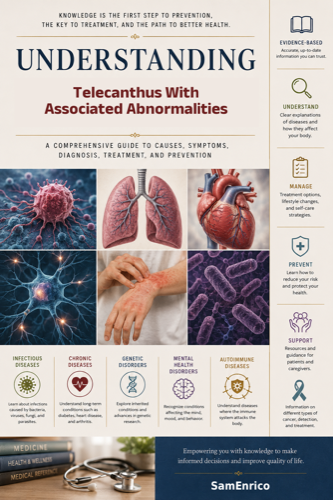
Non-FictionInformativeEducational
Understanding Telecanthus With Associated Abnormalities
This disease publication, published by SamEnrico,
by Heckman Kasi
This disease publication, published by SamEnrico, covers Understanding Telecanthus With Associated Abnormalities
Formats
About this book
Free sample
Chapter 1: The Widened Gaze...--The infant’s eyes were the first thing the nurses noticed. Not the color—though they were a striking, deep blue—but the space between them. Too wide, one nurse whispered to another, as she placed the newborn on the warming table. The mother, exhausted but alert, reached for her child and paused. Something was different.
Not wrong, exactly. But different.That infant, whom we will call Maya, would spend the next four years of her life being told that her wide-set eyes were “just a family trait,” “nothing to worry about,” and “probably just how she looks.” It would take a failed hearing screening, a chance encounter with a geneticist at a birthday party, and a tearful consultation to finally arrive at a diagnosis: Waardenburg syndrome type 1. Maya’s telecanthus—the medical term for that widened gaze—was not an isolated quirk of anatomy. It was a clue. A visible signpost pointing to a constellation of associated abnormalities that had been hiding in plain sight.This chapter is about that clue.
It is about learning to see what the untrained eye misses. It is about understanding the difference between eyes that appear wide and eyes that truly are wide. And it is about acquiring the diagnostic tools that will allow you, whether you are a medical student, a parent, a geneticist, or a surgeon, to distinguish telecanthus from its many look-alikes—because that distinction is not an academic exercise. It is the first step toward a correct diagnosis, appropriate genetic counseling, timely surgical intervention, and, ultimately, a life lived with greater understanding and fewer surprises.The Problem with “Wide-Set Eyes”In clinical medicine, few descriptors are as deceptively simple—and as frequently misused—as “wide-set eyes.” The phrase appears in countless pediatric records, genetic consultation notes, and even popular media as a catch all for any face in which the eyes appear unusually separated. But this imprecision creates real harm.
A child with true orbital hypertelorism has a fundamentally different condition from a child with telecanthus. A child with pseudotelecanthus may need no treatment at…
This is the end of the free sample. Get the eBook to keep going. Buy now
Contents
- Chapter 1
- Chapter 2
- Chapter 3
- Chapter 4
- Chapter 5
- Chapter 6
- Chapter 7
- Chapter 8
- Chapter 9
- Chapter 10
- Chapter 11
- Chapter 12
Details
- Author
- Heckman Kasi
- Publisher
- SamEnrico
- Language
- English
- Genre
- Non-Fiction, Informative, Educational
- Released
- 2026-05-11
- Pages (approx.)
- 160
- Available as
- eBook, Audiobook

Read better in the ZLOADR app
Your eBooks on your phone or tablet. Sign in with your SamEnrico account and start reading.
More by Heckman Kasi
 Nightmare Resolution Incubation WorkbookHeckman Kasi$11.99
 Active Listening For CouplesHeckman Kasi$11.99
 DBT For ImmigrantsHeckman Kasi$11.99
 The Academic Crisis PlanHeckman Kasi$11.99
 The Celebrity Cyberstalker FilesHeckman Kasi$11.99
 Love and Loyalty at the Hydaspes: The Last Letters of HephaestionHeckman Kasi$11.99
 How to Start a Academic Network Business (Beginners Guide)Heckman Kasi$11.99
 South Korea Green Credit SystemHeckman Kasi$12.99
 Art Pop Up GuideHeckman Kasi$12.99
 Material CoordinatorHeckman Kasi$11.99
You may also like
 Hong Kong Handover 1997Dunn Johnnie$11.99
 Zumba For Postnatal Recovery CourseNeal Christian$11.99
 Zumba for BeginnersLadner Nikia$11.99
 YouTube Comment Mining GuideHumes Pandora$12.99
 Worry Box MeditationCarlin Rudy$11.99
 Workplace Stress MeditationNguyen Lynn$11.99
 Workplace Stress and Sleep RepairHawley Ivory$11.99
 Workplace Perfectionism CureDelaney Jeffry$11.99
 Workplace Injustice Anger GuideWallen Isabelle$11.99
 Work Addiction and Burnout LinkGreenwood Ester$11.99
 Women in Yoga and WellnessBeattie Galina$11.99
 Women in Stand Up ComedyChun Evangeline$11.99