
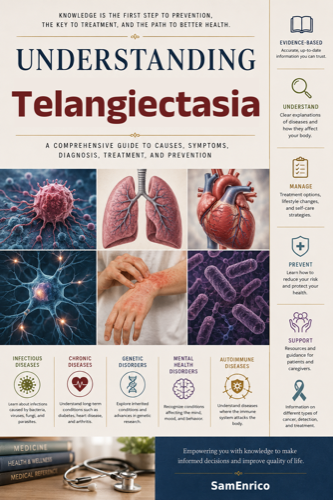
Non-FictionInformativeEducational
Understanding Telangiectasia eBook
This disease publication, published by SamEnrico,
This disease publication, published by SamEnrico, covers Understanding Telangiectasia
Formats
Free sample
Chapter 1: The Red Threads...--The first time I saw a telangiectasia kill someone, I almost missed it.I was a third-year medical student rotating through the emergency department, sleep-deprived and overconfident, when a forty-two-year-old woman named Catherine arrived by ambulance. She had come in for what she described as a "bad nosebleed"—the kind that had soaked through three towels on her drive to the hospital. Her blood pressure was stable. Her heart rate was slightly elevated but not alarming. She was talking, joking with the paramedics about ruining her favorite blouse.
On paper, she was fine.But then I looked at her hands.Between her index and middle fingers, clustered on the thenar eminence of her palm, were half a dozen small red spots. They looked like tiny spiders frozen mid-crawl—each one a central dot with fine legs radiating outward. I had seen similar marks on my grandmother's cheeks, on the legs of my pregnant sister-in-law. I had always been told they were nothing. Cosmetic.
A normal part of aging or hormones or standing too long at work.Something made me ask, "How long have you had those?"Catherine glanced at her palm. "Years," she said. "They come and go. My mother had them, too. Her mother, actually.
Four generations of women in my family with these stupid red dots. We call them the 'ladybug spots.'"I did not know then what I know now. I did not know that those "ladybug spots" were telangiectasias. I did not know that four generations of women with the same vascular marks suggested an autosomal dominant inheritance pattern. I did not know that a "simple nosebleed" in a middle-aged woman with a family history of red spots could be the first domino in a cascade that ends with a ruptured arteriovenous malformation in the lung, a paradoxical embolism to the brain, and a funeral.Catherine was discharged that night with nasal cautery and a referral to an ENT.
No one checked her oxygen saturation on room air. No one ordered a bubble echocardiogram. No one asked if she ever felt short of breath walking up stairs.Eight months later, she collapsed in her kitchen. The cause of death was a brain abscess—a pocket of infection that had traveled from her gut through a pulmonary AVM that should have been detected, should have been embolized, should have been a footnote rather than a fatality.The red threads on her hands were not cosmetic. They were warning signs.
And every physician who saw them—including me—failed to read them.This book exists because of Catherine, and because of the thousands of patients like her whose telangiectasias are dismissed as trivial until they are not. It exists because the same visible phenomenon—a dilated superficial blood vessel—can mean radically different things: a cosmetic annoyance on the thigh of a pregnant woman, a harbinger of liver failure on the cheek of a man with cirrhosis, or a diagnostic cornerstone of a life-threatening genetic disorder affecting one in five thousand people. Understanding the difference is not a matter of academic curiosity. It is a matter of life and death.What Is a Telangiectasia?Let us begin with a precise definition, because precision matters. A telangiectasia (plural: telangiectasias, or less commonly, telangiectases) is a permanently dilated superficial blood vessel—specifically, a post-capillary venule or capillary—that measures between 0.1 and 1.0 millimeters in diameter.
The word derives from the Greek telos (end), angeion (vessel), and ektasis (dilation): literally, "dilation at the end of a vessel."Telangiectasias appear as red, blue, or purple lines, dots, or branching patterns on the skin or mucous membranes. They blanch (turn white) when pressed firmly with a glass slide—a phenomenon called diascopy—and refill from the center outward when pressure is released. This distinguishes them from hemorrhagic lesions (purpura, petechiae), which do not blanch because the blood is extravasated outside the vessel.Understanding telangiectasias requires understanding what they are not. They are not:Cherry angiomas (bright red, dome-shaped papules that do not blanch and are completely benign)Spider angiomas (central pulsatile arteriole with radiating branches, associated with liver disease—more on this distinction shortly)Petechiae (tiny flat red dots from bleeding into the skin, do not blanch)Varicose veins (dilated veins >3mm, often tortuous and rope-like, associated with venous reflux)Telangiectasias occupy a unique middle ground: they are large enough to be visible to the naked eye, small enough to be dismissed as insignificant, and variable enough in their implications to cause diagnostic chaos. They can be present at birth or appear at age seventy.
They can remain stable for decades or multiply over months. They can cause no symptoms whatsoever or bleed profusely with minor trauma. They can be confined to the skin or signal severe disease in the lungs, liver, or brain.The goal of this book is to help you—whether you are a patient, a family member, or a clinician—navigate that variability. By the end of this chapter, you will understand the foundational distinction that organizes everything that follows: the difference between telangiectasias that are primarily a cosmetic or local medical concern, and those that are the visible surface of a systemic genetic disorder.A Map of the Territory: Primary vs. Secondary, Benign vs.
Dangerous All telangiectasias can be sorted into two broad categories based on their origin: primary (genetic) and secondary (acquired). This distinction is not merely academic—it determines whether you need to screen for internal AVMs, test your children, or simply apply makeup and move on with your life.Primary (Genetic) Telangiectasias Primary telangiectasias result from inherited mutations in genes that control blood vessel formation and maintenance. The most important by a wide margin—the one that justifies an entire section of this book—is Hereditary Hemorrhagic Telangiectasia (HHT) , also known as Osler-Weber-Rendu syndrome. We will spend Part III of this book exploring HHT in exhaustive detail, but here is what you need to know now:HHT is an autosomal dominant disorder (meaning you need only one copy of the mutated gene to be affected) caused most commonly by mutations in the ENG gene (HHT type 1) or the ACVRL1 gene (HHT type 2). It affects approximately 1 in 5,000 to 8,000 people worldwide—roughly 70,000 Americans, 11,000 Canadians, and 400,000 people in the European Union.
Most people with HHT have never been diagnosed.The telangiectasias of HHT appear most commonly on the lips, tongue, oral mucosa, fingertips, and nasal mucosa. They are typically smaller and more numerous than acquired telangiectasias, often described as "pinpoint red dots" or "small red lines." They frequently bleed—hence "hemorrhagic" in the name—with nosebleeds (epistaxis) being the most common symptom, affecting 95% of HHT patients by age 40.But the danger of HHT is not the visible telangiectasias. The danger is what you cannot see: arteriovenous malformations (AVMs) . These are direct connections between arteries and veins that bypass the normal capillary network. In the lungs (pulmonary AVMs), they allow blood clots or bacteria to travel directly from the right side of the heart to the left, causing stroke or brain abscess.
In the liver (hepatic AVMs), they can cause high-output heart failure. In the brain (cerebral AVMs), they can rupture and cause hemorrhagic stroke.…
This is the end of the free sample. Get the eBook to keep going. Buy now
About this book
Details
- Author
- Paxton Jannie
- Publisher
- SamEnrico
- Language
- English
- Genre
- Non-Fiction, Informative, Educational
- Released
- 2026-05-08
- Pages (approx.)
- 160
- Available as
- eBook, Audiobook

Read better in the ZLOADR app
Your eBooks on your phone or tablet. Sign in with your SamEnrico account and start reading.
More by Paxton Jannie
 The Social Media Harasser ProfilePaxton Jannie$11.99
 Financial Problem Dream Guidance HandbookPaxton Jannie$11.99
 Active Listening WorkbookPaxton Jannie$11.99
 The Chronically Ill Student GuidePaxton Jannie$11.99
 DBT For College StudentsPaxton Jannie$11.99
 The Silk Road Merchants of Axum: Africa's Ancient Trade TitansPaxton Jannie$11.99
 Manuscript ConservatorPaxton Jannie$11.99
 How to Become a Configuration Management AnalystPaxton Jannie$11.99
 Pop Up Holiday Season GuidePaxton Jannie$12.99
 African Green Investment GuidePaxton Jannie$12.99
You may also like
 Hong Kong Handover 1997Dunn Johnnie$11.99
 Zumba For Postnatal Recovery CourseNeal Christian$11.99
 Zumba for BeginnersLadner Nikia$11.99
 YouTube Comment Mining GuideHumes Pandora$12.99
 Worry Box MeditationCarlin Rudy$11.99
 Workplace Stress MeditationNguyen Lynn$11.99
 Workplace Stress and Sleep RepairHawley Ivory$11.99
 Workplace Perfectionism CureDelaney Jeffry$11.99
 Workplace Injustice Anger GuideWallen Isabelle$11.99
 Work Addiction and Burnout LinkGreenwood Ester$11.99
 Women in Yoga and WellnessBeattie Galina$11.99
 Women in Stand Up ComedyChun Evangeline$11.99