
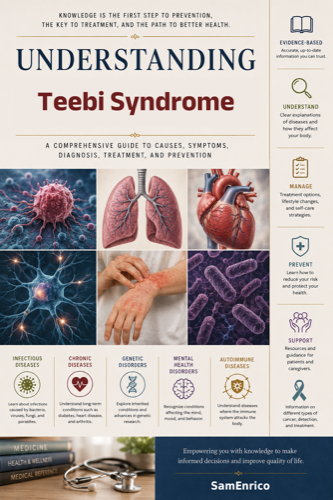
Non-FictionInformativeEducational
Understanding Teebi Syndrome eBook
This disease publication, published by SamEnrico,
This disease publication, published by SamEnrico, covers Understanding Teebi Syndrome
Formats
Free sample
Chapter 1: The Face Before Names...--–- Before there was a name for it, before the discovery of the SPECC1L gene, before the first research paper or the online support group or the diagnostic code that insurance companies would one day recognize, there was simply a child. A child with eyes set slightly wider than expected, a forehead that seemed to catch the light differently, a small hand that gripped a parent's finger with the same fierce determination as any other newborn. And that child's parents, sitting in a quiet hospital room, heard a doctor say words they could not have prepared for: "We're not sure what this is. But we're going to find out."The Moment Everything Changes Every rare disease story begins the same way: with a moment of ordinary time that suddenly fractures. For most families who will eventually receive a diagnosis of Teebi syndrome, that moment arrives in the delivery room or during the first pediatric visit.
The baby is healthy—breathing, crying, feeding—but something about the face gives the medical team pause. The eyes, perhaps. The shape of the forehead. A subtle difference that most parents might not notice at first, but that a trained physician recognizes as falling outside the typical range.This chapter is not a clinical overview, though those will come. This chapter is about what happens before the overview.
Before the geneticist enters the picture. Before the words "hypertelorism" and "craniosynostosis" and "whole-exome sequencing" enter your vocabulary. This chapter is about the space between noticing that something is different and understanding what that difference means.That space can last weeks, months, or even years. For some families, the diagnostic odyssey for Teebi syndrome stretches across a decade, as their child is passed from specialist to specialist, collecting possible diagnoses like stamps in a passport—Aarskog syndrome, perhaps, or Opitz G/BBB, or simply "unknown genetic syndrome." For others, the answer comes relatively quickly, because a savvy geneticist has seen a similar case before or because whole-genome sequencing has become more accessible. But whether the journey is short or long, the emotional terrain is remarkably consistent.
And understanding that terrain is the first step toward navigating it.The Weight of Uncertainty Let us be honest about something that most medical books avoid: not knowing is harder than knowing something terrible. There is a strange psychology to rare disease diagnosis. Families often report that receiving a devastating but definitive diagnosis—even one with a poor prognosis—brought them a measure of relief. Because finally, there was a name. Finally, there was something to fight, or to accept, or to research.
Uncertainty, by contrast, offers no foothold. It is a fog through which no path appears.For families in the early stages of suspecting Teebi syndrome, the uncertainty is compounded by the condition's extreme rarity. As of this writing, fewer than one hundred confirmed cases have been reported in the medical literature. That means the pediatrician you are sitting across from has almost certainly never encountered Teebi syndrome before. The geneticist you are referred to may have read about it but never diagnosed it.
The online search you perform late at night will yield a handful of case reports, perhaps a single image or two, and a great deal of scientific terminology that seems designed to confuse rather than clarify.This scarcity of information is itself a kind of burden. In the absence of data, the human mind tends to fill the gaps with worst-case scenarios. You imagine the most frightening possibilities. You wonder if your child will ever speak, or walk independently, or live a normal lifespan. You search for other families online and find… almost no one.
The loneliness of a ultra-rare diagnosis is a specific and cruel form of isolation.And yet. And yet, there is also something liberating about rarity, once you learn to see it differently. If only one hundred people in the world have this condition, then there is no established "typical" outcome. Your child is not a statistic. Your child is an individual.
And while that means there are no guarantees, it also means that the limits of this condition have not yet been written. Every child with Teebi syndrome is, in a very real sense, writing the book as they go.The First Medical Clues What actually causes a doctor to suspect Teebi syndrome in the first place? The answer lies primarily in the face. All children with confirmed Teebi syndrome share a constellation of craniofacial features, though the intensity of these features varies widely—a phenomenon called variable expressivity, which we will explore in depth in Chapter 2.The most consistent finding is orbital hypertelorism. This medical term simply means that the distance between the inner corners of the eyes is wider than typical.
In a child with Teebi syndrome, this widening is often noticeable at birth and does not diminish with age. Hypertelorism is not a functional problem in itself—vision is usually unaffected—but it is a powerful visual clue that something in the early development of the face followed an unusual path.Alongside hypertelorism, clinicians look for a prominent forehead, sometimes called frontal bossing. The forehead may appear unusually full or rounded, particularly in profile. The nasal bridge—the bony upper part of the nose between the eyes—is often broad and flattened. The upper lip may be thin, and the palpebral fissures (the openings between the upper and lower eyelids) may slant slightly downward rather than sitting horizontally.These features are not always dramatic.
In some individuals, they are subtle enough that a casual observer would not notice anything unusual. In others, they are pronounced enough to prompt immediate referral to a medical geneticist. Importantly, the presence of these features alone is not diagnostic; many other syndromes share similar facial characteristics. The differential diagnosis process, covered in Chapter 3, involves ruling out conditions like Aarskog syndrome and craniofrontonasal syndrome before settling on Teebi syndrome.Less common but more serious craniofacial findings include cleft lip and palate and craniosynostosis—the premature fusion of the skull bones. Craniosynostosis is particularly important to identify early, because it can restrict brain growth and increase intracranial pressure if not surgically corrected.
Fortunately, craniosynostosis appears to be rare in Teebi syndrome, affecting only a minority of reported cases. But its potential presence means that any child suspected of having Teebi syndrome should undergo early evaluation by a craniofacial specialist.Beyond the Face: The First Clues Elsewhere in the Body The face tells the first part of the story, but it is not the whole story. Teebi syndrome affects multiple body systems, and some of the most important manifestations are not visible at all.Cardiovascular anomalies are among the most significant potential complications. Reported heart defects in Teebi syndrome include atrial septal defects (ASD), ventricular septal defects (VSD), and aortic root dilation. These range from small defects that close on their own to larger abnormalities requiring surgical repair.
Because heart defects may not produce obvious symptoms in a newborn, the standard of care for any child with a suspected Teebi diagnosis is an echocardiogram—an ultrasound of the heart—ideally performed within the first few months of life.Skeletal and limb…
This is the end of the free sample. Get the eBook to keep going. Buy now
About this book
Details
- Author
- Culbertson Alysa
- Publisher
- SamEnrico
- Language
- English
- Genre
- Non-Fiction, Informative, Educational
- Released
- 2026-06-02
- Pages (approx.)
- 148
- Available as
- eBook, Audiobook

Read better in the ZLOADR app
Your eBooks on your phone or tablet. Sign in with your SamEnrico account and start reading.
More by Culbertson Alysa
 Dreams And Disgust TraumaCulbertson Alysa$11.99
 The Syndication SEC Compliance GuideCulbertson Alysa$11.99
 DBT For Breakup RecoveryCulbertson Alysa$11.99
 The Academic Peer Pressure GuideCulbertson Alysa$11.99
 The Battle of Nahavand: The Persian Empire's Last StandCulbertson Alysa$11.99The Battle of Nahavand: The Persian Empire's Last StandCulbertson Alysa$11.99
 Pop Up Legal GuideCulbertson Alysa$12.99
 Green Tax Compliance CalendarCulbertson Alysa$12.99
 Lizardite MiningCulbertson Alysa$11.99
 How to Start a Pamphlet Printing Business (Beginners Guide)Culbertson Alysa$11.99
You may also like
 Hong Kong Handover 1997Dunn Johnnie$11.99
 Zumba For Postnatal Recovery CourseNeal Christian$11.99
 Zumba for BeginnersLadner Nikia$11.99
 YouTube Comment Mining GuideHumes Pandora$12.99
 Worry Box MeditationCarlin Rudy$11.99
 Workplace Stress MeditationNguyen Lynn$11.99
 Workplace Stress and Sleep RepairHawley Ivory$11.99
 Workplace Perfectionism CureDelaney Jeffry$11.99
 Workplace Injustice Anger GuideWallen Isabelle$11.99
 Work Addiction and Burnout LinkGreenwood Ester$11.99
 Women in Yoga and WellnessBeattie Galina$11.99
 Women in Stand Up ComedyChun Evangeline$11.99