
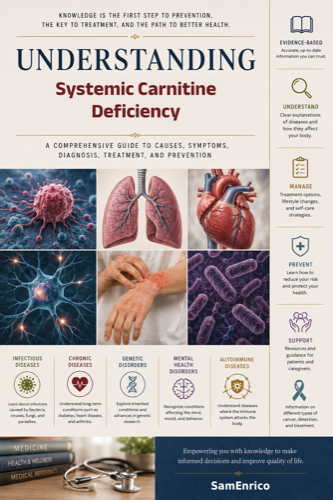
Non-FictionInformativeEducational
Understanding Systemic Carnitine Deficiency eBook
This disease publication, published by SamEnrico,
This disease publication, published by SamEnrico, covers Understanding Systemic Carnitine Deficiency
Formats
Free sample
Chapter 1: The Furnace Within...--Every human body is built around a profound contradiction. You are simultaneously the most sophisticated machine ever assembled and a fragile vessel that can fail in ways you cannot see, cannot feel, and cannot predict until the moment it is almost too late. This contradiction lies at the heart—quite literally—of Systemic Primary Carnitine Deficiency, and understanding it begins not with a textbook definition, but with a question: Where does your energy actually come from?Most people believe they understand energy. You eat food. You feel full.
You move through your day. When you are tired, you sleep. When you are hungry, you eat. This simple, intuitive model of human metabolism works remarkably well for the vast majority of people for the vast majority of their lives. But for a person with CDSP, this model is not merely incomplete—it is dangerously wrong.
The tiredness they experience is not the tiredness of a poor night's sleep. The hunger they feel is not the hunger of an empty stomach. And the energy they lack cannot be restored by any amount of rest or any quantity of food, because the problem is not in the fuel tank. The problem is in the furnace.This chapter will take you inside that furnace. You will learn what a mitochondrion is, why it matters, and how a tiny molecule called carnitine determines whether your body runs like a well-tuned engine or sputters toward catastrophic failure.
You will learn the difference between the fuel you can see—the food on your plate—and the fuel your cells can actually use. And you will emerge with a metaphor that will guide you through every subsequent chapter: the car with a full gas tank and a broken fuel pump. Because once you understand that metaphor, you will understand everything that follows.The Energy Illusion: Why Eating Enough Isn't Enough Let us begin with a thought experiment that has haunted metabolic physicians for decades. Imagine two children of the same age, same weight, same activity level. Both eat the same breakfast: oatmeal with fruit, a glass of milk, perhaps a slice of toast with butter.
Both appear healthy, happy, and full of energy as they run out the door to school. Now imagine that both children skip lunch. Maybe they are busy. Maybe they forgot their lunchbox. Maybe they simply are not hungry.
By mid-afternoon, both children feel tired. Both feel a bit shaky. Both complain of hunger.One child will be fine. She will come home, eat a substantial dinner, and wake up the next day as if nothing happened. The other child will not be fine.
By late afternoon, her fatigue will deepen into lethargy. The shakiness will progress to muscle weakness so profound that she cannot lift a glass of water. The hunger will be replaced by nausea, then vomiting. By early evening, she will be confused, unable to recognize her parents. By midnight, she will be in the emergency department, unconscious, with blood sugar so low that it barely registers on the monitor.
By morning, if she is lucky, a physician will think to check her carnitine level. If she is not lucky, she will be dead.Both children ate the same breakfast. Both skipped the same lunch. Both ate the same dinner when they got home—except one never made it home. What is the difference?
The difference is not in what they ate. The difference is in what their bodies could do with what they ate. The first child had a functioning metabolic furnace. The second child did not.This thought experiment is not hypothetical. It has played out thousands of times in emergency departments around the world, usually with the same tragic ending: a child who was "fine this morning" is now in a coma, and no one can figure out why.
The parents are interrogated about poisoning, about head trauma, about neglect. The child is poked and prodded and scanned and tested for everything from meningitis to malignancy. And all the while, the answer is hiding in plain sight, in a biochemical pathway that most physicians learned about briefly in medical school and promptly forgot.The Mitochondrion: Your Cellular Power Plant To understand what goes wrong in CDSP, you must first understand where energy comes from at the cellular level. The answer lies in an organelle so small that you could fit a billion of them on the head of a pin, so ancient that it was once a free-living bacterium engulfed by another cell nearly two billion years ago, and so essential that without it, you would cease to function in less than a minute.The mitochondrion (plural: mitochondria) is the power plant of the cell. Every cell in your body except red blood cells contains hundreds or thousands of these tiny structures, each one a self-contained factory for converting the food you eat into a form of energy your cells can actually use.
The scale of this operation is almost incomprehensible: at any given moment, your body contains approximately ten million billion mitochondria, collectively producing enough energy each day to lift your body weight into orbit. But they do not produce this energy from just any fuel. They are picky. And that pickiness is the key to everything.Mitochondria can burn two primary fuels: glucose (sugar) and fatty acids (fats). Both are abundant in the modern diet.
Both contain large amounts of chemical energy. But they are not interchangeable, and the rules governing when each fuel is used are strict, unforgiving, and—for the person with CDSP—potentially fatal.Glucose: The Kindling Think of glucose as kindling. It ignites quickly, burns hot, and produces a rapid burst of energy that is essential for certain tissues—most notably the brain. Your brain is a glucose glutton, consuming approximately 120 grams of glucose per day, accounting for 20% of your total energy expenditure despite representing only 2% of your body weight. Without a steady supply of glucose, your brain begins to fail within minutes.
Confusion sets in. Consciousness fades. Neurons die.But here is the problem with kindling: it burns fast, and you cannot store very much of it. Your body maintains a circulating pool of glucose in the blood—approximately 4 grams, enough for about 10 minutes of normal activity. Your liver stores additional glucose in the form of glycogen, but even this reserve is limited to about 100 grams in an adult, enough for roughly 24 hours of sedentary living.
During exercise or stress, those reserves can be depleted in hours. When the kindling runs out, you must either find more kindling (eat sugar) or switch to a different fuel.Most people switch seamlessly. Their bodies sense falling glucose levels, release hormones that signal the need for alternative fuel, and begin burning fat. But the person with CDSP cannot make that switch. And that is where the logs come in.Fatty Acids: The Logs Fatty acids are the logs.
They are dense, slow-burning, and abundant. While your body stores only about 2,000 calories of glucose, it stores over 100,000 calories of fat—even in a lean adult. This fat is your reserve tank, your emergency fund, your long-term survival strategy. When food…
This is the end of the free sample. Get the eBook to keep going. Buy now
About this book
Details
- Author
- Carswell Milagros
- Publisher
- SamEnrico
- Language
- English
- Genre
- Non-Fiction, Informative, Educational
- Released
- 2026-05-11
- Pages (approx.)
- 160
- Available as
- eBook, Audiobook

Read better in the ZLOADR app
Your eBooks on your phone or tablet. Sign in with your SamEnrico account and start reading.
More by Carswell Milagros
 The Student Mindfulness GuideCarswell Milagros$11.99
 CEO Executive Stress GuideCarswell Milagros$11.99
 Dreams And Chronic Pain TraumaCarswell Milagros$11.99
 Nigel Mansell Red FiveCarswell Milagros$11.99
 The Climate Tech Product ManagerCarswell Milagros$11.99
 The Iron Corsairs: How Pirate Innovators Forged the First Armored Land RaidersCarswell Milagros$11.99
 International RecruiterCarswell Milagros$11.99
 Cold Email Professor StrategyCarswell Milagros$12.99
 Pop Up Costs NYC GuideCarswell Milagros$12.99
 How to Start a Palmist Business (Beginners Guide)Carswell Milagros$11.99
You may also like
 Hong Kong Handover 1997Dunn Johnnie$11.99
 Zumba For Postnatal Recovery CourseNeal Christian$11.99
 Zumba for BeginnersLadner Nikia$11.99
 YouTube Comment Mining GuideHumes Pandora$12.99
 Worry Box MeditationCarlin Rudy$11.99
 Workplace Stress MeditationNguyen Lynn$11.99
 Workplace Stress and Sleep RepairHawley Ivory$11.99
 Workplace Perfectionism CureDelaney Jeffry$11.99
 Workplace Injustice Anger GuideWallen Isabelle$11.99
 Work Addiction and Burnout LinkGreenwood Ester$11.99
 Women in Yoga and WellnessBeattie Galina$11.99
 Women in Stand Up ComedyChun Evangeline$11.99