
Non-FictionInformativeEducational
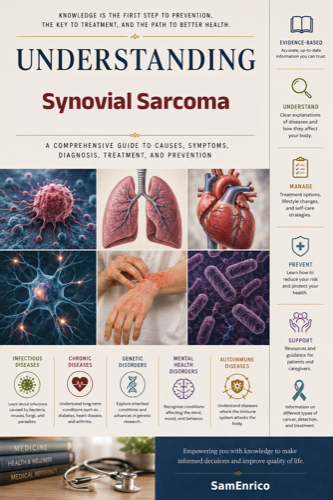
Understanding Synovial Sarcoma eBook
This disease publication, published by SamEnrico,
by Carter Edgar
This disease publication, published by SamEnrico, covers Understanding Synovial Sarcoma
Formats
Free sample
Chapter 1: The Stranger Within--–- The lump appeared on a Tuesday. Not with a bang, not with pain, not with any of the dramatic flourish that movies had taught me to expect from cancer. It was just... there. A small, firm knot behind my left knee, about the size of a grape, invisible to anyone but me.
I pressed on it with my thumb. It didn't hurt. It didn't move. I told myself it was probably nothing.That was eight months before anyone said the words "synovial sarcoma."This chapter is for every person who has ever found a strange lump and hoped it would disappear. For every parent who noticed their teenager limping and assumed it was a sports injury.
For every young adult who was told "you're too young for cancer" and believed it. And for the thousands of patients around the world who will hear the words "synovial sarcoma" this year—many of them for the first time, many of them after a long and frustrating diagnostic odyssey.Before we dive into genetics, staging, and treatment plans, we must first answer three fundamental questions: What is this disease? Who gets it? And why has it been hiding in plain sight? This chapter lays the foundation for everything that follows.
Consider it your first conversation with a doctor who has all the time in the world to explain things clearly, without jargon, without rushing, and without sugarcoating the hard parts.Let us begin with the name itself, because the name is where much of the confusion starts.The Great Misnomer: Why "Synovial" Is a Lie If you have already done some research—perhaps in a panicked late-night internet search—you have likely encountered the term "synovial sarcoma" and made a logical assumption: that this cancer arises from the synovium, the thin layer of tissue that lines your joints. This assumption is wrong. And that error has caused decades of misunderstanding, even among some doctors.The name "synovial sarcoma" is a historical accident, a linguistic fossil from the early twentieth century when pathologists first described the tumor under a microscope. In 1905, a pathologist named Lejars observed that some tumor cells resembled the cells found in developing joint linings. He called it "synovial sarcoma," and the name stuck—even though subsequent research proved conclusively that the tumor does not originate from the synovium at all.So where does it actually come from?Synovial sarcoma arises from primitive mesenchymal stem cells.
These are the body's multitool cells, the ones that have not yet decided what they want to be when they grow up. Normally, mesenchymal cells differentiate into muscle, fat, bone, cartilage, or connective tissue. But in synovial sarcoma, a genetic accident (which we will explore in depth in Chapter 2) transforms these innocent precursor cells into malignant ones. Because mesenchymal cells are found throughout the body—not just in joints—synovial sarcoma can appear almost anywhere.Think of it this way: calling synovial sarcoma a "joint cancer" because it sometimes grows near joints is like calling a rose a "garden plant" because it sometimes grows in gardens. It is true but incomplete.
The rose can grow in a pot on a balcony, in a crack in the sidewalk, or in a carefully tended flower bed. Similarly, synovial sarcoma can grow in the thigh, the calf, the shoulder, the forearm, the chest wall, the abdomen, the neck, the head, or the retroperitoneum (the space behind the abdominal cavity).This distinction matters for two reasons. First, if a doctor mistakenly believes that synovial sarcoma only occurs near joints, they may miss a tumor in an unusual location. Second, understanding that this cancer arises from mesenchymal cells explains why it behaves differently from carcinomas (the most common type of cancer) and why treatment strategies must be tailored specifically to sarcomas.The Rarity Problem: Why Your Doctor May Have Never Seen One Let me share a statistic that should alarm you: the average medical student receives less than one hour of instruction on sarcomas during four years of medical school. The average primary care physician will see exactly zero cases of synovial sarcoma in their entire career.
A general radiologist might encounter one every few years. Even among oncologists, many will go through their entire training without managing a single synovial sarcoma patient.This is not a criticism of doctors. It is simple math.Synovial sarcoma is rare. In the United States, approximately 1,000 new cases are diagnosed each year. To put that number in perspective, consider these comparisons:Breast cancer: approximately 290,000 new cases per year Lung cancer: approximately 235,000 new cases per year Prostate cancer: approximately 250,000 new cases per year Colon cancer: approximately 150,000 new cases per year Synovial sarcoma: approximately 1,000 new cases per year Among soft tissue sarcomas (which themselves are rare, representing only 1% of all adult cancers), synovial sarcoma accounts for approximately 5-10% of cases.
This means it is a rare subtype of a rare disease.Rarity has consequences. When a patient presents with a painless lump, the doctor's mind naturally goes to the most common explanations: a lipoma (benign fatty tumor), a sebaceous cyst, a muscle strain, a hematoma from old trauma, a swollen lymph node from a recent infection. These are all far more likely than synovial sarcoma. In fact, for every 10,000 soft tissue lumps a primary care doctor evaluates, exactly one will be a synovial sarcoma.This is why delayed diagnosis is the rule, not the exception. Studies consistently show that the average time from symptom onset to definitive diagnosis of synovial sarcoma is 6 to 12 months.
Some patients wait two, three, or even five years before someone orders the right test.The author of this book—the voice you are reading now—has spoken with hundreds of synovial sarcoma patients. Their stories share a painful common thread. The athlete whose thigh mass was treated with physical therapy for a "strained quadriceps" for eighteen months. The teenager whose knee lump was dismissed as "growing pains." The mother whose abdominal tumor was called a "fibroid" for three years. The construction worker whose arm mass was attributed to "repetitive strain" despite growing relentlessly.If you are reading this chapter because you or someone you love has been diagnosed with synovial sarcoma, you may be feeling anger at the delays you experienced.
That anger is valid. But I want you to understand something important: the delay was almost certainly not due to incompetence or indifference. It was due to rarity. Your doctor was playing the odds, and the odds said "benign." For the 9,999 other patients, the odds would have been correct. You were the 1 in 10,000.This does not excuse missed diagnoses.
It does, however, contextualize them. And it underscores the single most important lesson of this chapter: you must be your own advocate. If you have a deep, enlarging mass that persists for more than four weeks, you must insist on imaging. Not because you should assume cancer, but because the cost of being wrong is too high.The Age Paradox: Who Gets Synovial Sarcoma?If I asked you to picture a cancer patient, what age comes to mind? Most people imagine an older adult—sixty, seventy, eighty years old.
This is reasonable, because most cancers are diseases of aging. The accumulated genetic damage of decades eventually overwhelms the body's…
This is the end of the free sample. Get the eBook to keep going. Buy now
About this book
Details
- Author
- Carter Edgar
- Publisher
- SamEnrico
- Language
- English
- Genre
- Non-Fiction, Informative, Educational
- Released
- 2026-05-07
- Pages (approx.)
- 159
- Available as
- eBook, Audiobook

Read better in the ZLOADR app
Your eBooks on your phone or tablet. Sign in with your SamEnrico account and start reading.
More by Carter Edgar
 Pregnancy Loss Dream HealingCarter Edgar$11.99
 Bourbon Restoration 1814-1815 CourseCarter Edgar$11.99
 Tony Stewart Smokes StoryCarter Edgar$11.99
 The Assertive Role Play GuideCarter Edgar$11.99
 The Childhood Home Memory PalaceCarter Edgar$11.99
 The Cairo Poisoner: The Trial That Redefined Criminal Insanity (1890s)Carter Edgar$11.99
 Health and Safety OfficerCarter Edgar$11.99
 Chinese Supplier Contract TipsCarter Edgar$12.99
 Asian PhD Without PublicationsCarter Edgar$12.99
 How to Start a Wood Preservation BusinessCarter Edgar$11.99
You may also like
 Hong Kong Handover 1997Dunn Johnnie$11.99
 Zumba For Postnatal Recovery CourseNeal Christian$11.99
 Zumba for BeginnersLadner Nikia$11.99
 YouTube Comment Mining GuideHumes Pandora$12.99
 Worry Box MeditationCarlin Rudy$11.99
 Workplace Stress MeditationNguyen Lynn$11.99
 Workplace Stress and Sleep RepairHawley Ivory$11.99
 Workplace Perfectionism CureDelaney Jeffry$11.99
 Workplace Injustice Anger GuideWallen Isabelle$11.99
 Work Addiction and Burnout LinkGreenwood Ester$11.99
 Women in Yoga and WellnessBeattie Galina$11.99
 Women in Stand Up ComedyChun Evangeline$11.99