
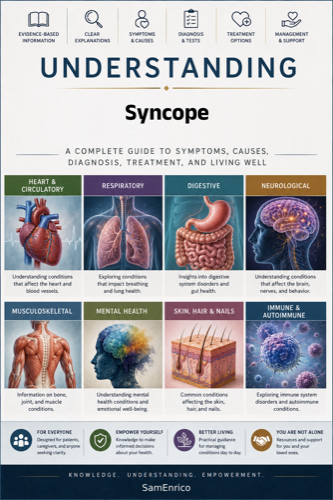
Understanding Syncope
This condition publication, published by SamEnrico
by Paige Cristy
This condition publication, published by SamEnrico, covers Understanding Syncope
Formats
About this book
Free sample
Chapter 1: The Million-Dollar Collapse...--–- The first time 22-year-old Sarah collapsed, she was walking across her college campus. The second time, she was behind the wheel of her car. Sarah had no memory of either event—only the waking up: confused, bruised, surrounded by strangers, and terrified. An emergency physician told her she might have epilepsy. A neurologist started her on anti-seizure medication.
A cardiologist performed an echocardiogram, a Holter monitor, and a stress test. All were normal. Over the next eighteen months, Sarah saw seven specialists, underwent two hospital admissions, and accumulated $47,000 in medical bills. She lost her driver’s license, withdrew from college, and began avoiding going outside alone. “I thought I was dying,” she later told a syncope specialist.
“But mostly, I thought no one believed me.”Sarah did not have epilepsy. She did not have a heart attack, a brain tumor, or a psychiatric disorder. She had vasovagal syncope—the most common form of fainting, affecting nearly one in three people at some point in their lives. The anti-seizure medication she took for eighteen months not only failed to help but also caused fatigue, cognitive slowing, and weight gain. The cardiology workup, while expensive, was never indicated in the first place.
What Sarah needed was not more testing but a different question: not “what is wrong with your heart or brain?” but “what happened to your blood pressure and heart rate in the moments before you lost consciousness?”Sarah’s story is not unusual. It is, in fact, the rule.Each year in the United States, more than one million emergency department visits are attributed to syncope—the medical term for fainting. Up to forty percent of these patients are initially misdiagnosed. The annual cost of syncope-related hospitalizations exceeds five billion dollars, much of it spent on unnecessary cardiac testing, neurologic imaging, and specialty consultations that could have been avoided with a structured clinical approach. Syncope is not a diagnosis; it is a symptom.
And like all symptoms—chest pain, shortness of breath, headache—the path to correct treatment begins not with a test but with a…
This is the end of the free sample. Get the eBook to keep going. Buy now
Contents
- Chapter 1
- Chapter 2
- Chapter 3
- Chapter 4
- Chapter 5
- Chapter 6
- Chapter 7
- Chapter 8
- Chapter 9
- Chapter 10
- Chapter 11
- Chapter 12
Details
- Author
- Paige Cristy
- Publisher
- SamEnrico
- Language
- English
- Genre
- Non-Fiction, Informative, Educational
- Released
- 2026-06-02
- Pages (approx.)
- 150
- Available as
- eBook, Audiobook

Read better in the ZLOADR app
Your eBooks on your phone or tablet. Sign in with your SamEnrico account and start reading.
More by Paige Cristy
 Reparenting Your Inner ChildPaige Cristy$11.99
 Footprint Casting GuidePaige Cristy$11.99
 Thyroid Cognitive AgingPaige Cristy$11.99
 Low Carb Thyroid SupportPaige Cristy$11.99
 Nightmare Rescripting For BullyingPaige Cristy$11.99
 The Imperial Gambit: The Holy Roman Empire's Gold HeistPaige Cristy$11.99
 Hidden Anger Triggers GuidePaige Cristy$11.99
 Cultural Adaptation For StudentsPaige Cristy$11.99
 Buckingham Case AnalysisPaige Cristy$11.99
 The Devil’s Tunnel: The Audacious Escape of Juan SoldadoPaige Cristy$11.99
 How to Produce Special TransportationPaige Cristy$11.99
 How to Produce a Goldstream DredgePaige Cristy$11.99