
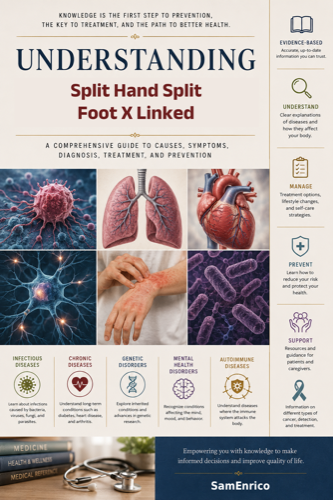
Non-FictionInformativeEducational
Understanding Split Hand Split Foot X Linked eBook
This disease publication, published by SamEnrico,
by Kroll Leigha
This disease publication, published by SamEnrico, covers Understanding Split Hand Split Foot X Linked
Formats
Free sample
Chapter 1: The Silent Blueprint--– In the quiet hours before a newborn’s first cry, before the first breath fills tiny lungs, a remarkable process has already completed its most critical work. The human hand—that intricate masterpiece of bone, tendon, nerve, and skin—has formed, taken shape, and ultimately revealed its final architecture. For most infants, that architecture follows a predictable pattern: five fingers on each hand, five toes on each foot, arranged in a precise order that has been conserved across millions of years of primate evolution. But for a small number of families around the world, the moment of revelation brings a different sight—a hand that appears deeply cleft, as if the center has been scooped away, or a hand that bears only a single finger where five should stand. This is the reality of Split Hand/Foot Malformation, and for those affected by its X-linked form, the journey of understanding has only just begun.No parent expects to see a difference in their child’s hands.
The prenatal ultrasound images, the genetic screening results, the careful measurements of growth—all of these modern medical tools exist to reassure expecting families that development is proceeding normally. Yet despite the remarkable advances in prenatal medicine, the majority of children with isolated SHFM are diagnosed only after birth, when the child’s hands are first counted, examined, and measured against an invisible standard of normalcy. For the families who receive this unexpected news, the questions come quickly and urgently: Why did this happen? Will my child have other problems? Can it be fixed?
Did I do something wrong? And perhaps most haunting: Will this happen again in future pregnancies?The answers to these questions depend entirely on which form of SHFM has occurred. The term “Split Hand/Foot Malformation” encompasses at least five distinct genetic conditions, each with its own inheritance pattern, each with its own spectrum of severity, and each with its own prognosis. The X-linked form, known scientifically as SHFM2, occupies a unique and challenging position within this family of disorders. It follows the complex rules of X-chromosome inheritance, meaning it can skip generations, affect males far more severely than females, and appear seemingly out of nowhere in a family with no prior history of limb differences.
It is also the form that remains most mysterious to medical science, as the specific gene responsible has eluded researchers for decades despite intensive study. This chapter begins the journey of unraveling that mystery, starting not with the gene itself but with the condition it creates—what SHFM2 looks like, how it behaves in families, and why precise diagnosis matters more than parents might initially realize.Defining the Unseen: What We Mean by “Split Hand/Foot Malformation”The term “Split Hand/Foot Malformation” is descriptive, clinical, and intentionally neutral. It refers to a spectrum of congenital limb differences characterized by the absence of one or more central digits—typically the second, third, and fourth fingers or toes—resulting in a deep, V-shaped cleft that appears to “split” the hand or foot. This central ray deficiency is the hallmark of the condition, distinguishing it from other limb reduction defects that affect the radial (thumb) side or ulnar (small finger) side of the hand. In some affected individuals, the cleft is shallow and the missing digits are only partially formed; in others, the cleft extends deep into the palm or foot, and only the first and fifth rays remain.
In the most severe form, even the first or fifth ray may be absent, leaving only a single functional digit—a presentation known as monodactyly, which is particularly characteristic of the X-linked form.To understand why precise terminology matters, one must first confront the long and troubling history of language used to describe this condition. For more than a century, medical texts referred to SHFM as “lobster claw deformity” due to a superficial resemblance between the cleft hand and the pincer of a marine crustacean. This term, now widely rejected as both inaccurate and stigmatizing, caused immeasurable harm to generations of affected individuals who were compared to animals and treated as curiosities rather than patients deserving of dignity and respect. Even today, an Internet search for “split hand/foot malformation” may return images labeled with this outdated terminology, perpetuating a legacy of misunderstanding that this book seeks to correct. The preferred terminology is clear: Split Hand/Foot Malformation, or SHFM when brevity is needed.
For the X-linked form specifically, the designation SHFM2 provides genetic precision while avoiding the dehumanizing metaphors of the past.The distinction between Isolated and Syndromic SHFM represents one of the most critical concepts in the diagnostic process, with profound implications for prognosis, management, and family counseling. Isolated SHFM, as the name suggests, occurs without any other congenital anomalies. The child’s hands and feet may be affected, but the remainder of the physical examination—the heart, the kidneys, the palate, the hearing, the hair, the teeth, and the nails—is entirely normal. Children with isolated SHFM have normal cognitive development, normal life expectancy, and no associated medical complications beyond those directly related to their limb differences. They may require surgeries, occupational therapy, and adaptive strategies, but they are fundamentally healthy children with a localized anatomical variation.Syndromic SHFM, by contrast, occurs as one feature of a broader genetic syndrome affecting multiple organ systems.
The most common syndromic associations include EEC syndrome (Ectrodactyly-Ectodermal Dysplasia-Clefting), which adds cleft lip or palate, sparse hair, absent teeth, and abnormal tear ducts to the limb findings; and SHFM1 with deafness or intellectual disability, caused by deletions of chromosome 7q21 that affect multiple adjacent genes. Children with syndromic SHFM require a vastly different medical management plan, including surveillance for hearing loss, renal anomalies, feeding difficulties, and other complications. The distinction between isolated and syndromic is therefore not an academic nicety—it is the first and most important branch point in the clinical decision tree.The Landscape of SHFM: An Overview of Genetic Heterogeneity One of the most surprising facts about SHFM—and one that often confuses both families and general practitioners—is that the condition is not caused by a single gene. Rather, SHFM is a genetically heterogeneous disorder, meaning that mutations in different genes on different chromosomes can produce remarkably similar clinical pictures. This phenomenon, known as locus heterogeneity, is common in developmental disorders but is particularly striking in SHFM because the five known loci (SHFM1 through SHFM5) produce limb findings that can be nearly indistinguishable to the untrained eye.
Only careful attention to subtle clinical features, inheritance patterns, and molecular testing can reliably distinguish between them.SHFM1, located on chromosome 7q21, is the most common form and follows autosomal dominant inheritance. It is caused by deletions or mutations in the DLX5 and DLX6 genes, which encode transcription factors critical for limb development. Individuals with SHFM1 typically have a classic central cleft with two well-formed digits on either side, and the feet are often similarly affected. However, because the SHFM1 region contains multiple genes, some patients have larger deletions that cause intellectual disability, sensorineural hearing loss, or facial anomalies. This variability means that a child diagnosed with SHFM1 requires careful evaluation for non-limb findings, even…
This is the end of the free sample. Get the eBook to keep going. Buy now
About this book
Details
- Author
- Kroll Leigha
- Publisher
- SamEnrico
- Language
- English
- Genre
- Non-Fiction, Informative, Educational
- Released
- 2026-05-06
- Pages (approx.)
- 151
- Available as
- eBook, Audiobook

Read better in the ZLOADR app
Your eBooks on your phone or tablet. Sign in with your SamEnrico account and start reading.
More by Kroll Leigha
 Anger Journal for EmployeesKroll Leigha$11.99
 Wrecks Submarine ArchaeologyKroll Leigha$11.99
 Forgiving Parents For DivorceKroll Leigha$11.99
 Overcoming Workaholism HandbookKroll Leigha$11.99
 The Being Chased Dream GuideKroll Leigha$11.99
 The Ghosts of Actium: Cleopatra’s Last StandKroll Leigha$11.99
 Desk Based Nervous System RegulationKroll Leigha$12.99
 Tanzania Cooperative GuideKroll Leigha$12.99
 Academic TutorKroll Leigha$11.99
 How to Start a Churns Made of Iron or Steel Business (Beginners Guide)Kroll Leigha$11.99
You may also like
 Hong Kong Handover 1997Dunn Johnnie$11.99
 Zumba For Postnatal Recovery CourseNeal Christian$11.99
 Zumba for BeginnersLadner Nikia$11.99
 YouTube Comment Mining GuideHumes Pandora$12.99
 Worry Box MeditationCarlin Rudy$11.99
 Workplace Stress MeditationNguyen Lynn$11.99
 Workplace Stress and Sleep RepairHawley Ivory$11.99
 Workplace Perfectionism CureDelaney Jeffry$11.99
 Workplace Injustice Anger GuideWallen Isabelle$11.99
 Work Addiction and Burnout LinkGreenwood Ester$11.99
 Women in Yoga and WellnessBeattie Galina$11.99
 Women in Stand Up ComedyChun Evangeline$11.99