
Non-FictionInformativeEducational
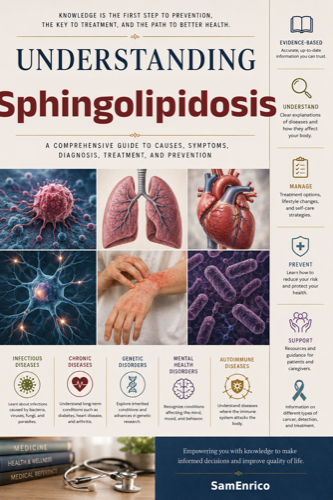
Understanding Sphingolipidosis eBook
This disease publication, published by SamEnrico,
This disease publication, published by SamEnrico, covers Understanding Sphingolipidosis
Formats
Free sample
Chapter 1: The Ceramide Key...--– In the beginning, there was fat. Not the fat that accumulates around a sedentary waistline or the fat that clogs coronary arteries, but a far more sophisticated and essential kind of fat—a molecule so perfectly designed that evolution has preserved its basic structure for over a billion years. This molecule, called ceramide, is the hidden key to understanding a family of devastating diseases that medical science has only recently begun to conquer. Without ceramide, your brain would literally dissolve. Your nerve cells could not communicate.
Your body would have no way to insulate the electrical signals that allow you to think, to move, to feel, to be. And yet, when the machinery that processes this remarkable molecule breaks down, the result is a cascade of cellular catastrophe that we call the sphingolipidoses.The sphingolipidoses are rare, inherited disorders in which the body cannot properly break down certain fats. But that simple definition obscures the staggering complexity of what actually goes wrong. To understand these diseases—to truly grasp why a baby born seemingly perfect at six months begins to regress, losing skills one by one until she cannot see, cannot swallow, cannot breathe—you must first understand the molecule at the center of the storm. You must understand ceramide.Ceramide belongs to a broader class of molecules called sphingolipids, named for the mythical Sphinx because their structure and function puzzled scientists for decades.
The basic architecture is deceptively simple: a long-chain amino alcohol called sphingosine is linked to a fatty acid by an amide bond. That is ceramide. But from this simple foundation, cells construct an astonishing array of complex molecules, each with a specific job. Add a single glucose molecule to ceramide, and you get glucocerebroside. Add a sugar called galactose, and you get galactocerebroside.
Add a bulky phosphorylcholine head group, and you get sphingomyelin. Add an elaborate chain of sugars, and you get the gangliosides—the molecules that give gray matter its name and its function.This diversity of form reflects a diversity of function. Sphingolipids are not passive structural elements, mere bricks in the walls of your cells. They are dynamic, active participants in virtually every aspect of cellular life. They organize membranes into functional platforms called rafts, where receptors and ion channels cluster to do their work efficiently.
They participate in signal transduction, relaying messages from the cell surface to the nucleus. And ceramide itself—the core molecule—serves as a powerful signaling agent, one that can command a cell to undergo programmed death when it is damaged or no longer needed.The story of how scientists unraveled these mysteries is a detective tale spanning more than a century. It begins in 1881, when a British ophthalmologist named Warren Tay peered through his ophthalmoscope at the retina of a one-year-old child and saw something he had never seen before: a bright cherry-red spot surrounded by a pale, milky-white ring. The child, who had been developing normally for the first six months of life, was already showing signs of regression. She would be dead before her fourth birthday.
Tay published his observation, not knowing what it meant, only that it was new and that it was lethal.One year later, in 1882, a French medical student named Philippe Gaucher was studying a different patient—a woman in her thirties with a massively enlarged spleen. Under the microscope, Gaucher saw cells unlike any he had encountered. They were large, with a distinctively wrinkled, crumpled-tissue-paper appearance. Gaucher described them accurately, but again, the underlying mechanism remained a mystery. These two observations—the cherry-red macula of Tay and the strange cells of Gaucher—were the first glimpses of what would eventually be recognized as a family of related diseases.The connections began to emerge in 1898, when two physicians working independently—Johannes Fabry in Germany and William Anderson in England—reported patients with clusters of dark red, non-blanching skin lesions called angiokeratomas.
These patients also suffered from burning pain in their hands and feet, progressive kidney failure, and early strokes. Fabry disease, as it came to be known, was clearly different from Tay-Sachs and Gaucher, yet there was a nagging similarity: all three seemed to involve abnormal accumulation of something in cells.But what was that something? The answer required a revolution in cell biology. In the 1950s, a Belgian scientist named Christian de Duve was studying enzymes that break down glucose. Using a technique called differential centrifugation—spinning cell extracts at progressively higher speeds to separate different components—he noticed something peculiar.
An enzyme called acid phosphatase was active only when he spun the extracts at very high speeds, and only when he used a particular detergent. This suggested that the enzyme was trapped inside some sort of membrane-bound compartment that was normally intact and only released when the detergent broke it open.De Duve had discovered a new organelle—a compartment within the cell that had never been properly described. He called it the lysosome, from the Greek words for "digestive body." The lysosome, he would later show, is the cell's recycling center, a membrane-bound bag filled with powerful enzymes capable of breaking down virtually every kind of biological molecule: proteins, nucleic acids, carbohydrates, and—crucially—lipids. For this discovery, de Duve received the Nobel Prize in 1974.The lysosome solved the puzzle of Tay-Sachs, Gaucher, and Fabry. Each of these diseases, it turned out, was caused by a deficiency of a specific lysosomal enzyme.
In Tay-Sachs, the missing enzyme was hexosaminidase A, which normally breaks down a ganglioside called GM2. Without it, GM2 accumulates in neurons, eventually causing them to swell and die. In Gaucher, the missing enzyme was glucocerebrosidase, leading to accumulation of glucocerebroside in macrophages—the very cells Gaucher had seen under his microscope a century earlier. In Fabry, the missing enzyme was alpha-galactosidase A, leading to accumulation of globotriaosylceramide in blood vessel walls.The lysosomal discovery unified the sphingolipidoses under a single conceptual framework. A single missing enzyme leads to accumulation of a single substrate.
That accumulation triggers a cascade of cellular dysfunction that depends on which cells are affected. In neurons, accumulation causes neurodegeneration. In macrophages, it causes organomegaly. In endothelial cells, it causes vascular damage. The specific symptoms of each disease—the cherry-red macula of Tay-Sachs, the bone pain of Gaucher, the burning acroparesthesias of Fabry—are direct consequences of where the substrate accumulates and which cells are most vulnerable.But the lysosome is not merely a bag of enzymes.
It is a highly sophisticated machine, and the sphingolipidoses have taught us just how sophisticated. The degradation of a sphingolipid is not a single step but a cascade—a carefully orchestrated sequence of cuts, each performed by a different enzyme. Take ganglioside GM2, for example. To break it down completely, the cell must remove three sugar molecules, one at a time, in a precise order. The first sugar is removed by an enzyme called neuraminidase.
The second requires hexosaminidase A—the enzyme missing in Tay-Sachs. But hexosaminidase A cannot work alone. It requires a helper protein, the GM2 activator protein, to lift the ganglioside out of the membrane and present it to the enzyme at the correct angle. This is why…
This is the end of the free sample. Get the eBook to keep going. Buy now
About this book
Details
- Author
- Prince Rosana
- Publisher
- SamEnrico
- Language
- English
- Genre
- Non-Fiction, Informative, Educational
- Released
- 2026-05-09
- Pages (approx.)
- 131
- Available as
- eBook, Audiobook

Read better in the ZLOADR app
Your eBooks on your phone or tablet. Sign in with your SamEnrico account and start reading.
More by Prince Rosana
 Pulse Survey Question BankPrince Rosana$11.99
 The LinkedIn Professional Envy GuidePrince Rosana$11.99
 Driving Cessation Self EsteemPrince Rosana$11.99
 The Video Game Streaming AddictionPrince Rosana$11.99
 Financial Legacy PlanningPrince Rosana$11.99
 Shadows Over the Silk Road: The Lost War of the TochariansPrince Rosana$11.99
 LLC Succession Tax PlanningPrince Rosana$12.99
 Cyber Climate InsurancePrince Rosana$12.99
 How to Start a Cladding Wall Panels Made of Precast Concrete Business (Beginners Guide)Prince Rosana$11.99
You may also like
 Hong Kong Handover 1997Dunn Johnnie$11.99
 Zumba For Postnatal Recovery CourseNeal Christian$11.99
 Zumba for BeginnersLadner Nikia$11.99
 YouTube Comment Mining GuideHumes Pandora$12.99
 Worry Box MeditationCarlin Rudy$11.99
 Workplace Stress MeditationNguyen Lynn$11.99
 Workplace Stress and Sleep RepairHawley Ivory$11.99
 Workplace Perfectionism CureDelaney Jeffry$11.99
 Workplace Injustice Anger GuideWallen Isabelle$11.99
 Work Addiction and Burnout LinkGreenwood Ester$11.99
 Women in Yoga and WellnessBeattie Galina$11.99
 Women in Stand Up ComedyChun Evangeline$11.99