
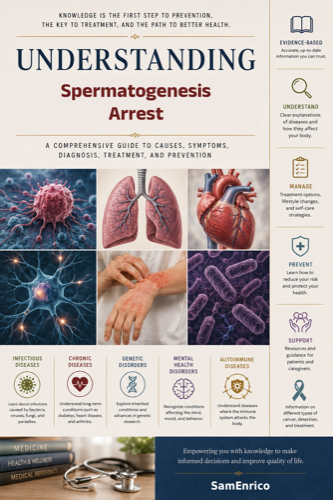
Non-FictionInformativeEducational
Understanding Spermatogenesis Arrest eBook
This disease publication, published by SamEnrico,
by Gaston Kieth
This disease publication, published by SamEnrico, covers Understanding Spermatogenesis Arrest
Formats
Free sample
Chapter 1: The Silent Factory...--The human body is a symphony of biological processes, most of which operate in seamless, unconscious harmony. The heart beats, the lungs breathe, the kidneys filter, and the man rarely gives any of it a second thought. Among these automatic marvels is the process of spermatogenesis—the continuous, fever-pitch production of millions of spermatozoa each day within the confines of the scrotum. For the vast majority of men, this factory runs with quiet, uncelebrated efficiency. For a small but significant number, however, the factory grinds to a halt.
The machinery is present. The workers are at their stations. But somewhere along the assembly line, production ceases. This is the reality of spermatogenesis arrest (SA), a condition that transforms the silent factory into a still life of unrealized potential and, for many, a source of profound grief and confusion.This chapter serves as the threshold to that reality. Before we can understand how and why spermatogenesis fails, we must first understand how it succeeds.
We must walk through the factory floor, meet the cellular workers, and trace the 74-day journey from a single stem cell to a motile, genetically potent spermatozoon. Without this foundation, the arrest is just a word. With it, every histology slide, every lab value, and every clinical decision becomes legible. This chapter is a promise: by its end, you will not be a passive reader of a medical condition. You will be an informed observer of one of biology’s most intricate and high-stakes processes.The Scale of Production: Why Numbers Matter To appreciate the catastrophe of spermatogenesis arrest, one must first appreciate the sheer scale of normal sperm production.
The average healthy male testis, weighing approximately 20-25 grams in adulthood, produces an astonishing 100 to 200 million spermatozoa every single day. Over a 74-day complete cycle of spermatogenesis, a single testis generates roughly 15 billion sperm cells. This is not a leisurely process; it is an industrial-scale biological imperative, driven by the evolutionary priority of reproduction.This high baseline output is why routine semen analysis thresholds are set where they are. The World Health Organization’s 5th edition reference values define a normal sperm concentration as 15 million per milliliter or higher. But this number is a minimum, not an average.
It represents the lowest 5th percentile of fertile men. The healthy testis vastly over-produces, creating a massive buffer against environmental insults, genetic noise, and age-related decline. Spermatogenesis is built on redundancy. The fact that SA can occur despite this redundancy—that a process so robust can be completely interrupted—speaks to the profound nature of the underlying defect, whether genetic, hormonal, or environmental.The Architecture of the Testis: Setting the Stage The testis is not a homogeneous organ. It is divided into roughly 250 to 300 conical compartments called testicular lobules, each containing one to three highly coiled seminiferous tubules.
If unraveled, the seminiferous tubules from a single testis would stretch approximately 300 to 500 meters in length. These tubules are the exclusive site of spermatogenesis, and they are surrounded by a specialized interstitial space that houses the Leydig cells.The seminiferous tubule itself is a stratified epithelium, bounded by a basement membrane and a layer of peritubular myoid cells that provide contractile force to move sperm and fluid toward the rete testis. Inside the tubule, the germ cells are arranged in concentric layers, with the most immature cells (spermatogonia) hugging the basement membrane and the most mature (spermatozoa) being released into the lumen. This spatial organization is not accidental. It mirrors the chronology of development: cells physically migrate inward as they mature, progressing from the periphery to the hollow core.Interspersed between the developing germ cells are the Sertoli cells, the non-negotiable support staff of the factory.
A single Sertoli cell can support and nourish 30 to 50 developing germ cells simultaneously. These cells extend from the basement membrane to the lumen, creating a physical and biochemical scaffolding. They secrete androgen-binding protein (ABP), which concentrates testosterone within the tubule to levels 50 to 100 times higher than in the bloodstream. They produce transferrin to deliver iron, lactate for energy, and a host of growth factors. Most critically, they form the blood-testis barrier.The Blood-Testis Barrier: An Impenetrable Wall The blood-testis barrier is one of the tightest blood-tissue barriers in the mammalian body, rivaling the blood-brain barrier in its selectivity.
It is formed by tight junctions between adjacent Sertoli cells, physically dividing the seminiferous epithelium into two compartments: the basal compartment (housing spermatogonia and early spermatocytes) and the adluminal compartment (housing late spermatocytes, spermatids, and spermatozoa).This barrier serves two essential purposes. First, it creates an immune-privileged environment. Meiotic germ cells express unique surface antigens that would be recognized as foreign by the systemic immune system. The barrier prevents these antigens from escaping into the bloodstream, averting autoimmune orchitis. Second, it allows the creation of a unique luminal fluid microenvironment, rich in specific ions, proteins, and hormones that are required for meiosis and spermiogenesis.
This fluid is utterly different from serum or interstitial fluid. Without this barrier, germ cells cannot survive past the early meiotic stages—a fact that underscores its importance in understanding meiotic arrest, the most common form of SA.The Three Phases: Mitosis, Meiosis, and Spermiogenesis Spermatogenesis is conventionally divided into three functional phases, each with its own vulnerabilities, checkpoints, and patterns of arrest.Phase 1: Mitosis – The Proliferative Foundation The process begins with the spermatogonial stem cells (SSCs), also known as A-dark spermatogonia, which reside on the basement membrane. These cells are the true biological founders. They self-renew through mitotic division to maintain a constant stem cell pool, and they produce differentiating progeny—A-pale spermatogonia—that will commit to becoming sperm.The mitotic phase involves a series of divisions: A-pale spermatogonia divide to form B spermatogonia, which then divide to form primary spermatocytes. In the human male, this phase requires approximately 16 to 20 days.
The key event is clonal expansion. A single SSC can give rise to hundreds of primary spermatocytes, each genetically identical except for mutations acquired during replication. This expansion is why pre-meiotic arrest—failure at the spermatogonial level—is so devastating. If the SSCs are absent or non-functional, there is no supply chain. The factory has no raw materials.Phase 2: Meiosis – The Great Reduction The primary spermatocytes, now committed to meiosis, enter a prolonged prophase that can last up to 22 days—the longest phase of spermatogenesis.
This is where the genetic future of any potential offspring is shaped. During prophase I, homologous chromosomes pair, align, and undergo crossing over, the physical exchange of genetic material between maternal and paternal chromosomes. This process is mediated by the synaptonemal complex, a proteinacious zipper that holds homologous chromosomes together, and by double-strand breaks induced by the SPO11 enzyme.The transition through meiosis is guarded by multiple checkpoints. If crossing over is incomplete or if there are errors in chromosome synapsis, the spermatocyte is eliminated via apoptosis. This is the most common site of SA.
Meiotic arrest, where abundant primary spermatocytes are present but no haploid cells form, is the classic presentation of a checkpoint-mediated failure. After completing the two meiotic divisions, the product is a round spermatid—a haploid cell with 23 single chromosomes, either X or Y. It is genetically complete…
This is the end of the free sample. Get the eBook to keep going. Buy now
About this book
Details
- Author
- Gaston Kieth
- Publisher
- SamEnrico
- Language
- English
- Genre
- Non-Fiction, Informative, Educational
- Released
- 2026-05-08
- Pages (approx.)
- 150
- Available as
- eBook, Audiobook

Read better in the ZLOADR app
Your eBooks on your phone or tablet. Sign in with your SamEnrico account and start reading.
More by Gaston Kieth
 Gato Class Submarine GuideGaston Kieth$11.99
 Career as Calling WorkbookGaston Kieth$11.99
 Art And Creativity For SeniorsGaston Kieth$11.99
 The Behavioral Addiction for TherapistsGaston Kieth$11.99
 The Facebook Envy Trap HandbookGaston Kieth$11.99
 The Merchant Princes of the Swahili Coast: Wealth, Trade, and the Birth of African CapitalismGaston Kieth$11.99
 How to Start a Capsuling Machinery Business (Beginners Guide)Gaston Kieth$11.99
 Sea Level Rise InsuranceGaston Kieth$12.99
 Buy Sell Agreement Tax UpdateGaston Kieth$12.99
 User Story WriterGaston Kieth$11.99
You may also like
 Hong Kong Handover 1997Dunn Johnnie$11.99
 Zumba For Postnatal Recovery CourseNeal Christian$11.99
 Zumba for BeginnersLadner Nikia$11.99
 YouTube Comment Mining GuideHumes Pandora$12.99
 Worry Box MeditationCarlin Rudy$11.99
 Workplace Stress MeditationNguyen Lynn$11.99
 Workplace Stress and Sleep RepairHawley Ivory$11.99
 Workplace Perfectionism CureDelaney Jeffry$11.99
 Workplace Injustice Anger GuideWallen Isabelle$11.99
 Work Addiction and Burnout LinkGreenwood Ester$11.99
 Women in Yoga and WellnessBeattie Galina$11.99
 Women in Stand Up ComedyChun Evangeline$11.99