
Non-FictionInformativeEducational
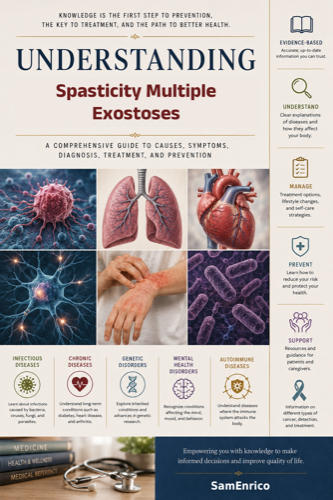
Understanding Spasticity Multiple Exostoses eBook
This disease publication, published by SamEnrico,
This disease publication, published by SamEnrico, covers Understanding Spasticity Multiple Exostoses
Formats
Free sample
Chapter 1: The Silent Architect...--–- The first time eleven-year-old Maya touched the hard ridge just above her left knee, she was standing in a warm shower after soccer practice, steam fogging the tiles, her legs still humming from ninety minutes of sprints. Her fingers traced a lump the size of an acorn—painless, immovable, and utterly foreign. She assumed it was a bruise from a slide tackle, or perhaps her kneecap had shifted weirdly. She didn't mention it to her mother that night. She didn't mention it the next morning either, when the lump was still there, unchanged.
It was only three weeks later, when Maya's mother noticed her daughter wincing while pulling on jeans, that the family doctor was called. And that call—that single, unremarkable Tuesday afternoon appointment—would unravel a story written not in the soft tissues of a bruised muscle but in the very blueprint of Maya's bones.This is not a book about rare diseases you will never encounter. This is a book about a condition that lives in the shadows of medicine, misdiagnosed as growing pains, dismissed as clumsiness, and too often discovered only after years of confusion, frustration, and unnecessary suffering. Multiple Hereditary Exostoses—MHE—is a genetic disorder that builds bone where bone should not grow. It is an architect that works in silence, laying down cartilage-capped tumors called osteochondromas along the growth plates of long bones, ribs, shoulder blades, and sometimes the spine.
These lesions are not cancer. They are not a death sentence. But they are, for the approximately one in fifty thousand people who carry the mutation, a lifelong negotiation between a body that grows unpredictably and a spirit that refuses to be defined by it.This chapter is the foundation. Before we can understand spasticity—the strange, stubborn tightness that makes muscles feel like locked cables—before we can navigate surgeries, genetic counseling, or the labyrinth of school accommodations, we must first name the thing that starts it all. We must understand what MHE actually is, what it is not, and why the first lump is never just a lump.--What Is an Osteochondroma?
A Story Written in Cartilage and Bone To understand MHE, you must first understand the osteochondroma. The word itself is a解剖ical poem: osteo (bone), chondro (cartilage), oma (tumor or growth). Put simply, an osteochondroma is a benign bone tumor capped with cartilage. But simplicity here is deceptive. These are not chaotic, inscrutable masses.
They follow rules—rules written in the biology of growth plates and the timing of puberty.Imagine a child's long bone, say the femur or the tibia. At each end lies the physis—the growth plate, a thin disc of cartilage where new bone is born. Throughout childhood, this plate produces bone at a remarkable rate, lengthening limbs, building stature. In MHE, the cells that should quietly follow this orderly process occasionally misread their instructions. A small cluster of cartilage cells begins to grow sideways, outward, like a branch from a tree trunk.
As the child grows, this branch grows too, keeping pace with the skeleton. By the time the growth plates close at the end of adolescence, the osteochondroma has completed its expansion. It will not grow again—unless, in a small number of cases (which we will discuss honestly in Chapter 12), malignant transformation occurs.There are two shapes these lesions take. Pedunculated osteochondromas grow on a stalk, like a mushroom on a tree. They point away from the joint and can sometimes be palpated through the skin as a hard, movable bump.
Sessile osteochondromas are broader, flatter, hugging the bone like a shelf. Neither shape is inherently more dangerous. But both can cause problems depending on their location.The critical fact to internalize—the one that changes how you think about every symptom to come—is this: osteochondromas grow only during skeletal growth. A child diagnosed at eight may develop new lesions until age fourteen to sixteen (girls) or sixteen to eighteen (boys). An adult who has finished growing will not develop new lesions.
This means that childhood and early adolescence are the periods of highest change, highest uncertainty, and highest opportunity for intervention.--Epidemiology: The 1 in 50,000 Question You will hear the number "one in fifty thousand" repeated in clinic hallways and on support group forums. It is the accepted estimate for the prevalence of MHE worldwide. But like all rare disease numbers, it comes with an asterisk.MHE is likely underdiagnosed. Why? Because not everyone with a few small osteochondromas ever seeks medical attention.
A person with a single painless bump on a rib or a solitary lesion on a finger may live their entire life without an X-ray, without a genetic test, without ever hearing the words "Multiple Hereditary Exostoses." The one-in-fifty-thousand figure captures only those diagnosed—those with enough lesions, enough pain, enough functional limitation to land in a doctor's office. The true number may be closer to one in thirty thousand or even one in twenty thousand.MHE does not discriminate by geography or ethnicity. It appears in every population studied. It affects males and females, though males often develop more numerous and larger lesions—a sex difference we will explore in Chapter 8. The only demographic variable that matters is inheritance.
Two thirds of cases are passed from parent to child. The remaining third—like Maya's case—arise from spontaneous mutations, with no family history.For the parent reading this chapter with a newly diagnosed child, the spontaneous mutation statistic is both a relief and a new burden. Relief: you did not cause this. There is no hidden carrier in your family tree. Burden: you cannot look to a parent or grandparent for guidance on what comes next.
You are the first. That is a lonely feeling. But it is also an invitation to build knowledge from the ground up—and this book is designed to help you do exactly that.--The Growth Plate Clock: Why Timing Is Everything One of the most common misconceptions about MHE is that lesions appear randomly throughout life. They do not. They appear only when the growth plates are open.
This simple fact has profound implications for how you monitor the condition and when you intervene.Let us walk through a typical timeline.Birth to age five: Osteochondromas are rarely detected in toddlers. They are small, often asymptomatic, and hidden beneath layers of soft tissue. However, in severe cases, parents may notice asymmetry—one leg slightly shorter than the other, a rib that feels prominent, a shoulder blade that sticks out.Ages six to twelve (elementary and middle school): This is often when the first lump is discovered. The child is active, growing quickly, and lesions are large enough to be felt or seen. Maya's story—a lump found after soccer practice—is archetypal.
At this stage, most lesions are asymptomatic. Pain, if present, is usually mechanical: a bump rubbing against a muscle or tendon.Ages twelve to sixteen (girls) or fourteen to eighteen (boys): This is the period of most rapid growth and the appearance of most new lesions. It is also the window during which deformities become clinically significant. Genu valgum (knock-knees), ankle valgus (the heel…
This is the end of the free sample. Get the eBook to keep going. Buy now
About this book
Details
- Author
- Dorman Erminia
- Publisher
- SamEnrico
- Language
- English
- Genre
- Non-Fiction, Informative, Educational
- Released
- 2026-05-11
- Pages (approx.)
- 147
- Available as
- eBook, Audiobook

Read better in the ZLOADR app
Your eBooks on your phone or tablet. Sign in with your SamEnrico account and start reading.
More by Dorman Erminia
 Operation Drumbeat ExplainedDorman Erminia$11.99
 The Behavioral Addiction CBT GuideDorman Erminia$11.99
 Spirituality And Senior Self EsteemDorman Erminia$11.99
 Values Based Life HandbookDorman Erminia$11.99
 The Breast Cancer Caregiver GuideDorman Erminia$11.99
 The Sleep Experiment: How the CIA Tried to Erase a Man's MemoryDorman Erminia$11.99
 Unix EngineerDorman Erminia$11.99
 Installment Sale to Intentionally Defective Grantor TrustDorman Erminia$12.99
 Crop Insurance Climate RiskDorman Erminia$12.99
 How to Become a Police-academy InstructorDorman Erminia$11.99
You may also like
 Hong Kong Handover 1997Dunn Johnnie$11.99
 Zumba For Postnatal Recovery CourseNeal Christian$11.99
 Zumba for BeginnersLadner Nikia$11.99
 YouTube Comment Mining GuideHumes Pandora$12.99
 Worry Box MeditationCarlin Rudy$11.99
 Workplace Stress MeditationNguyen Lynn$11.99
 Workplace Stress and Sleep RepairHawley Ivory$11.99
 Workplace Perfectionism CureDelaney Jeffry$11.99
 Workplace Injustice Anger GuideWallen Isabelle$11.99
 Work Addiction and Burnout LinkGreenwood Ester$11.99
 Women in Yoga and WellnessBeattie Galina$11.99
 Women in Stand Up ComedyChun Evangeline$11.99