
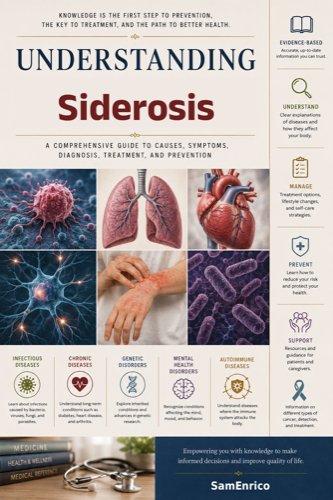
Non-FictionInformativeEducational
Understanding Siderosis eBook
This disease publication, published by SamEnrico,
This disease publication, published by SamEnrico, covers Understanding Siderosis
Formats
Free sample
Chapter 1: The Iron Paradox...--The chest X-ray hanging on the lightbox looked like a night sky peppered with stars—except the stars were white, and the sky was black, and the patient was only forty-nine years old.Dr. Elena Vasquez had been reading pulmonary films for eighteen years, but this one made her pause. Thousands upon thousands of tiny micronodules speckled both lung fields, dense in the upper and middle zones, tapering toward the bases. The pattern was unmistakable to anyone who had seen it before, yet most physicians—even most pulmonologists—might go an entire career without encountering it."Is it cancer?" asked Mark, a wiry man with forearms like twisted rope and calloused hands that hadn't stopped fidgeting since he sat down. He had never smoked a cigarette in his life.
He ran five kilometers every Saturday morning. He felt fine. He came in only because a routine occupational health screening required a chest X-ray every three years for his job."No," Dr. Vasquez said, turning from the lightbox to face him. "It's not cancer."Mark exhaled.
His shoulders dropped half an inch."It's rust."The word hung in the examination room like a verdict. Rust. The orange-brown corrosion that forms on old garden tools, on the undersides of cars in wet climates, on the chains of playground swings left out all winter. Rust in a human lung.Mark blinked. "How?""You've been arc welding for how long now?""Twenty-eight years.
Started when I was twenty-one.""Do you wear a respirator?"Mark shrugged—the universal gesture of a man who knew the right answer but lived the wrong one. "Sometimes. When I remember. When it's not too hot. The guys on the crew, they make fun of you if you wear one.
Says it makes you look weak."That shrug, more than any statistic or textbook passage, explained the X-ray. For nearly three decades, Mark had stood inches from molten metal, bathing in a plume of invisible iron oxide particles. Each breath pulled those particles deep into his alveolar sacs, where his immune system did exactly what it was designed to do: it engulfed the invaders. Macrophages—the garbage collectors of the human body—gobbled up the iron, wrapped it in ferritin, and stored it for safekeeping.Then those macrophages died. New macrophages arrived, engulfed the debris, and stored even more iron.
Rinse and repeat, five days a week, fifty weeks a year, for twenty-eight years.Mark's lungs now contained an estimated half-pound of rust.And yet—and this is the paradox that makes siderosis one of the most misunderstood conditions in all of medicine—Mark could still breathe. His oxygen saturation was ninety-eight percent. His pulmonary function tests showed only the mildest restriction, well within normal limits for a man his age. He ran 5Ks on weekends.The iron in his lungs was, for now, a silent passenger. A benign stowaway.
A ticking clock that might never tick.But the story of Mark—a composite patient drawn from dozens of real cases in the medical literature—does not end with that X-ray. Because three years after that first image, Mark fell off a ladder while cleaning his gutters. He didn't hit his head. He wasn't knocked unconscious. He got up, dusted himself off, and finished the job.That fall, however, did something that no one could have predicted.
It reopened a tiny, forgotten dural tear—a nick in the membrane surrounding his spinal cord—from a minor car accident twenty-three years earlier. A low-pressure venous bleed began, silent and slow, leaking just a few drops of blood into his cerebrospinal fluid each day.That blood contained hemoglobin. Hemoglobin contained iron. And that iron—unlike the iron trapped safely in his lungs—was about to settle into the worst possible real estate in his body: the surfaces of his brain and spinal cord.By age fifty-five, Mark was using a cane. By fifty-seven, he was deaf in one ear and struggling to understand speech in the other.
By fifty-nine, the cane had become a walker, and the walker was becoming a wheelchair.His lungs were still fine.The Essential Poison Iron is the fourth most abundant element on Earth, by mass. It makes up about five percent of the planet's crust. Before humans learned to smelt copper and tin into bronze, they worked iron—first meteoric iron, then terrestrial ore—into tools and weapons that transformed civilization. The Iron Age, which began around 1200 BCE, marked the ascendancy of human technology. Without iron, there would be no skyscrapers, no bridges, no railroads, no automobiles.Inside the human body, iron plays an equally transformative role.
Approximately two-thirds of the body's iron—about two to three grams in an average adult—resides in hemoglobin, the protein inside red blood cells that binds oxygen in the lungs and releases it in the tissues. Without iron, hemoglobin cannot hold oxygen. Without oxygen, cells die within minutes. Brain cells are especially vulnerable: four to six minutes without oxygen can cause irreversible damage.Most of the remaining iron is stored in ferritin, a spherical protein complex that can hold up to 4,500 iron atoms in its hollow core. Ferritin is the body's iron buffer.
When iron levels are high, ferritin stores it safely. When iron levels drop, ferritin releases it. Small amounts of iron are also incorporated into myoglobin (which stores oxygen in muscle tissue), cytochromes (which transfer electrons in mitochondria, the power plants of cells), and various enzymes involved in neurotransmitter synthesis, including dopamine and serotonin.Iron is essential for life. Without it, we cannot breathe, cannot move, cannot think.But iron is also, without exaggeration, a slow poison.The same chemical properties that make iron so useful—its ability to gain and lose electrons, to shift between ferrous (Fe²⁺) and ferric (Fe³⁺) states—also make it dangerous. Free iron, not bound to protein, participates in a chemical reaction that damages everything it touches.The Fenton Reaction: Chemistry of Destruction In 1894, a British chemist named H.J.H.
Fenton described a reaction that would later become fundamental to understanding oxidative damage in biology. The Fenton reaction, in its simplest form, looks like this:Fe²⁺ + H₂O₂ → Fe³⁺ + OH⁻ + OH•Let me translate that into plain English. Ferrous iron (Fe²⁺) reacts with hydrogen peroxide (H₂O₂) to produce ferric iron (Fe³⁺), a hydroxide ion (OH⁻), and a hydroxyl radical (OH•).That last product—the hydroxyl radical—is among the most destructive reactive oxygen species known to biology. It tears through cell membranes in a process called lipid peroxidation. It damages DNA, causing mutations and strand breaks.
It inactivates enzymes by oxidizing critical amino acids. It triggers programmed cell death (apoptosis) and inflammatory pathways.The hydroxyl radical does not travel far—it reacts with the first molecule it encounters—but what it encounters, it destroys.Under normal conditions, the body protects itself from this danger. Iron is almost always bound to proteins—hemoglobin, ferritin, transferrin (the transport protein), lactoferrin (in secretions)—which keep it from participating in Fenton chemistry. The body also produces antioxidants, such as glutathione and superoxide dismutase, that neutralize reactive oxygen species before they cause damage.But when iron accumulates in tissues in its free or poorly bound form, the protective…
This is the end of the free sample. Get the eBook to keep going. Buy now
About this book
Details
- Author
- Sander Christin
- Publisher
- SamEnrico
- Language
- English
- Genre
- Non-Fiction, Informative, Educational
- Released
- 2026-05-11
- Pages (approx.)
- 151
- Available as
- eBook, Audiobook

Read better in the ZLOADR app
Your eBooks on your phone or tablet. Sign in with your SamEnrico account and start reading.
More by Sander Christin
 Third Party Logistics OutlookSander Christin$11.99
 Thistle Plant Based ComparisonSander Christin$11.99
 The Arthritis and Comorbidity GuideSander Christin$11.99
 The Battle Royale Gaming DisorderSander Christin$11.99
 Deep Work Morning GuideSander Christin$11.99
 Silent Shadows: The Double Life of Mata Hari’s InformantSander Christin$11.99
 Spinner (demonstration)Sander Christin$11.99
 B2B Sales Egypt Market GuideSander Christin$12.99
 Credit Union Business Loan RatesSander Christin$12.99
 How to Start a Dressing Gown Cord and Girdle Business (Beginners Guide)Sander Christin$11.99
You may also like
 Hong Kong Handover 1997Dunn Johnnie$11.99
 Zumba For Postnatal Recovery CourseNeal Christian$11.99
 Zumba for BeginnersLadner Nikia$11.99
 YouTube Comment Mining GuideHumes Pandora$12.99
 Worry Box MeditationCarlin Rudy$11.99
 Workplace Stress MeditationNguyen Lynn$11.99
 Workplace Stress and Sleep RepairHawley Ivory$11.99
 Workplace Perfectionism CureDelaney Jeffry$11.99
 Workplace Injustice Anger GuideWallen Isabelle$11.99
 Work Addiction and Burnout LinkGreenwood Ester$11.99
 Women in Yoga and WellnessBeattie Galina$11.99
 Women in Stand Up ComedyChun Evangeline$11.99