
Non-FictionInformativeEducational
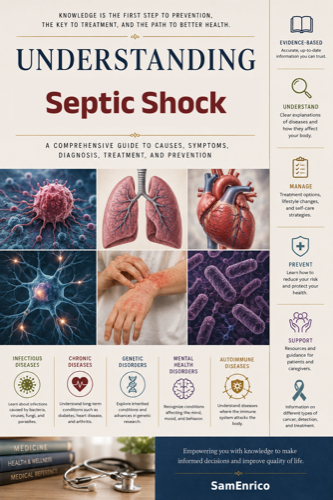
Understanding Septic Shock eBook
This disease publication, published by SamEnrico,
This disease publication, published by SamEnrico, covers Understanding Septic Shock
Formats
Free sample
Chapter 1: The 2.8-Second Killer--– In the time it takes you to read this sentence, another human being somewhere in the world has begun their final descent into septic shock. By the time you finish this paragraph, three more will have joined them. Before you complete this chapter, nearly two hundred people will have died from a condition that most of them had never heard of until it was too late. This is not hyperbole. This is epidemiology.Sepsis and its deadliest form, septic shock, kill approximately eleven million people annually worldwide.
To put that number in context, that is more deaths than breast cancer, prostate cancer, and HIV/AIDS combined. It is one death every 2.8 seconds. In high-income countries, the mortality rate for septic shock ranges from twenty to forty percent. In low-resource settings, where access to intensive care units, advanced monitoring, and broad-spectrum antibiotics is limited, that number can exceed sixty percent. Despite these staggering figures, a 2023 international survey found that nearly two-thirds of adults had never heard the word "sepsis," and fewer than fifteen percent could name even one of its early warning signs.This chapter exists to close that gap.But before we can understand how to stop septic shock, we must first understand what it actually is — and what it is not.
This is not merely an academic exercise. The difference between recognizing septic shock in its first hour versus its sixth hour can be the difference between walking out of the hospital and leaving in a body bag. The difference between treating the right infection with the right antibiotic versus guessing blindly can be the difference between full recovery and the loss of limbs, kidneys, or cognitive function. The difference between understanding septic shock as "a really bad infection" versus understanding it as "a dysregulated host response that turns the body's own defense systems into weapons of self-destruction" is the difference between practicing medicine in 1995 and practicing medicine today.Let us begin with a story.The Case of Mr. Anderson Mr.
Anderson was fifty-two years old, a construction foreman with no significant medical history. He did not smoke. He exercised three times per week. He took no medications. He was, by all objective measures, the picture of middle-aged health.On a Tuesday morning, he felt a dull ache in his lower back.
He assumed he had strained a muscle at work. By Tuesday evening, he had a fever of 38.9°C (102°F) and felt "flu-ish." He drank some water, took acetaminophen, and went to bed. On Wednesday morning, his wife noticed he seemed confused — he asked her the same question three times in ten minutes. His fever was now 39.4°C (103°F). She drove him to the emergency department.At triage, his vital signs were: heart rate 128 beats per minute, blood pressure 88/52 mm Hg, respiratory rate 26 breaths per minute, oxygen saturation 93% on room air.
The triage nurse documented "fever, tachycardia, borderline hypotension, tachypnea." Mr. Anderson was placed in a hallway bed because the emergency department was overcrowded.Two hours later, a blood pressure check read 74/40 mm Hg. A lactate level was ordered as an afterthought. It came back at 4.8 mmol/L. The normal range is less than 1.0.
By the time the intensive care team was consulted, Mr. Anderson had received one liter of normal saline. His blood pressure transiently improved to 90/50 but then fell again. He was started on norepinephrine through a peripheral intravenous line. Blood cultures were drawn.
Broad-spectrum antibiotics were administered — but not until nearly five hours after his arrival.The source of his infection was eventually identified: a urinary tract infection with a common bacterium called Escherichia coli that had seeded into his bloodstream. The bacteria had likely originated in his own colon, migrated to his urethra, and traveled upward into his bladder and kidneys. From there, they had entered his bloodstream. His immune system had responded appropriately at first — fever, inflammation, recruitment of white blood cells. But then the response had spiraled out of control.Mr.
Anderson survived. He spent twelve days in the intensive care unit, seven of them on a mechanical ventilator for acute respiratory distress syndrome. He required hemodialysis for two weeks because his kidneys had failed. He lost approximately fifteen kilograms of muscle mass. At six months after discharge, he had not returned to work.
He suffered from debilitating fatigue, difficulty concentrating, and recurrent nightmares about his time in the ICU. He was, by the medical definition, a survivor. But "survivor" is not the same as "recovered."Mr. Anderson's case is not exceptional. It is, tragically, typical.
And almost everything that went wrong in his case — the delayed recognition, the late lactate measurement, the prolonged time to antibiotics, the absence of a formal sepsis screening tool at triage — is preventable.Defining the Enemy: From Infection to Septic Shock To understand septic shock, we must first understand a hierarchy of terms that are often used interchangeably by the public and even by some clinicians. They are not synonyms. The differences matter because they determine how aggressively a patient is treated and how urgently.Infection is the invasion of normally sterile tissue by microorganisms — bacteria, viruses, fungi, or parasites. A urinary tract infection is an infection. Pneumonia is an infection.
An infected surgical wound is an infection. Infection can exist without any systemic response. Many infections are localized, self-limited, and require no treatment beyond observation or a short course of oral antibiotics.Bacteremia is the presence of viable bacteria in the bloodstream. This is a subset of infection, not a synonym for sepsis. Transient bacteremia can occur after brushing your teeth, undergoing a dental procedure, or even vigorous physical exercise.
The immune system clears these low-level bacterial invasions without incident. Persistent bacteremia is another matter — it indicates a source that is continuously seeding bacteria into the blood, such as an infected heart valve (endocarditis), an abscess, or an infected intravenous catheter.Sepsis (as defined by the Third International Consensus Definitions for Sepsis and Septic Shock, published in 2016 and still the gold standard) is life-threatening organ dysfunction caused by a dysregulated host response to infection. Let us parse that definition carefully because every word has been chosen with precision."Life-threatening" means that without prompt and appropriate intervention, death is a likely outcome. "Organ dysfunction" means that one or more organ systems — lungs, kidneys, heart, brain, liver, coagulation system — are failing to perform their normal functions. This is measured using the Sequential Organ Failure Assessment (SOFA) score, which assigns points based on six domains: respiration (oxygenation), coagulation (platelet count), liver (bilirubin), cardiovascular (blood pressure and vasopressor requirement), central nervous system (Glasgow Coma Scale), and renal (creatinine or urine output).
An increase in SOFA score of two or more points from baseline defines sepsis."Dysregulated host response" is the crucial phrase. It signals that the problem is not merely the infection itself but the body's exaggerated, chaotic, and ultimately harmful reaction to that infection. The immune system, which evolved to protect us, has become a weapon turned inward.Septic shock is a subset of sepsis. It is defined by two criteria that must both be present: (1) persistent hypotension requiring vasopressor medications to maintain a mean arterial pressure of 65 mm Hg or higher, and (2)…
This is the end of the free sample. Get the eBook to keep going. Buy now
About this book
Details
- Author
- Doherty Mignon
- Publisher
- SamEnrico
- Language
- English
- Genre
- Non-Fiction, Informative, Educational
- Released
- 2026-05-11
- Pages (approx.)
- 148
- Available as
- eBook, Audiobook

Read better in the ZLOADR app
Your eBooks on your phone or tablet. Sign in with your SamEnrico account and start reading.
More by Doherty Mignon
 The Arthritis Flare WorkbookDoherty Mignon$11.99
 Remote Company Retreats Time Zone TacticsDoherty Mignon$11.99
 Chunking Personal FinancesDoherty Mignon$11.99
 The Jedediah Smith Mountain ManDoherty Mignon$11.99
 Mental Health Professional BurnoutDoherty Mignon$11.99
 Leaping into the Unknown: The Birth of Wingsuit FlyingDoherty Mignon$11.99
 KAIST International Scholarship GuideDoherty Mignon$12.99
 EU Food Safety RegulationsDoherty Mignon$12.99
 How to Become a Orthotics TechnicianDoherty Mignon$11.99
 RocketsDoherty Mignon$11.99
You may also like
 Hong Kong Handover 1997Dunn Johnnie$11.99
 Zumba For Postnatal Recovery CourseNeal Christian$11.99
 Zumba for BeginnersLadner Nikia$11.99
 YouTube Comment Mining GuideHumes Pandora$12.99
 Worry Box MeditationCarlin Rudy$11.99
 Workplace Stress MeditationNguyen Lynn$11.99
 Workplace Stress and Sleep RepairHawley Ivory$11.99
 Workplace Perfectionism CureDelaney Jeffry$11.99
 Workplace Injustice Anger GuideWallen Isabelle$11.99
 Work Addiction and Burnout LinkGreenwood Ester$11.99
 Women in Yoga and WellnessBeattie Galina$11.99
 Women in Stand Up ComedyChun Evangeline$11.99