
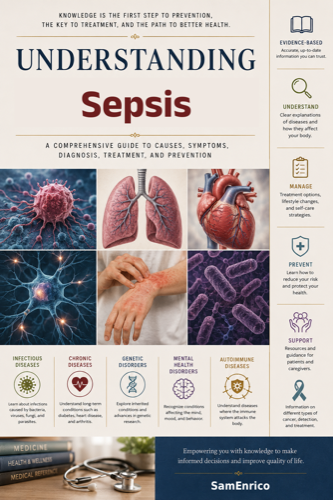
Non-FictionInformativeEducational
Understanding Sepsis eBook
This disease publication, published by SamEnrico,
This disease publication, published by SamEnrico, covers Understanding Sepsis
Formats
Free sample
Chapter 1: The Shadow Pandemic...--The call came in at 2:17 AM on a Tuesday. A 34-year-old woman, previously healthy, mother of two young children, had been feeling "under the weather" for two days. She thought it was the flu. She thought it would pass. By the time her husband found her in the bathroom, slumped against the wall with vacant eyes and skin the color of ash, her organs had been failing for hours.
In the emergency department, her blood pressure was 74/42. Her heart raced at 140 beats per minute. Her lactate was 6.8—more than triple the upper limit of normal. She was intubated within minutes. Broad-spectrum antibiotics were hung within the hour.
But the source of her infection, a simple urinary tract infection that had seeded into her bloodstream, had already triggered a cascade her body could not stop. She died three days later, leaving behind a husband who would spend years asking the same devastating question: "Why didn't anyone tell me sepsis could look like the flu?"This is not an isolated tragedy. It is a daily reality repeated tens of thousands of times each year, in every country, in every type of hospital, across every demographic imaginable. And the most frightening part is not the mortality rate—though that is staggering enough. The most frightening part is how many people, including healthcare professionals, still do not fully understand what sepsis is, what it looks like in its earliest and most treatable stages, and why the clock matters more than almost anything else in medicine.What Sepsis Really Is (And What It Is Not)The word "sepsis" comes from the ancient Greek word "σήψις" (sēpsis), meaning "decay" or "putrefaction." For most of human history, that etymology was tragically accurate—sepsis was simply accepted as the inevitable progression of a severe infection, a death sentence written in the language of rotting flesh and spreading redness.
Even as recently as the 1980s, many physicians viewed sepsis as an unavoidable consequence of serious bacterial infection, something to be managed with supportive care while hoping the patient's own immune system would eventually prevail.That fatalistic view has changed dramatically, but public understanding has not kept pace. Ask a hundred people on any city street what sepsis means, and you will hear a confusing array of answers. Some will say "blood poisoning," an old but imprecise term that suggests the problem is simply bacteria multiplying in the bloodstream—what physicians call bacteremia. Others will say it is "a severe infection," which is closer but still misses the critical distinction. Still others will have no answer at all, never having heard the word despite its status as one of the leading causes of death on the planet.Here is the definition that every person should memorize, because understanding it is the first step toward prevention: Sepsis is a life-threatening organ dysfunction caused by a dysregulated host response to infection.Let us break that down, because each word matters.
The "dysregulated host response" means the problem is not merely the infection itself—it is the body's reaction to the infection, which spirals out of control. Think of a small kitchen fire. A normal immune response would be like grabbing a fire extinguisher, aiming it at the flames, and putting out the fire while leaving the rest of the house untouched. That is what happens when you have a localized infection: your immune system attacks the bacteria, inflammation is confined to the area, and you recover.Sepsis is the equivalent of the fire alarm malfunctioning, the sprinkler system flooding the entire house, the fire department showing up and spraying water through every window, and the structural supports weakening under the weight of all that water. Your immune system—the very system designed to protect you—becomes the agent of destruction.
It attacks not just the bacteria but your own organs. It floods your bloodstream with inflammatory chemicals called cytokines. It makes your blood vessels leaky, causing fluid to escape into your tissues and your blood pressure to crash. It activates your clotting system in ways that create microscopic clots throughout your body, blocking blood flow to your kidneys, brain, heart, and lungs while simultaneously consuming your clotting factors so that when you do bleed, you cannot stop.This is not an exaggeration. This is the molecular reality of sepsis, and it explains why the condition carries a mortality rate of 15 to 30 percent even in the best hospitals in the wealthiest countries, and up to 50 percent or higher when septic shock—the most severe form—develops.The Epidemiology: Numbers That Demand Attention To understand why sepsis deserves urgent attention, consider these figures, which represent the most current global estimates compiled by researchers publishing in The Lancet in 2020, drawing on data from 195 countries.Sepsis affects an estimated 49 million people annually.
That is 49 million individual human beings—mothers, fathers, children, grandparents, colleagues, neighbors—each with a story, each with a family, each with a life that hangs in the balance. Of those 49 million, approximately 11 million die. That is one in five deaths worldwide. To put that in perspective, sepsis kills more people each year than breast cancer, prostate cancer, and all digestive tract cancers combined. It kills more people than stroke.
It kills more people than road traffic accidents. It kills more people than HIV, malaria, and tuberculosis combined.But these global figures, as staggering as they are, obscure an even more troubling reality: sepsis is not distributed equally across populations or geographies. The highest burden falls on the youngest and the oldest. Children under five account for nearly half of all sepsis cases worldwide, with the highest mortality in newborns, whose immature immune systems cannot mount an effective response. At the other end of the spectrum, adults over 65—particularly those with chronic conditions like diabetes, kidney disease, heart failure, or cancer—face dramatically elevated risk.
A minor urinary tract infection that would be an inconvenience for a healthy 30-year-old can become a death sentence for an 80-year-old with diabetes and hypertension.Geography matters just as much as age. In high-income countries like the United States, Canada, Western Europe, Australia, and Japan, sepsis mortality rates have declined substantially over the past two decades, thanks to better recognition, standardized treatment protocols, and intensive care capabilities. A patient with septic shock in a well-resourced urban hospital today has a 70 to 85 percent chance of survival—still sobering, but vastly improved from the 50 percent survival rates of the 1990s.In low-income countries, however, the picture is catastrophic. Sepsis mortality rates often exceed 50 percent overall, and approach 70 to 80 percent in the most resource-limited settings. The reasons are not mysterious: lack of access to antibiotics, absence of intensive care units, shortages of trained medical personnel, inadequate diagnostic capabilities, and delays in seeking care due to distance, cost, or lack of awareness.
A child with pneumonia-induced sepsis in rural sub-Saharan Africa may never see a doctor at all, or may arrive at a clinic after days of travel only to find there are no oxygen tanks, no intravenous fluids, no vasopressor medications, and no ability to provide mechanical ventilation.The Economic Cost of Misdiagnosis Even in wealthy countries, sepsis exacts a devastating financial toll. The average hospitalization for sepsis…
This is the end of the free sample. Get the eBook to keep going. Buy now
About this book
Details
- Author
- Newberry Shena
- Publisher
- SamEnrico
- Language
- English
- Genre
- Non-Fiction, Informative, Educational
- Released
- 2026-06-02
- Pages (approx.)
- 157
- Available as
- eBook, Audiobook

Read better in the ZLOADR app
Your eBooks on your phone or tablet. Sign in with your SamEnrico account and start reading.
More by Newberry Shena
 Chunking Meeting AgendasNewberry Shena$11.99Chunking Meeting AgendasNewberry Shena$11.99
 Caregiver Burnout Rescue GuideNewberry Shena$11.99
 Andorran Ski Resort DeveloperNewberry Shena$11.99
 Hip Arthritis ManagementNewberry Shena$11.99
 The Zebulon Pike Expedition GuideNewberry Shena$11.99
 The Siege of Chittorgarh: Blood and Honor in the Rajput StrongholdNewberry Shena$11.99
 How to Become a Dye WeigherNewberry Shena$11.99
 SNU Scholarship for InternationalsNewberry Shena$12.99
 EU Pesticide Limits CoffeeNewberry Shena$12.99
 River RaftingNewberry Shena$11.99
You may also like
 Hong Kong Handover 1997Dunn Johnnie$11.99
 Zumba For Postnatal Recovery CourseNeal Christian$11.99
 Zumba for BeginnersLadner Nikia$11.99
 YouTube Comment Mining GuideHumes Pandora$12.99
 Worry Box MeditationCarlin Rudy$11.99
 Workplace Stress MeditationNguyen Lynn$11.99
 Workplace Stress and Sleep RepairHawley Ivory$11.99
 Workplace Perfectionism CureDelaney Jeffry$11.99
 Workplace Injustice Anger GuideWallen Isabelle$11.99
 Work Addiction and Burnout LinkGreenwood Ester$11.99
 Women in Yoga and WellnessBeattie Galina$11.99
 Women in Stand Up ComedyChun Evangeline$11.99