
Non-FictionInformativeEducational
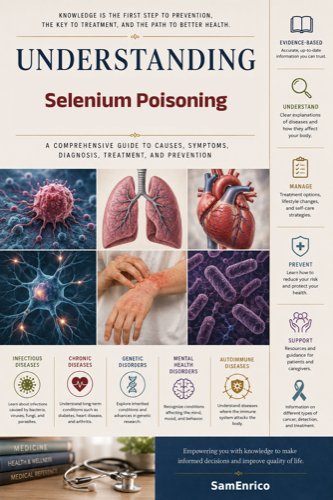
Understanding Selenium Poisoning eBook
This disease publication, published by SamEnrico,
by Prunty Kieth
This disease publication, published by SamEnrico, covers Understanding Selenium Poisoning
Formats
Free sample
Chapter 1: The Goldilocks Element...--Selenium is one of the most misunderstood substances in human health. It is neither a friend nor an enemy, a cure nor a poison. Instead, it is something far more dangerous precisely because of its duality: an essential nutrient that sustains life at low doses and a potent toxin that destroys it at high doses. This chapter tells the story of that paradox—the Goldilocks element that must be consumed in the narrowest of windows, where too little harms and too much kills. Understanding this duality is not merely an academic exercise.
It is the difference between reaching for a supplement that heals and swallowing a pill that slowly, imperceptibly, or catastrophically poisons you.Selenium was discovered in 1817 by the Swedish chemist Jöns Jacob Berzelius, who named it after Selene, the Greek goddess of the moon, because it appeared as a byproduct of sulfuric acid production and seemed to follow tellurium (named for Tellus, the Roman goddess of the earth). For more than a century, selenium was regarded primarily as an industrial toxin, a hazard in glass manufacturing and electronics. No one considered it a nutrient. That changed dramatically in the 1950s and 1960s, when researchers discovered that selenium prevented liver necrosis in rats and that it was an essential component of glutathione peroxidase, the body's primary defense against oxidative damage. Suddenly, the moon goddess had a second face: she was not only a destroyer but a preserver.The story of how selenium moved from toxin to nutrient is itself a cautionary tale about the limits of scientific knowledge.
For decades, veterinarians in the Great Plains of the United States had observed a mysterious illness in livestock known as "alkali disease." Affected animals developed brittle hooves, lost hair from their manes and tails, and walked with a stumbling, staggering gait. In more severe cases, they died suddenly. The cause was unknown. Meanwhile, in parts of China, children were developing a debilitating form of osteoarthritis called Kashin-Beck disease, and adults in certain rural areas were dying of a strange cardiomyopathy named after the Keshan province where it was first identified. The cause was also unknown.
Only later did scientists realize that both sets of observations were two sides of the same coin. The American livestock were grazing on selenium-rich soils that poisoned them. The Chinese villagers were living on selenium-poor soils that starved them. The same element, in different concentrations, produced opposite diseases. Selenium was the first element recognized as having both an essential nutritional role and a toxicological hazard—a duality that would later be observed in other trace elements like chromium and copper, but never so dramatically as with selenium.Today, we understand that selenium is incorporated into more than 25 selenoproteins—specialized proteins that contain selenium in the form of the amino acid selenocysteine, often called the twenty-first amino acid.
The most famous of these are the glutathione peroxidases, a family of enzymes that neutralize hydrogen peroxide and lipid hydroperoxides, preventing oxidative damage to cell membranes, DNA, and proteins. Without adequate selenium, these enzymes cannot function. The result is a cascade of oxidative stress that manifests as muscle weakness, immune dysfunction, thyroid disorders, infertility, and, in severe cases, the specific deficiency diseases—Keshan disease (a cardiomyopathy that can be fatal within days) and Kashin-Beck disease (a degenerative joint disease that cripples children). The Recommended Dietary Allowance for adults is 55 micrograms per day, an amount easily obtained from a balanced diet that includes grains, meat, fish, eggs, and nuts. One Brazil nut, as we will see repeatedly in this book, contains approximately 70 to 90 micrograms—more than the entire daily requirement.But the same biochemical pathways that make selenium essential also make it dangerous.
The Tolerable Upper Intake Level—the maximum daily intake from all sources (food, water, and supplements) that is considered safe for most healthy individuals—is 400 micrograms per day for adults. That is only about seven times the RDA. Compare this to vitamin C, where the UL is more than thirty times the RDA, or vitamin B12, which has no established UL at all because toxicity is virtually unknown. Selenium's narrow therapeutic window—the range between deficiency and toxicity—is among the smallest of all essential nutrients. This is the central fact that every reader must internalize: with selenium, a little is life-saving, a little more is harmless, but too much is poison.The transition from essential to toxic occurs through mechanisms that are the mirror image of its beneficial effects.
At nutritional doses, selenium functions as an antioxidant. At high doses, it becomes a pro-oxidant—a chemical that generates the very reactive oxygen species that antioxidants are supposed to neutralize. This paradoxical "pro-oxidant switch" is the molecular basis of selenium poisoning. Inorganic selenite, one of the common forms of selenium in supplements, reacts directly with glutathione to generate superoxide and hydrogen peroxide. These reactive oxygen species overwhelm the body's antioxidant defenses, causing widespread cellular damage.
Simultaneously, selenium replaces sulfur in the amino acids cysteine and methionine, forming selenocysteine and selenomethionine. These selenium-containing amino acids are incorporated into proteins during synthesis, disrupting normal protein folding. This disruption is most visible in keratin, the structural protein of hair and nails, where disulfide bridges that provide strength are replaced by weaker selenide bonds, causing hair to break at the roots and nails to develop characteristic horizontal ridges known as Mees' lines. The neurotoxicity of selenium—manifesting as peripheral neuropathy, irritability, and fatigue—results from oxidative damage to myelin sheaths and depletion of glutathione in neurons.These mechanisms explain why the symptoms of chronic selenium poisoning, known as chronic selenosis, are so distinctive. The classic triad—garlic breath (from exhaled dimethyl selenide), brittle hair that breaks at the roots, and horizontal nail ridging or complete nail loss—is highly characteristic, though not universal.
Some patients develop only one or two of these signs. Others experience peripheral neuropathy described as "burning feet," fatigue, irritability, and gastrointestinal disturbances. The variability reflects individual differences in selenium metabolism, genetics, diet, and the specific chemical form of selenium ingested.Acute selenium poisoning, which results from a single massive ingestion—typically a supplement overdose or industrial accident—presents differently. Symptoms develop within hours to days and include metallic taste, nausea, vomiting, diarrhea, abdominal pain, peripheral neuropathy, hypotension, and in severe cases, respiratory distress, myocardial depression, and death. The threshold for acute toxicity is approximately 1 to 5 milligrams per kilogram of body weight.
For a 70-kilogram adult, that is 70 to 350 milligrams of elemental selenium in a single ingestion. Massive ingestion exceeding 10 milligrams per kilogram—700 milligrams for a 70-kilogram adult—is often fatal without aggressive medical intervention. To put these numbers in perspective, the liquid supplement that poisoned more than 200 people in the 2008 US outbreak contained 200,000 micrograms—200 milligrams—per recommended dose. That is well within the acutely toxic range for most adults.The epidemiological data on selenium poisoning are sobering. According to the American Association of Poison Control Centers, there were more than 3,500 reported exposures to selenium supplements in the United States between 2017 and 2021, with nearly 40 percent of those cases involving children under the age of six.
The vast majority of these exposures were accidental ingestions of chewable supplements or liquid drops. Most resulted in mild symptoms…
This is the end of the free sample. Get the eBook to keep going. Buy now
About this book
Details
- Author
- Prunty Kieth
- Publisher
- SamEnrico
- Language
- English
- Genre
- Non-Fiction, Informative, Educational
- Released
- 2026-06-02
- Pages (approx.)
- 148
- Available as
- eBook, Audiobook

Read better in the ZLOADR app
Your eBooks on your phone or tablet. Sign in with your SamEnrico account and start reading.
More by Prunty Kieth
 Divorce Self Care RoutinePrunty Kieth$11.99
 Barbadian Rum DistillerPrunty Kieth$11.99
 Burnout Prevention Sleep ProtocolPrunty Kieth$11.99
 Naturopathy for Lymphatic HealthPrunty Kieth$11.99
 The Ernest Shackleton Endurance GuidePrunty Kieth$11.99
 The Iron Discipline: Frederick the Great and the Birth of Prussian EfficiencyPrunty Kieth$11.99
 Resident AssistantPrunty Kieth$11.99
 Franchise Catering Global GuidePrunty Kieth$12.99
 Research vs Industry AI Master'sPrunty Kieth$12.99
 Ultimate Handbook Guide to Beipiao : (China) Travel GuidePrunty Kieth$11.99
You may also like
 Hong Kong Handover 1997Dunn Johnnie$11.99
 Zumba For Postnatal Recovery CourseNeal Christian$11.99
 Zumba for BeginnersLadner Nikia$11.99
 YouTube Comment Mining GuideHumes Pandora$12.99
 Worry Box MeditationCarlin Rudy$11.99
 Workplace Stress MeditationNguyen Lynn$11.99
 Workplace Stress and Sleep RepairHawley Ivory$11.99
 Workplace Perfectionism CureDelaney Jeffry$11.99
 Workplace Injustice Anger GuideWallen Isabelle$11.99
 Work Addiction and Burnout LinkGreenwood Ester$11.99
 Women in Yoga and WellnessBeattie Galina$11.99
 Women in Stand Up ComedyChun Evangeline$11.99