
Non-FictionInformativeEducational
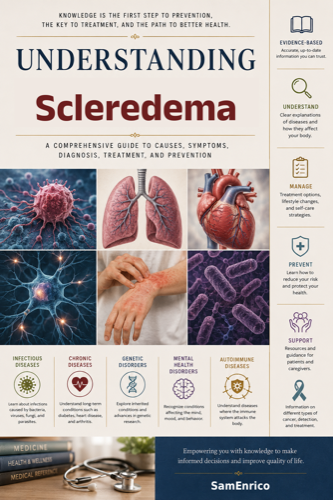
Understanding Scleredema eBook
This disease publication, published by SamEnrico,
by Harp Miles
This disease publication, published by SamEnrico, covers Understanding Scleredema
Formats
Free sample
Chapter 1: The Wooden Prison...--Maria stood in front of her bathroom mirror on a Tuesday morning, just like any other Tuesday. She was fifty-two years old, a grandmother of three, and a diabetic for nearly two decades. She raised her arms to brush her hair, but something strange happened—or rather, something stopped happening. Her shoulders would not lift past a certain point. Her neck felt tight, as if someone had cinched an invisible collar around her throat overnight.
She leaned closer to the mirror and noticed that her skin, usually soft and pliable across her upper back and the back of her neck, looked different. It did not look red or swollen. It did not look like a rash. It looked thick. She pressed her fingers into the skin just below her hairline.
It did not indent like normal skin. It felt hard. Wooden. Foreign.Maria did not know it yet, but she had just discovered the first clue in a medical mystery that would take her two more years to solve. She would visit her primary care doctor, who would order thyroid tests (normal).
She would see a rheumatologist, who would suspect scleroderma and order an ANA panel (negative—though no one told her that negative result was actually good news). She would undergo an MRI of her cervical spine (mild arthritis, nothing explaining the stiffness). She would be told, more than once, that it was probably just "tight muscles" or "getting older" or "anxiety." She would spend thousands of dollars and countless sleepless nights searching for answers.And then, finally, she would sit in the exam room of a dermatologist who had seen exactly three cases like hers in twenty years of practice. That dermatologist would perform a simple maneuver—the Pinch Test—and immediately recognize what Maria had. He would explain that she had a rare condition called Scleredema adultorum of Buschke, that it was not her fault, that it was not contagious, and that it was not going to kill her.
He would also tell her that there was no cure, but that there was hope. Maria would cry—not from despair, but from the relief of finally having a name for the wooden prison growing around her body.This book is for Maria. And for the thousands of others, scattered across the globe, who share her condition or something like it. If you are reading these words, you or someone you love may be trapped in the same diagnostic odyssey. You may have been told you have scleroderma, or fibrosis, or "nothing at all." You may have searched online and found almost nothing.
You may feel alone. You are not. This chapter—indeed, this entire book—exists to give you what Maria eventually found: answers, a roadmap, and the truth about a disease most doctors have never heard of.The Disease Without a Name Scleredema (pronounced skleer-uh-DEE-muh) is a rare, chronic disorder of the connective tissue characterized by a peculiar hardening of the skin. The medical literature calls it Scleredema adultorum of Buschke, named after the German dermatologist Abraham Buschke, who first described it in 1902. The name itself tells a story: "sclero" means hard, "edema" means swelling—a hardening swelling of the skin.
But that simple translation belies the complexity and mystery that still surround this condition more than a century after its discovery.The hallmark of Scleredema is a non-pitting, woody induration of the skin. In plain language, the skin becomes thick, tight, and hard, like wood or leather, and when you press on it, it does not dimple or bounce back. This thickening typically begins on the back of the neck and the upper back, then spreads symmetrically to the shoulders, the face, the chest, and sometimes the arms. In most cases, it stops at the abdomen. The hands and feet are almost always spared—and as you will learn later, that sparing is one of the most important clues that separates Scleredema from its more famous mimicker, scleroderma.The skin does not itch.
It does not hurt, at least not in the way a cut or a burn hurts. Instead, patients describe a sensation of tightness, of being wrapped in a bandage that is slowly being cinched tighter. They feel restricted. They feel heavy. They feel as though their bodies are no longer their own.A Disease of Astonishing Rarity Before we go any further, it is important to confront an uncomfortable truth: Scleredema is extraordinarily rare.
The best estimates, drawn from European and North American epidemiological studies, place its incidence at fewer than one case per million people per year. To put that number in perspective, you are more likely to be struck by lightning in your lifetime than to develop Scleredema. You are more likely to win a small lottery prize. You are more likely to be diagnosed with ALS, or with a brain tumor, or with any number of conditions that most people have heard of.This rarity has profound consequences for patients and doctors alike. For patients, it means that you may never meet another person with the same condition.
It means that your primary care doctor, your endocrinologist, even your rheumatologist may go their entire careers without seeing a single case. It means that when you search for information online, you will find fragments—case reports from medical journals, brief mentions in dermatology textbooks, and patient forums with dozens, not thousands, of members.For doctors, the rarity of Scleredema creates a dangerous blind spot. Medical training emphasizes common diseases. A physician learns to think first of horses, not zebras. Scleredema is not even a zebra; it is a unicorn.
When a patient walks in with stiff skin, the doctor's mind will naturally turn to scleroderma, to myxedema, to eosinophilic fasciitis, to any of the dozen more common conditions that can cause similar symptoms. Scleredema will not make the list because the doctor has likely never heard of it.This is the first of many paradoxes you will encounter in this book: a disease that is almost invisible to medicine, yet devastatingly real to those who live with it.The Great Impostor: Why Scleredema Is So Often Misdiagnosed Maria's story illustrates a painful pattern. Before her correct diagnosis, she was evaluated for:Thyroid disease (because hypothyroidism can cause skin thickening, a condition called myxedema)Scleroderma (the most common cause of pathological skin hardness in the public imagination)Cervical spine arthritis (because her neck stiffness mimicked a skeletal problem)Anxiety and muscle tension (the default diagnosis when tests come back normal)Each of these was a reasonable consideration. Each was wrong.The single most common misdiagnosis—and the most consequential—is scleroderma. Systemic sclerosis (scleroderma) is an autoimmune disease that causes fibrosis of the skin and internal organs.
It is much more common than Scleredema, affecting approximately 20 to 30 people per million. Most physicians have seen at least one case. The two conditions share the word "sclero" and share the symptom of skin thickening, but they diverge in almost every other respect.Here is the distinction that every patient needs to tattoo on their memory:Feature Scleredema Scleroderma (Systemic Sclerosis)Finger involvement Almost always spared Almost always involved (sclerodactyly)Raynaud's phenomenon…
This is the end of the free sample. Get the eBook to keep going. Buy now
About this book
Details
- Author
- Harp Miles
- Publisher
- SamEnrico
- Language
- English
- Genre
- Non-Fiction, Informative, Educational
- Released
- 2026-05-08
- Pages (approx.)
- 159
- Available as
- eBook, Audiobook

Read better in the ZLOADR app
Your eBooks on your phone or tablet. Sign in with your SamEnrico account and start reading.
More by Harp Miles
 The Sleep Deprivation EffectHarp Miles$11.99
 The Active Surveillance Prostate GuideHarp Miles$11.99
 Divorce And Anxiety GuideHarp Miles$11.99
 Botanical Medicine HandbookHarp Miles$11.99
 Apalai Spiritual Guide AmazonHarp Miles$11.99
 The Secret Scrolls of Halas and Batchelor: Britain's Forgotten Animation PioneersHarp Miles$11.99
 How to Become a Station Installer-and-repairerHarp Miles$11.99
 Subscription Generations GuideHarp Miles$12.99
 Brazil Dropshipping WhatsApp GuideHarp Miles$12.99
 Public Health PhysicianHarp Miles$11.99
You may also like
 Hong Kong Handover 1997Dunn Johnnie$11.99
 Zumba For Postnatal Recovery CourseNeal Christian$11.99
 Zumba for BeginnersLadner Nikia$11.99
 YouTube Comment Mining GuideHumes Pandora$12.99
 Worry Box MeditationCarlin Rudy$11.99
 Workplace Stress MeditationNguyen Lynn$11.99
 Workplace Stress and Sleep RepairHawley Ivory$11.99
 Workplace Perfectionism CureDelaney Jeffry$11.99
 Workplace Injustice Anger GuideWallen Isabelle$11.99
 Work Addiction and Burnout LinkGreenwood Ester$11.99
 Women in Yoga and WellnessBeattie Galina$11.99
 Women in Stand Up ComedyChun Evangeline$11.99