
Non-FictionInformativeEducational
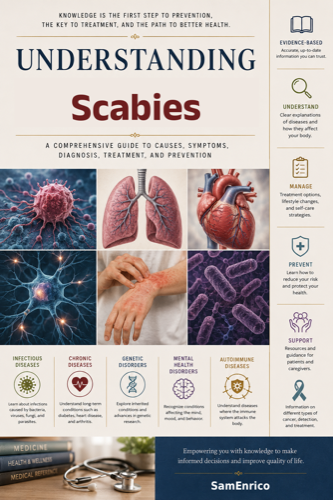
Understanding Scabies eBook
This disease publication, published by SamEnrico,
This disease publication, published by SamEnrico, covers Understanding Scabies
Formats
Free sample
Chapter 1: The Unseen Enemy...–- It begins, almost always, with a single itch.Not the kind of itch you can ignore by focusing on work or distracting yourself with a movie. Not the kind that fades after a good scratch against a doorframe. This is different. This is the itch that arrives in the quiet hours—when you are lying still in the dark, finally still after a long day—and it does not leave. It whispers.
It insists. It multiplies. By the second week, you are waking up three, four, five times a night, nails digging into your skin before your conscious mind even registers the sensation. By the third week, you have drawn blood. By the fourth week, you have convinced yourself of at least three different things: that you are allergic to your laundry detergent, that you have developed a sudden case of eczema, or that you are losing your mind.You are not losing your mind.
You are not allergic to your detergent. And while you might have a mild case of eczema, that is not what is keeping you awake at 2:00 AM, standing in front of the bathroom mirror with your phone’s flashlight aimed at your wrist, searching for something you cannot quite name.What you are experiencing is the work of an organism so small that fifty of them could gather on a single grain of salt. An organism that has evolved alongside humans for tens of thousands of years, perfecting its ability to hide, to exploit, and to survive. An organism that does not care about your hygiene, your income, your education, or how many times you shower each day.Its name is Sarcoptes scabiei var. hominis—the human itch mite.
And this chapter is your first look at the enemy you cannot see.The Invisible Invader: Size, Scale, and the Shock of Recognition Let us begin by understanding exactly what we are dealing with. The scabies mite is an arachnid, a relative of spiders and ticks. Under a microscope, it resembles a tiny tortoise with eight legs (the females) or six legs (the larval stage). But its size is the first thing that matters: an adult female mite measures approximately 0.3 to 0.4 millimeters in length. To put that number in human terms, you could line up ten adult mites side by side and they would barely span the width of a pencil tip.
You could fit more than two hundred mites on a single U.S. dime.This microscopic scale is not merely a biological curiosity. It is the mite’s primary survival strategy. Because it is invisible to the naked eye, because it leaves no obvious trail that a casual observer would recognize, the mite moves through human populations silently. A person can carry ten, twenty, even fifty mites on their body and have no idea—not for weeks.
And during those weeks, while the mite feeds, burrows, and reproduces, the human host goes about their daily life: shaking hands, hugging children, sharing beds with partners, riding crowded buses. The mite asks for no permission and leaves no calling card.A powerful analogy: Imagine a tick the size of a sesame seed crawling across the skin of an elephant. The elephant would never feel it. The tick could travel for hours, find a comfortable fold of skin, and begin feeding without the elephant ever knowing. Now shrink that tick by a factor of ten.
That is the relationship between the scabies mite and you. You are the elephant. The mite is barely a speck. And it has been perfecting its invisibility for longer than humans have been writing history.The Life Cycle: From Egg to Enemy To defeat an enemy, you must understand how it lives, how it breeds, and where it is vulnerable. The scabies mite has a life cycle that lasts approximately fourteen to twenty-one days.
Within that window, a single fertilized female can create an entire infestation. Let us walk through each stage.Stage One: The Burrow The story begins when a fertilized female mite—having mated on the surface of the skin—chooses her territory. She is selective. She prefers the thinnest, warmest, most protected areas of the body: the webbed spaces between fingers, the flexor surface of the wrists, the elbows, the buttocks, the genitals, the areolae of the breasts. In infants and the elderly, her preferences shift, but we will explore that in later chapters.Using her mouthparts and the specialized cutting edges on her front legs, the female mite cuts into the stratum corneum—the outermost layer of the skin, composed of dead, flattened cells that serve as the body’s first line of defense against the outside world.
She does not burrow deep. She does not reach living tissue or blood vessels. She carves a tunnel just beneath the surface, a serpentine path that will eventually extend 5 to 15 millimeters in length. This tunnel is her home, her nursery, and her refuge.As she burrows, she leaves behind a trail of debris: shed skin cells, digestive enzymes, and—most importantly—her feces. These fecal pellets, known in medical terms as scybala, contain the proteins that will, weeks later, trigger the devastating allergic reaction that we call the scabies itch.Stage Two: Egg Laying Once her burrow is established, the female begins laying eggs.
She produces two to three eggs per day, every day, for the remainder of her life—roughly four to six weeks. Each egg is oval, translucent, and approximately 0.1 millimeters long. She deposits them in the roof of the burrow, where they will be protected from the outside environment while still receiving enough warmth from the host’s body to develop.Stage Three: Hatching and Larvae After three to four days, the eggs hatch. The emerging organisms are not yet adult mites. They are larvae, equipped with only six legs (adults have eight).
Larvae are smaller than adults, but they are already mobile, already hungry, and already capable of beginning the cycle again. They leave the original burrow—either by breaking through the skin surface or by crawling back out the entrance—and migrate across the skin to find new territory.Stage Four: Molting and Nymphs Over the next four to six days, the larvae feed, grow, and molt. Molting is the process of shedding the exoskeleton to allow for expansion, and the scabies mite does it multiple times. After the first molt, the larva becomes a protonymph (eight legs, still immature). After a second molt, it becomes a tritonymph.
These nymph stages are essentially teenagers: fully mobile, fully feeding, but not yet capable of reproduction.Stage Five: Adults After the final molt, the tritonymph becomes an adult mite. Adult males are smaller than females, measuring about 0.2 millimeters. Their lifespan is shorter—they mate and die within a few days. Adult females, as we have seen, live four to six weeks and lay eggs continuously. Mating occurs on the skin surface, after which the male dies and the female begins her burrow.The Takeaway: A single fertilized female mite can produce roughly fifty to one hundred eggs over her lifetime.
Not all will survive to adulthood. But enough will. And because the life cycle is continuous, overlapping, and invisible, a…
This is the end of the free sample. Get the eBook to keep going. Buy now
About this book
Details
- Author
- Halcomb Nubia
- Publisher
- SamEnrico
- Language
- English
- Genre
- Non-Fiction, Informative, Educational
- Released
- 2026-06-02
- Pages (approx.)
- 157
- Available as
- eBook, Audiobook

Read better in the ZLOADR app
Your eBooks on your phone or tablet. Sign in with your SamEnrico account and start reading.
More by Halcomb Nubia
 The Ronald Cotton Case StudyHalcomb Nubia$11.99
 Secondary Infertility After Loss HandbookHalcomb Nubia$11.99
 Construction ESG Performance GuideHalcomb Nubia$11.99
 The Thirty Day Metta ChallengeHalcomb Nubia$11.99
 The Letting Go of ExpectationsHalcomb Nubia$11.99
 The Golden Quill: How Amina of Zaria Became West Africa's First Female Poet LaureateHalcomb Nubia$11.99
 Physical Vapor Deposition (Pvd)Halcomb Nubia$11.99
 Trade References Credit GuideHalcomb Nubia$12.99
 Voice Messaging for Mentor OutreachHalcomb Nubia$12.99
 How to Become a Legal InvestigatorHalcomb Nubia$11.99
You may also like
 Hong Kong Handover 1997Dunn Johnnie$11.99
 Zumba For Postnatal Recovery CourseNeal Christian$11.99
 Zumba for BeginnersLadner Nikia$11.99
 YouTube Comment Mining GuideHumes Pandora$12.99
 Worry Box MeditationCarlin Rudy$11.99
 Workplace Stress MeditationNguyen Lynn$11.99
 Workplace Stress and Sleep RepairHawley Ivory$11.99
 Workplace Perfectionism CureDelaney Jeffry$11.99
 Workplace Injustice Anger GuideWallen Isabelle$11.99
 Work Addiction and Burnout LinkGreenwood Ester$11.99
 Women in Yoga and WellnessBeattie Galina$11.99
 Women in Stand Up ComedyChun Evangeline$11.99