
Non-FictionInformativeEducational
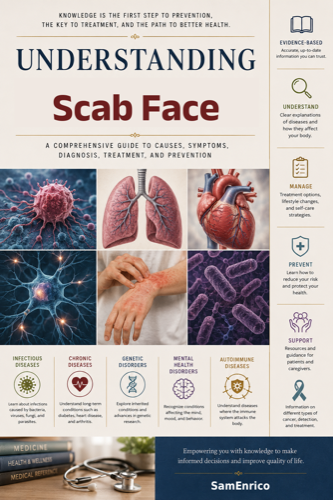
Understanding Scab Face eBook
This disease publication, published by SamEnrico,
This disease publication, published by SamEnrico, covers Understanding Scab Face
Formats
Free sample
Chapter 1: The Living Crust...--–- The first thing you need to understand about a scab is that it is not dead. It is not a dry, inert piece of waste sitting on your face like a forgotten leaf on a sidewalk. It is, in fact, one of the most biologically active, carefully orchestrated, and fiercely intelligent structures your body can produce. Think of it as a temporary organ—a living, breathing (metaphorically speaking) emergency room built from your own blood, your own cells, and your own remarkable capacity for self-repair. Every time you look in the mirror and see that dark, reddish-brown crust staring back at you, you are witnessing a biological miracle that has been perfected over six hundred million years of evolution.
And yet, most people—including many doctors—treat scabs with a mixture of disgust, impatience, and outright hostility. We pick them. We scratch them. We slather them with harsh chemicals. We hide them under makeup and bandages.
We apologize for them. We are, in short, at war with one of our own body’s most sophisticated defense mechanisms.This book exists because that war is unwinnable—and unnecessary. The goal of "Understanding Scab Face" is not merely to teach you how to heal facial scabs faster or with less scarring. The goal is to fundamentally change the way you see them. By the time you finish this chapter, you will never look at a scab the same way again.
You will see it not as an embarrassment or a flaw, but as a testament to your body’s resilience. And more importantly, you will understand why almost everything you thought you knew about scab care is probably wrong.The Evolutionary Genius of the Scab To understand why a scab is so remarkable, you have to go back to a time before faces existed—before humans, before mammals, before vertebrates. The ability to form a blood clot and then a protective crust over a wound is one of the oldest survival mechanisms in the animal kingdom. It appears in insects, in fish, in reptiles, and in every mammal ever studied. Evolution has kept this system largely unchanged for hundreds of millions of years because it works.
And it works with breathtaking elegance.The moment your facial skin is broken—whether by a fingernail, a razor, a pimple, or a microscopic mite—your body launches a cascade of events that would impress any emergency response team. Within seconds, blood vessels in the area constrict to limit bleeding. Within minutes, platelets—tiny, disc-shaped cells that float in your blood like emergency workers waiting for a call—begin sticking to the exposed collagen fibers at the wound site. They change shape from smooth discs to spiky stars, extending long tentacle-like arms to grab onto each other and onto the wound edges. They release chemical signals that scream for help, summoning more platelets and activating the coagulation cascade—a series of protein reactions that reads like a military operations manual.The star player in this cascade is a soluble protein called fibrinogen, which floats harmlessly in your blood until it is needed.
When activated, fibrinogen transforms into fibrin—a sticky, thread-like protein that weaves itself into a dense, three-dimensional mesh. This mesh traps red blood cells, platelets, and plasma, forming a gel-like plug that hardens as it dries. That hardened mesh, combined with trapped blood cells, is what you see as a scab. But here is what most people miss: the scab is not just a plug. It is a scaffold.
A communication hub. A drug delivery system. A temporary skin substitute. And it is doing all of these things simultaneously, twenty-four hours a day, without you giving it a single conscious instruction.Why the Face is Different from Everywhere Else Before we go any further, we need to talk about why this book focuses specifically on the face. A scab on your knee and a scab on your cheek are not the same thing.
They are governed by different rules, face different challenges, and produce different outcomes. The face is, from a biological perspective, the most demanding wound-healing environment on the human body.First, consider blood flow. The face is one of the most vascularized regions of the body—meaning it has an extraordinarily dense network of blood vessels. This is why facial cuts bleed so profusely compared to cuts on your arm or leg. But that same rich blood supply is actually a double-edged sword.
On one hand, it means that facial wounds receive more oxygen, more immune cells, and more growth factors than wounds elsewhere. This is why facial scabs heal faster—typically 30-50% faster than comparable wounds on the torso or limbs. On the other hand, that same rich blood supply means that facial wounds are more prone to dramatic bleeding and more visible inflammation. The redness, swelling, and heat that accompany a facial wound are amplified compared to elsewhere on the body.Second, consider mobility. The skin on your back moves very little.
The skin on your face moves constantly. Every time you talk, the skin around your mouth stretches and compresses. Every time you blink, the delicate skin around your eyes folds and unfolds. Every time you raise an eyebrow, smile, frown, chew, yawn, or sneeze, your facial skin is in motion. This constant movement creates mechanical stress on healing wounds.
A scab that is allowed to dry out becomes brittle, and a brittle scab on a moving surface will crack. A cracked scab bleeds again, resets the healing clock, and increases the risk of scarring. This is why facial scabs require different care than scabs on your shin—they need flexibility, moisture, and protection from repetitive micro-trauma.Third, and perhaps most importantly, consider psychology. The face is not just another body part. It is the primary locus of social identity.
It is what people look at when they talk to you. It is how you recognize yourself in photographs and in mirrors. A visible scab on the face triggers an entirely different psychological response than a scab on the toe. It triggers self-consciousness, anxiety, and often an overwhelming urge to hide or remove the offending mark. This psychological pressure leads to what we might call "interference behavior"—picking, scratching, covering, and treating.
And interference behavior is the single greatest predictor of poor healing outcomes. More than infection, more than wound size, more than age or nutrition—the act of messing with a scab is what turns a minor wound into a permanent scar.The Three Phases of Healing: What Happens Under the Surface Now that we understand what a scab is and why the face is special, let us walk through the healing process in detail. Healing is not a single event but a carefully choreographed sequence of three overlapping phases. Understanding these phases is the key to knowing what to do—and, more importantly, what not to do—at each stage of recovery.The Inflammatory Phase (Days 0-3)The inflammatory phase begins the instant the skin is broken and lasts approximately three days. This phase is often misunderstood as the "bad" part of healing—the part with redness, swelling, heat, and pain.
But these are not signs that something has gone wrong. They are signs that something has gone right. Inflammation is…
This is the end of the free sample. Get the eBook to keep going. Buy now
About this book
Details
- Author
- Ferrer Kelsie
- Publisher
- SamEnrico
- Language
- English
- Genre
- Non-Fiction, Informative, Educational
- Released
- 2026-06-02
- Pages (approx.)
- 154
- Available as
- eBook, Audiobook

Read better in the ZLOADR app
Your eBooks on your phone or tablet. Sign in with your SamEnrico account and start reading.
More by Ferrer Kelsie
 The Loving Kindness ScienceFerrer Kelsie$11.99
 Pregnancy Loss And Relationship Strain WorkbookFerrer Kelsie$11.99
 Post Event Information ContaminationFerrer Kelsie$11.99
 The Letting Go of Grief GuideFerrer Kelsie$11.99
 Telecom ESG Benchmarking GuideFerrer Kelsie$11.99
 The Crown & The Courtroom: The Untold Battle of Prince Andrew and Sarah FergusonFerrer Kelsie$11.99
 10 Ways to Use Demi-glace Sauce (Recipe Book)Ferrer Kelsie$11.99
 Physical TherapistFerrer Kelsie$11.99
 Bank Account Credit BuildingFerrer Kelsie$12.99
 First Message to a Potential MentorFerrer Kelsie$12.99
You may also like
 Hong Kong Handover 1997Dunn Johnnie$11.99
 Zumba For Postnatal Recovery CourseNeal Christian$11.99
 Zumba for BeginnersLadner Nikia$11.99
 YouTube Comment Mining GuideHumes Pandora$12.99
 Worry Box MeditationCarlin Rudy$11.99
 Workplace Stress MeditationNguyen Lynn$11.99
 Workplace Stress and Sleep RepairHawley Ivory$11.99
 Workplace Perfectionism CureDelaney Jeffry$11.99
 Workplace Injustice Anger GuideWallen Isabelle$11.99
 Work Addiction and Burnout LinkGreenwood Ester$11.99
 Women in Yoga and WellnessBeattie Galina$11.99
 Women in Stand Up ComedyChun Evangeline$11.99