
Non-FictionInformativeEducational
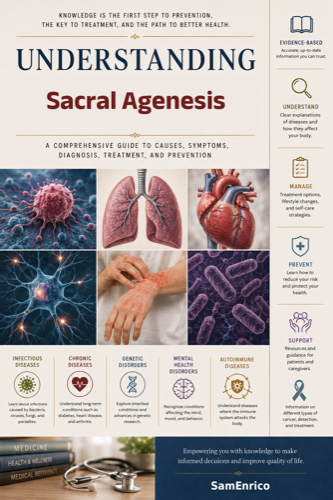
Understanding Sacral Agenesis eBook
This disease publication, published by SamEnrico,
by Muniz Tess
This disease publication, published by SamEnrico, covers Understanding Sacral Agenesis
Formats
Free sample
Chapter 1: The Blueprint That Failed--–- The ultrasound tech’s face went still first. Then came the silence—that terrible, prolonged quiet where the only sound is the whoosh of the Doppler and your own heart hammering against your ribs. You asked, “Is everything okay?” And the tech said, “The doctor will talk to you.” That was the moment your life split into before and after. Welcome to the before. This chapter is your first step into the after.Every parent who receives a diagnosis of sacral agenesis (SA) remembers that exact second.
The vocabulary is unfamiliar, the prognosis is uncertain, and the internet is a terrifying place of worst-case scenarios and outdated information. This book exists to replace fear with knowledge, confusion with a roadmap, and isolation with a community of families who have walked this path before you.Let us begin with what you need to know right now: Sacral agenesis is a rare congenital condition in which the lower part of the spine—the sacrum and sometimes the coccyx—fails to form completely during the first four to six weeks of pregnancy. The word “agenesis” comes from Greek roots: “a-” meaning without, and “genesis” meaning birth or origin. Your child was born without a sacrum, or with a sacrum that is partially formed. That is the medical fact.
What that fact means for your child’s life is far more complex, far more variable, and far more hopeful than any single sentence can capture.This chapter will give you the foundational knowledge you need to understand the diagnosis, the terminology, and the journey ahead. We will cover normal spinal development, the precise nature of the “blueprint error” that leads to SA, the relationship between sacral agenesis and caudal regression syndrome, and—most importantly—the core philosophy that will guide this entire book. By the end of this chapter, you will have a clear, accurate, and compassionate understanding of what sacral agenesis is and what it is not.The Weight of Words: Why Terminology Matters Before we dive into anatomy, let us address a critical issue that causes unnecessary anxiety for newly diagnosed families: the words doctors use. You may hear “sacral agenesis,” “caudal regression syndrome,” “sacral dysgenesis,” or “caudal dysplasia sequence.” These terms are not all identical, and understanding the differences will help you communicate more effectively with your medical team.Sacral agenesis (SA) specifically refers to the absence or incomplete formation of the sacrum—the triangular bone at the base of the spine that connects the spine to the pelvis. The sacrum normally consists of five fused vertebrae (S1 through S5).
In SA, some or all of these are missing. The condition can be isolated (affecting only the sacrum) or part of a broader syndrome.Caudal regression syndrome (CRS) is a broader diagnosis. It includes sacral agenesis but may also involve absent or fused lumbar vertebrae, leg abnormalities (including the rare but severe “mermaid syndrome” or sirenomelia), and sometimes gastrointestinal or genitourinary malformations. In clinical practice, many doctors use the terms interchangeably because the distinction does not always change treatment. However, for the sake of precision, this book will use sacral agenesis as the primary term, with the understanding that some readers may have been told “caudal regression syndrome.” A simple way to remember the difference: CRS is the larger umbrella; SA is one of the conditions under that umbrella.
If your child has only sacral involvement, they have SA. If they also have lumbar vertebral abnormalities or leg fusion, they have CRS. For the practical guidance in this book, the management strategies are largely the same, and we will note specific differences when they matter.Why does this distinction matter for you? Because when you search online support groups or medical literature, searching both “sacral agenesis” and “caudal regression syndrome” will yield more complete results. Some families find community under one label or the other.
You are welcome in both.The Architecture of the Spine: Understanding What Is Missing To understand sacral agenesis, you first need a basic map of the spine. Think of the spine as a multi-story building. Each floor serves a different purpose, and the bottom floors—the sacrum—are the foundation that connects the building to the ground.The human spine has five sections:Cervical spine (C1–C7): The neck. Seven vertebrae that support the head and allow it to turn.Thoracic spine (T1–T12): The upper and mid-back. Twelve vertebrae, each attached to a pair of ribs.Lumbar spine (L1–L5): The lower back.
Five large, weight-bearing vertebrae.Sacrum (S1–S5): Five fused vertebrae that form a triangular bone at the base of the spine. The sacrum connects the spine to the pelvis via the sacroiliac joints.Coccyx (tailbone): Four small fused vertebrae at the very bottom.In sacral agenesis, the problem is in the sacrum—sometimes only part of it, sometimes all of it, and in rare cases extending upward into the lumbar spine. The coccyx is almost always absent when the sacrum is significantly affected, but the coccyx itself has no critical function, so its absence is not medically significant.Now, here is why the sacrum matters so much:First, the sacrum is the structural anchor for the pelvis. It connects the spine to the hip bones. Without a fully formed sacrum, the pelvis may be unstable, which affects how the legs attach and how weight is transferred from the trunk to the lower body.
This is why orthopedic issues—hip dislocations, leg deformities, and mobility challenges—are common in SA.Second, the sacrum houses and protects the sacral nerves (S2–S4). These nerves do not control the legs (that is the lumbar spine’s job). Instead, the sacral nerves control:Bladder function (the ability to sense fullness and empty voluntarily)Bowel function (sensation of stool and control of the anal sphincter)Sexual function (erections in males, lubrication and orgasm in females)Part of the leg muscles (specifically the hamstrings and calf muscles)When the sacrum fails to form, those nerves are often missing or damaged. This is why neurogenic bladder and neurogenic bowel are nearly universal in moderate to severe SA. It is not that the bladder or bowel themselves are defective; it is that the nerves that control them never developed.Third, the sacrum is the attachment point for multiple ligaments and muscles.
Without a normal sacrum, the mechanical relationships between the spine, pelvis, and legs change. This leads to the characteristic “frog-leg” position (hips externally rotated, knees bent) that many infants with SA adopt. That position is not a deformity; it is the body’s natural adaptation to an unstable pelvic foundation.The Blueprint Error: What Happens in the First Six Weeks The human spine begins forming around the third week of pregnancy. This process is called neurulation—the formation of the neural tube, which will become the brain and spinal cord. By the end of the fourth week, the neural tube should be closed.
The vertebrae (the bony segments that surround and protect the spinal cord) form slightly later, during weeks four through six.Sacral agenesis is not a neural tube defect like spina bifida. In spina bifida, the neural tube fails to close, leaving…
This is the end of the free sample. Get the eBook to keep going. Buy now
About this book
Details
- Author
- Muniz Tess
- Publisher
- SamEnrico
- Language
- English
- Genre
- Non-Fiction, Informative, Educational
- Released
- 2026-06-02
- Pages (approx.)
- 153
- Available as
- eBook, Audiobook

Read better in the ZLOADR app
Your eBooks on your phone or tablet. Sign in with your SamEnrico account and start reading.
More by Muniz Tess
 The Vagus Nerve Stress LinkMuniz Tess$11.99
 Cross Border Franchise Privacy PolicyMuniz Tess$11.99
 Dual Diagnosis in ElderlyMuniz Tess$11.99
 The Budget Creative ChallengeMuniz Tess$11.99
 Anger Management for Security GuardsMuniz Tess$11.99
 The Quantum Leap: How a 1989 Experiment Changed the Future of ComputingMuniz Tess$11.99
 Supply Chain Finance vs FactoringMuniz Tess$12.99
 Safe Harbor for CTAMuniz Tess$12.99
 Optometrist AssistantMuniz Tess$11.99
 How to Start a Circular or Reciprocating Saws Business (Beginners Guide)Muniz Tess$11.99
You may also like
 Hong Kong Handover 1997Dunn Johnnie$11.99
 Zumba For Postnatal Recovery CourseNeal Christian$11.99
 Zumba for BeginnersLadner Nikia$11.99
 YouTube Comment Mining GuideHumes Pandora$12.99
 Worry Box MeditationCarlin Rudy$11.99
 Workplace Stress MeditationNguyen Lynn$11.99
 Workplace Stress and Sleep RepairHawley Ivory$11.99
 Workplace Perfectionism CureDelaney Jeffry$11.99
 Workplace Injustice Anger GuideWallen Isabelle$11.99
 Work Addiction and Burnout LinkGreenwood Ester$11.99
 Women in Yoga and WellnessBeattie Galina$11.99
 Women in Stand Up ComedyChun Evangeline$11.99