
Non-FictionInformativeEducational
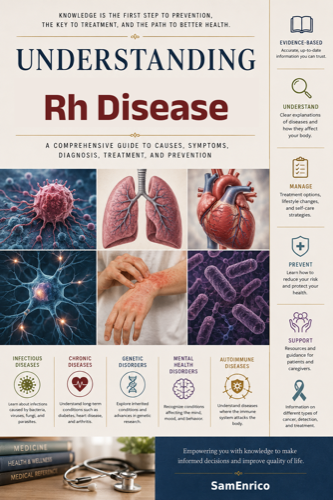
Understanding Rh Disease eBook
This disease publication, published by SamEnrico,
This disease publication, published by SamEnrico, covers Understanding Rh Disease
Formats
Free sample
Chapter 1: The Yellow Crib...--The crib was white, clean, and waiting. The mother—let us call her Margaret, though that was not her real name—had painted it herself, in the eighth month of her first pregnancy, when hope was still a thing she could hold in her hands. She had sanded the rails twice, applied three coats of non-toxic paint, and tied a mobile of felted sheep above the mattress. The nursery was ready. The name—Thomas, after her father—was stitched into a sampler on the wall.
Margaret had done everything right. She had taken prenatal vitamins, attended every appointment, and refused so much as a sip of wine. When her water broke at thirty-nine weeks, she and her husband drove to the hospital with a packed bag, a car seat, and the easy confidence of people who believed that modern medicine had solved the problem of childbirth.She was wrong. Not about her preparation—that was exemplary—but about the fundamental premise that childbirth in 1947 was safe. It was safer than it had been a generation earlier, certainly.
Antibiotics had tamed puerperal fever. Blood transfusions had become routine. But there was a ghost in the nursery that no one yet understood, a killer that struck not the first child but the second, not the mother but the baby, not with fever or infection but with a slow, inexorable yellowing that turned healthy newborns into limp, swollen, dying infants within seventy-two hours.Thomas was born vigorous and pink, with a full head of dark hair and a cry that rattled the delivery room windows. The nurses weighed him—seven pounds, three ounces—and placed him on Margaret’s chest. She counted ten fingers and ten toes and wept with relief.
For the first twenty-four hours, everything was perfect. He nursed eagerly. He slept in two-hour stretches. His skin was the warm, ruddy pink of a healthy newborn.Then, sometime during the second night, the nurse noticed it: a faint yellow tinge to his cheeks, the sclera of his eyes, the soft spot on his crown. “It’s just newborn jaundice,” the nurse said.
“Very common. Almost all babies get a little yellow. It will clear on its own.” Margaret nodded, relieved. She had read about jaundice in her pregnancy books. It was harmless, they said.
A normal part of adapting to life outside the womb.But by the morning of the second day, Thomas was not just yellow. He was the color of a highlighter pen. His cry had changed from a vigorous wail to a weak, high-pitched whimper. He no longer wanted to nurse. When Margaret tried to rouse him, he was limp—not the peaceful limpness of deep sleep, but the unnerving floppiness of a rag doll.
His belly, which had been soft and round, was now distended, tight as a drum. Fluid was accumulating where it should not be.The pediatrician was called. He took one look at Thomas and ordered an immediate bilirubin test. The number came back astronomical—far above the threshold for concern. “We need to do an exchange transfusion,” he told Margaret and her husband.
“We’ll take out his blood a little at a time and replace it with donor blood. It’s our best chance.”They did the exchange transfusion. They did two of them. They transfused Thomas with fresh whole blood from three different donors. For a few hours, he seemed better—pinker, more alert, willing to take an ounce of formula from a bottle.
Margaret allowed herself to hope. But then the yellow returned, faster and more furious than before. By the third day, Thomas was no longer responding to stimuli. His breathing became irregular. His heart rate, once strong and steady, began to falter.At 4:47 on the third afternoon, the nurse came out to the waiting room.
She did not need to speak. Margaret saw the answer in her face. Thomas was gone. The cause of death was listed as “erythroblastosis fetalis,” a term Margaret had never heard before and would not understand until many years later, when science finally gave a name to the ghost that had taken her son.She would have three more pregnancies. The second ended in a stillbirth at thirty-two weeks—a daughter, swollen with fluid, unrecognizable as the baby she had dreamed of holding.
The third was born alive but died of jaundice on day four, just like Thomas. The fourth never made it past twenty-eight weeks. Margaret’s doctor, helpless and frustrated, told her that “sometimes these things run in families” and that she should consider herself lucky to have one healthy child—her firstborn, a daughter who had escaped the curse that killed every subsequent baby.No one knew why. No one could tell her that her blood was Rh-negative and her husband’s was Rh-positive, and that her body had learned to treat her own children as foreign invaders. No one could tell her that a single injection, given within seventy-two hours of delivery, would have saved Thomas and the three who came after.
That injection did not exist yet. It would not exist for another twenty years. By then, Margaret was forty-five, her childbearing years behind her, her arms still empty for the babies she had lost.The Invisible Epidemic Margaret’s story was not unusual. It was, in fact, tragically typical. In the 1940s and 1950s, erythroblastosis fetalis—the condition we now call Rh disease—killed approximately ten thousand babies per year in the United States alone.
Globally, the toll was estimated at fifty to a hundred thousand annually, though accurate records were sparse in countries without centralized birth and death registries. To put that number in perspective: ten thousand dead infants per year is roughly equivalent to losing the entire population of a small town every twelve months. It was one of the leading causes of perinatal death, rivaling prematurity, birth defects, and infection.But unlike those other causes, Rh disease had a peculiar and maddening pattern. It almost never affected firstborn children. It struck second, third, and later pregnancies with terrifying regularity.
And it seemed to run in families—but only along paternal lines. If a woman married a man whose previous wife had suffered stillbirths, the pattern often repeated. If she remarried a different man, the pattern might disappear entirely. These observations were recorded in scattered medical journals, but no one connected them into a coherent explanation.The clinical presentation was unmistakable once you knew what to look for. The affected newborn typically appeared normal at birth—pink, vigorous, appropriately sized—only to develop jaundice within the first twenty-four to forty-eight hours.
The jaundice was not the mild, self-limited type that pediatricians called “physiologic jaundice of the newborn.” It was aggressive, relentless, and resistant to standard treatments like phototherapy (which had not yet been invented) or simple hydration. The bilirubin levels would climb and climb, often exceeding twenty or thirty milligrams per deciliter—levels that today would trigger an immediate exchange transfusion and a neonatology team on standby.As bilirubin accumulated, it crossed the blood-brain barrier and deposited in the basal ganglia, the deep brain structures that control movement, hearing, and coordination. This produced…
This is the end of the free sample. Get the eBook to keep going. Buy now
About this book
Details
- Author
- Culpepper Jeniffer
- Publisher
- SamEnrico
- Language
- English
- Genre
- Non-Fiction, Informative, Educational
- Released
- 2026-06-02
- Pages (approx.)
- 155
- Available as
- eBook, Audiobook

Read better in the ZLOADR app
Your eBooks on your phone or tablet. Sign in with your SamEnrico account and start reading.
More by Culpepper Jeniffer
 Loftie Alarm Clock GuideCulpepper Jeniffer$11.99
 Quadrant Four Avoidance PlanCulpepper Jeniffer$11.99
 Endometriosis Ultrasound GuideCulpepper Jeniffer$11.99
 Assertiveness For Survivors Of Abuse WorkbookCulpepper Jeniffer$11.99
 The Elizabeth Short Biography GuideCulpepper Jeniffer$11.99
 The Blood and Gold of Cajamarca: How a Dozen Conquistadors Captured an EmpireCulpepper Jeniffer$11.99
 Remote Turnover Prevention GuideCulpepper Jeniffer$12.99
 Student Rights in TurkeyCulpepper Jeniffer$12.99
 Machine Maintenance MechanicCulpepper Jeniffer$11.99
You may also like
 Hong Kong Handover 1997Dunn Johnnie$11.99
 Zumba For Postnatal Recovery CourseNeal Christian$11.99
 Zumba for BeginnersLadner Nikia$11.99
 YouTube Comment Mining GuideHumes Pandora$12.99
 Worry Box MeditationCarlin Rudy$11.99
 Workplace Stress MeditationNguyen Lynn$11.99
 Workplace Stress and Sleep RepairHawley Ivory$11.99
 Workplace Perfectionism CureDelaney Jeffry$11.99
 Workplace Injustice Anger GuideWallen Isabelle$11.99
 Work Addiction and Burnout LinkGreenwood Ester$11.99
 Women in Yoga and WellnessBeattie Galina$11.99
 Women in Stand Up ComedyChun Evangeline$11.99