
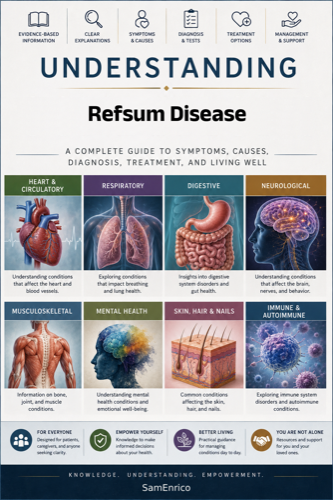
Non-FictionInformativeEducational
Understanding Refsum Disease eBook
This condition publication, published by SamEnrico
This condition publication, published by SamEnrico, covers Understanding Refsum Disease
Formats
Free sample
Chapter 1: The Diagnosis Delusion...--The first sign was nothing dramatic. No collapse, no seizure, no ambulance. For Elena, a 34-year-old graphic designer in Minneapolis, it was simply a strange difficulty seeing her computer screen after sunset. She assumed she needed new glasses. For Marcus, a 52-year-old farmer in rural Nebraska, it was a persistent numbness in his toes that he chalked up to old work boots.
For little Sophia, age 9 in Oslo, Norway, it was a peculiar waddling gait that her pediatrician initially dismissed as "clumsy phase."These three people, living on different continents, with different ages and different lives, shared something invisible. They shared a disease so rare that most doctors will never see a single case in their entire careers. They shared Refsum Disease.But here is the cruelest irony: Refsum Disease is also one of the most treatable genetic disorders in all of medicine. With the right diagnosis, progression can be halted. With proper management, life can be lived fully into old age.
Without diagnosis, it steals vision, mobility, and eventually life itself. The difference between these two outcomes is not a miracle drug or a cutting-edge gene therapy. It is simply knowledge. And that knowledge is what this book exists to provide.This chapter is not a dry medical introduction. It is a roadmap to understanding a condition that has been misunderstood, misdiagnosed, and marginalized for nearly eight decades.
If you are reading this because you or someone you love has received a Refsum diagnosis—or suspects one—you have already overcome the single greatest obstacle: awareness. Now, let us build on that awareness together.What Refsum Disease Actually Is Let us start with a definition clear enough for a patient, precise enough for a doctor, and memorable enough for a family member trying to understand what their loved one is facing.Refsum Disease is an inherited metabolic disorder in which the body cannot break down a specific type of fat called phytanic acid. Because this fat cannot be processed normally, it accumulates in tissues throughout the body—most dangerously in the myelin sheaths that insulate nerves, the retina of the eye, and the cerebellum (the part of the brain responsible for coordination).The full medical name, though you will rarely hear it used, is Hereditary Motor and Sensory Neuropathy Type IV (HMSN IV). Some medical texts still refer to it as Adult Refsum Disease, a holdover from the mistaken belief that it only appears in adulthood. As Sophia's case demonstrates, that is false.
Childhood onset, though less common, absolutely occurs.To understand why phytanic acid accumulates, imagine your body as a city with a waste management system. Every day, you consume food. That food contains various fats and oils that your body must either use for energy or break down into harmless components and eliminate. Most fats are processed efficiently. But phytanic acid is different.
It requires a specific enzyme—a molecular machine called phytanoyl-Co A hydroxylase—to begin the breakdown process. In Refsum Disease, that machine is broken. The waste piles up. And over time, that pile becomes toxic to the tissues where it lodges.This is not a storage disease in the sense of a swollen liver or enlarged spleen. The damage is neurological and ophthalmological.
It attacks the very systems that allow you to see, to walk, to feel, to hear, and ultimately to breathe.The Historical Journey: From Obscurity to Understanding Every rare disease has its origin story, and Refsum Disease's begins with a Norwegian physician named Sigvald Refsum. In 1946, Refsum published a paper describing a small group of patients who shared a peculiar constellation of symptoms: progressive night blindness, weakness and numbness in their limbs, difficulty coordinating their movements, and abnormally high levels of protein in their cerebrospinal fluid (the fluid that bathes the brain and spinal cord).At the time, no one knew what caused this cluster of symptoms. Refsum called it "heredopathia atactica polyneuritiformis"—a mouthful of Latin that described what he saw without explaining why. For nearly two decades, the condition remained a medical curiosity, described in case reports but understood by almost no one.The breakthrough came in the 1960s, when researchers discovered that patients with this condition had massively elevated levels of phytanic acid in their blood. Normal levels are below 30 micromoles per liter.
Refsum patients often had levels above 200, and sometimes over 1,000. This was the biochemical signature, the fingerprint of the disease.But discovery led to more questions. Why was phytanic acid accumulating? Where was it coming from? And most importantly, could lowering those levels reverse or stop the disease?The answers came slowly.
Researchers learned that humans cannot produce phytanic acid on their own. It comes entirely from diet—specifically from a molecule called phytol, which is found in chlorophyll (the green pigment in plants) and in the fat of ruminant animals (cattle, sheep, goats) that eat those plants. This was a revelation. If the disease was caused by something you ate, then perhaps diet could be the treatment.And indeed, it could. The first dietary interventions in the 1970s showed dramatic results.
Patients who eliminated phytol-rich foods saw their phytanic acid levels drop. More importantly, their symptoms stabilized. Some even improved. For the first time, a previously progressive and debilitating disease had a lever that patients could pull themselves.The final piece of the puzzle fell into place in the 1990s with the discovery of the genes responsible. Researchers identified two genes—PHYH (originally called PAHX) and PEX7—that, when mutated, cause Refsum Disease.
Both genes are involved in the same metabolic pathway. Both lead to the same enzyme deficiency. And both follow the same inheritance pattern: autosomal recessive, meaning you need two copies of the mutated gene (one from each parent) to develop the disease.Today, we understand Refsum Disease as a rare but eminently manageable condition. The tragedy is not that it exists. The tragedy is how many people go undiagnosed for years, even decades, while their nerves quietly deteriorate.The Classic Tetralogy: Four Clues to the Diagnosis One of the most useful tools for recognizing Refsum Disease is something called the "classic tetralogy"—four key features that, when present together, should immediately raise suspicion.
It is important to understand the history here, because it prevents confusion. Sigvald Refsum originally described three clinical features: retinitis pigmentosa (progressive vision loss), peripheral neuropathy (nerve damage in the arms and legs), and cerebellar ataxia (loss of coordination). Later, researchers added a fourth feature—elevated cerebrospinal fluid protein without an increase in white blood cells (a finding called albuminocytologic dissociation)—to complete the picture.Thus, what began as a triad became a tetralogy. You will see both terms in medical literature, but the four features are:1. Retinitis Pigmentosa (RP).
This is typically the earliest symptom, often appearing in childhood or the teenage years. It begins with night blindness—difficulty seeing in dim light, trouble driving after sunset, bumping into furniture in dark rooms. Over years or decades, it progresses to tunnel vision (loss of peripheral vision) and eventually to central vision loss. It is important to know that complete blindness is rare. Most patients retain some useful vision, particularly central vision, into late adulthood.
But the psychological impact of progressive vision loss cannot be overstated, and we will address that fully in Chapter 11.2.…
This is the end of the free sample. Get the eBook to keep going. Buy now
About this book
Details
- Author
- Hulsey Margrett
- Publisher
- SamEnrico
- Language
- English
- Genre
- Non-Fiction, Informative, Educational
- Released
- 2026-06-03
- Pages (approx.)
- 160
- Available as
- eBook, Audiobook

Read better in the ZLOADR app
Your eBooks on your phone or tablet. Sign in with your SamEnrico account and start reading.
More by Hulsey Margrett
 Client Renewal StrategiesHulsey Margrett$11.99
 Shape Peg System For VisualsHulsey Margrett$11.99
 Vitamins Supplement StudyHulsey Margrett$11.99
 Fear of Failure in BusinessHulsey Margrett$11.99
 Substantiation and Receipt RulesHulsey Margrett$11.99
 Vitamin B6 Metabolism GuideHulsey Margrett$11.99
 Quit Smoking for Fertility GuideHulsey Margrett$11.99
 Gambling and DivorceHulsey Margrett$11.99
 The Green Lions of the Commonwealth: The Forgotten Eco-Warriors of the 1700sHulsey Margrett$11.99
 The Last Oracle of Delphi: When the Gods Spoke in FireHulsey Margrett$11.99
 How to Produce Sound Dampening Panels and FoamHulsey Margrett$11.99
 How to Produce Ginger RootHulsey Margrett$11.99
You may also like
 Hong Kong Handover 1997Dunn Johnnie$11.99
 Zumba For Postnatal Recovery CourseNeal Christian$11.99
 Zumba for BeginnersLadner Nikia$11.99
 YouTube Comment Mining GuideHumes Pandora$12.99
 Worry Box MeditationCarlin Rudy$11.99
 Workplace Stress MeditationNguyen Lynn$11.99
 Workplace Stress and Sleep RepairHawley Ivory$11.99
 Workplace Perfectionism CureDelaney Jeffry$11.99
 Workplace Injustice Anger GuideWallen Isabelle$11.99
 Work Addiction and Burnout LinkGreenwood Ester$11.99
 Women in Yoga and WellnessBeattie Galina$11.99
 Women in Stand Up ComedyChun Evangeline$11.99